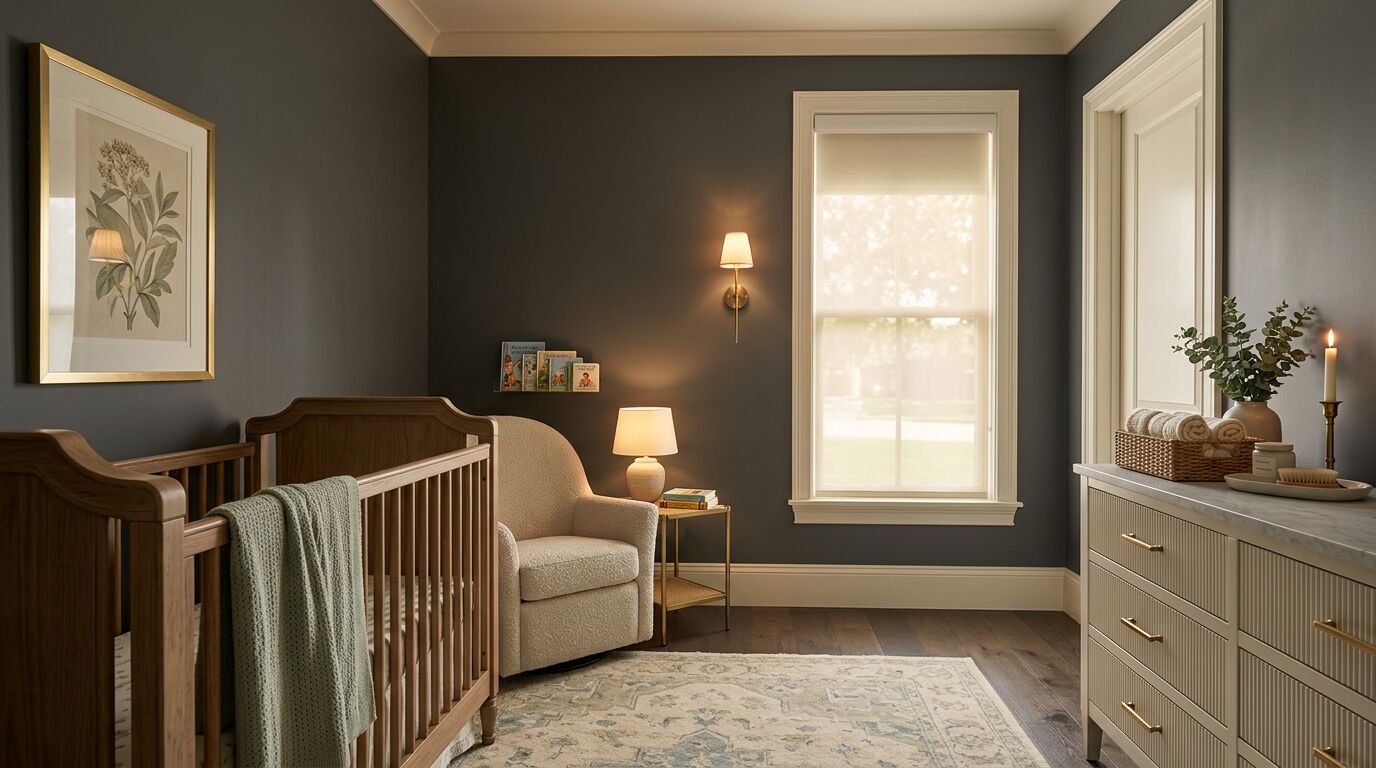
Two different products get called a dual roller shade, and mixing them up is how people end up disappointed. One is a single roll of fabric woven in alternating sheer and solid bands, sometimes called a zebra or banded shade. The other is two entirely separate shades, each on its own roll, sharing one bracket and one headrail. Only the second one can pair a true sheer with a true blackout. This is about that one, including the part where it takes up more window depth than people expect.
- A true dual roller shade is two independent shades, each its own roll and fabric, sharing a single mounting bracket and headrail.
- A zebra or banded shade is a different product: one roll of fabric with alternating sheer and solid stripes. It looks similar in a photo and behaves differently at the window.
- Only the two-shade version lets you run a genuinely sheer fabric and a genuinely opaque blackout fabric on the same window, each one controlled on its own.
- The headrail has to be deep enough to hold two rolls of fabric, not one. That is the real tradeoff, and it is worth measuring before you fall for a photo.
- Inside mount needs real depth in the window frame. Where that depth isn't there, outside mount is the honest answer, and it stands off the wall more than a single shade does.
- Each shade usually gets its own control, a cord loop, a wand or a motor. Two shades means two things to operate unless both are motorized to one remote.
- It costs more than a single shade on the same window, because it's built from two.
- It earns that cost in a room that genuinely needs both ends of the range on one window: full view and soft daylight, and full dark at night.
Two Products, One Name
Search for dual roller shades and most of what comes up is the banded style: one continuous piece of fabric with sheer strips and solid strips woven side by side, wound onto a single roller. Sliding the fabric shifts the bands, and lining the solid strips up over the sheer ones changes how much light and view comes through. It's a real product and a good one for everyday light control, but the solid bands are light filtering, not blackout, and there's only one fabric doing the work.
A true dual roller shade is built differently. It's two complete shades, front and back, each with its own fabric and its own roller, mounted together in one bracket assembly. Because the two rolls are independent, one can be a sheer that softens daylight and keeps the view, while the other is a genuine blackout that closes the room down completely. You run them separately or together, and the sheer stays a sheer no matter what the blackout is doing behind it.
How the Two-Shade Version Actually Mounts
Both rolls sit in one headrail, which means that headrail has to be noticeably deeper than the one on a single shade. A window with a shallow frame or a tight window well that would comfortably fit one shade can be too shallow for two. This is the detail that gets skipped in a glossy photo and shows up as a surprise at the measure, so it's worth asking about before you commit to the look.
Where the frame has the depth, an inside mount tucks the whole assembly into the opening and reads clean from the room. Where it doesn't, an outside mount is the honest fix, the same way it is for a shallow kitchen or bathroom opening, and it will stand further off the wall than a single outside-mounted shade would. Measuring for this setup follows the same principles as any shade, just with less room for error, and it's the kind of thing we confirm at the in-home measure rather than guess at from a spec sheet.
Picking the Two Fabrics
The common pairing is a sheer or light-filtering fabric in front and a true blackout in back, which gives a primary bedroom the full range: open for the view in the morning, softened for daytime, and completely dark at night without touching a second window covering. We laid out what blackout fabric actually blocks and where it still leaks in room-darkening versus blackout shades, and the same physics applies here. A blackout roll on a dual shade still needs side channels to close the light gap at the edges, the fabric alone won't do it.
Two light-filtering fabrics in different weaves is another real combination, used less for a hard day-night switch and more for layering texture and softness without ever needing full dark. It costs the same two-shade premium as the sheer-and-blackout pairing, so it's worth being honest with yourself about whether you need two functions or just like the look of two fabrics.
What It Costs Beyond the Fabric
A dual roller shade is priced as what it is, two shades built and mounted as one unit, so it runs higher than a single shade on the same window. The higher price is the material and the mechanism doubling, not a markup on the idea. Motorizing it adds another decision, since running both rolls off one remote is worth asking about at the consultation rather than assuming it comes standard. We cover the tradeoffs between the two control types in cordless and motorized shades, and a dual shade is exactly the kind of window where a motor earns its keep, because reaching for two separate controls on one window gets old fast.
Pricing depends on the window size, the two fabrics chosen and whether it's motorized, so the honest number comes from a free in-home consultation rather than a rule of thumb here.
Where a Single Shade Does the Job Just as Well
Not every window needs both extremes. If a room just needs a shade that's mostly private during the day and darker at night, a single well-chosen fabric, or a shade with a room-darkening liner, gets most homeowners there without the depth requirement or the added cost. Save the two-shade setup for windows where the difference between the two states genuinely matters: a primary bedroom, a media room, a nursery that needs a nap-time dark and an evening view.
If you're deciding between a dual roller shade and a simpler single shade for a window in your home, that's exactly the kind of question worth bringing to a free in-home consultation with custom shades, where Sheila can check the actual depth of your window frame and tell you honestly which one earns its place there.
See it in your own light.
Every room measures differently. Sheila comes to your home, looks at your actual windows and light, and helps you choose what fits. No showroom pressure, no obligation.
Book a free consultationProduct options, pricing and lead times vary by manufacturer and by window. Details here are general guidance — your in-home consultation is where we confirm what actually fits your home.