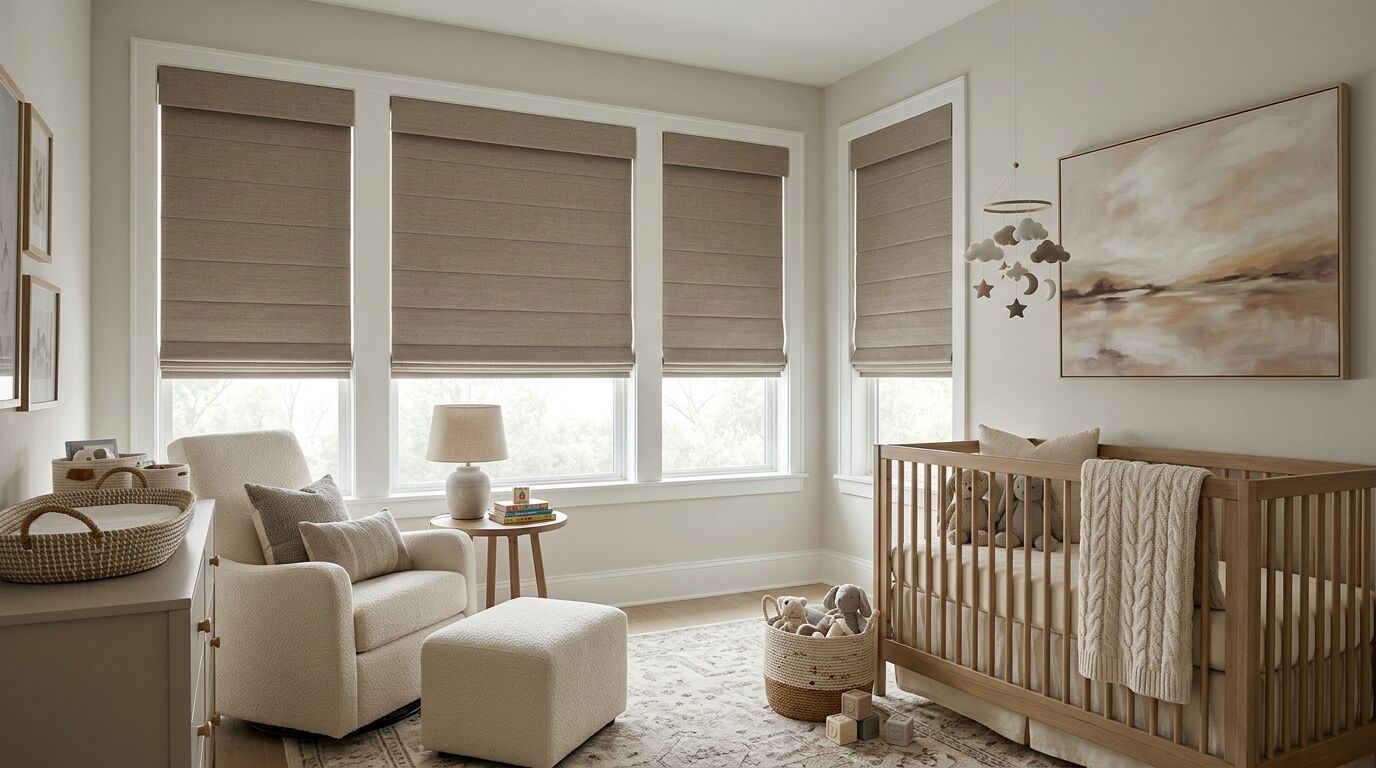
A homeowner in Celina called this spring because the nursery still glowed at six in the morning. She had bought blackout shades. She was right about the fabric, too: it was blackout fabric and it was doing its job. The light was arriving around the edges of it. That gap between what the label promises and what the room actually does is what this post is about, because almost nobody explains it before you order.
- Room-darkening and blackout describe the fabric. Neither word describes the window.
- Blackout fabric stops light passing through the material. The glow you see at the edges is a mounting problem, not a fabric problem.
- An inside-mounted shade is built narrower than the opening on purpose so it can raise and lower without dragging. That clearance is the light path.
- Two things fix it properly: side channels that capture the fabric edge, or an outside mount with generous overlap onto the wall.
- Decide how dark you need each room before you pick a fabric, because the answer changes the mount, not just the material.
What The Two Words Actually Mean
Both terms describe how much light passes through the material itself. That is all they cover.
Light-filtering fabric lets a soft, even glow through. You can read by it at noon with the shade down. Room-darkening fabric is denser or backed, so the room drops to a dim evening level and you can still make out the shape of the window. Blackout fabric is coated or laminated so no light passes through the weave at all. Hold a blackout sample up to a west window at four in the afternoon and you see a black rectangle with a bright outline.
That bright outline is the honest preview of what you are buying. None of those three words say anything about the four edges of the window, and the edges are where the trouble lives. A room-darkening shade sealed well into a tight opening can leave a bedroom darker than a blackout shade hung with a quarter inch of daylight running down each side.
Why A Blackout Shade Still Glows
On a typical inside mount there are three separate light paths, and the fabric is none of them.
The sides. A custom inside-mounted roller or cellular shade gets cut narrower than the measured opening so the fabric never rubs the jamb as it travels. That deduction is deliberate and every manufacturer takes one. Builder windows in newer North Texas construction are frequently a little out of square, which quietly widens the gap on one side. An eighth of an inch of daylight reads as a bright vertical line once your eyes adjust in a dark room.
The top. On a roller shade the fabric comes off the tube and hangs in front of the roll, so daylight can travel over the top of the tube and spill down into the room. A closed cassette or a sealed valance is what stops it. An open roller has nothing up there at all.
The bottom. The hem bar sits close to the sill but almost never touches it. On a window with a deep sill, light bouncing up off that ledge is usually the first thing people notice.
There is a fourth path on some cellular shades. Lift cords run through small holes punched through the honeycomb, and in a genuinely dark room those show up as a faint line of pinpricks. How noticeable that is depends on the lift system, so it's worth asking about a specific product rather than assuming. Cordless and motorized lifts are the child-safe and pet-safe choice regardless, since they remove dangling cords entirely.
The Two Fixes That Actually Work
Side channels. These are U-shaped aluminium or vinyl tracks fixed vertically inside the opening on both sides. The fabric edge runs down inside the channel, so there is no straight line left from the glass to the room. Blackout systems usually pair them with a sill channel at the bottom and a closed cassette at the top, and the four pieces together seal the opening. Channels need somewhere to sit, so jamb depth gets measured before anyone promises you a dark room. This is the answer when you want the shade tucked neatly into the frame and you still want the room black.
Outside mount with real overlap. Instead of fitting the shade inside the opening, you hang it on the wall or the casing and let it cover the window plus several inches on every side. Light that used to escape around the edge now has to get around fabric that is wider than the hole it covers. It's the simpler fix and often the less expensive one. The trade-off is visual: you see the shade and its brackets sitting on the wall rather than recessed into the frame, and on a window with handsome trim, some people would rather not.
Layering is a third route. A room-darkening roller behind lined custom drapery panels that return to the wall gets a bedroom properly dark for the same reason an outside mount does, and it looks softer than hardware ever will. It also handles the sound in a big room, which a shade alone does not.
Where Each Product Type Leaks
Roller shades carry the best blackout fabrics and the flattest look. They are also the most dependent on a cassette, because an exposed roll leaks at the top by design.
Cellular shades in blackout versions use a reflective liner inside each cell, which is why they insulate well and go dark at the same time. On a hot west-facing window that combination does real work. We wrote about that heat problem in more detail in our guide to window treatments for west-facing windows.
Roman shades stack in folds at the top when raised, so the top of the opening is compromised unless the mount accounts for it. Blackout lining works well in a roman, and the fold stack is part of why so many nurseries end up with one.
Shutters and blinds do not go dark, and any honest answer says so. Louvers and slats close tight enough for privacy and glare, but light comes through the tilt gaps, around the panel edges and at the hinges. If someone tells you plantation shutters will black out a media room, they are selling. Shutters are a beautiful answer to plenty of questions. Total darkness is not one of them.
How Dark Does That Room Really Need To Be
Worth answering room by room before you spend anything, because the difference in cost sits mostly in the channels and the hardware.
Nursery or a young child's room. This is the one where full darkness earns its keep, and it is the most common reason anyone calls us about this at all. Plan on channels or a generous outside mount from the start. Retrofitting darkness onto an inside-mounted shade later is more expensive than doing it once.
Primary bedroom. Plenty of adults sleep fine with room-darkening fabric and are happier with the cleaner inside-mount look. Some cannot. You already know which one you are, and it's a fair thing to say out loud at the consultation.
Media room. Darkness here is about contrast on the screen rather than sleep, and stray light from a window edge lands directly on the picture. Channels are usually the right call.
Living rooms, kitchens and offices. Room-darkening or a low-openness solar screen is normally plenty. Full blackout in a family room tends to get raised every morning and never used as intended.
One local note. On street-facing windows in Prosper and Frisco neighborhoods, HOA rules often ask for uniform white or neutral backing, and blackout fabrics come in a two-sided construction that handles that easily. Ask about the reverse side of the fabric, not just the room side.
What To Settle Before You Order
Five things, and every one of them gets decided at the measure rather than after installation.
Which specific windows need genuine darkness, and which just need the glare knocked down. Whether each of those windows is an inside or outside mount. How deep the jamb is, since that decides whether channels will fit. Which lift you want, cordless or motorized. And what the street sees from the outside.
Custom orders are made to your window and cannot be returned, which is exactly why Sheila measures in person, in your light, rather than working from numbers you send over. Blinds and shades typically run 2 to 3 weeks from order to installation, and the exact timeline gets confirmed the day the order is placed.
If you're weighing a nursery, a media room or a bedroom that faces the wrong way, book a free in-home consultation and we'll look at the actual openings together. You can see the full range of custom shades we build, and if you're in Celina or anywhere across North Dallas, Sheila will come to you.
See it in your own light.
Every room measures differently. Sheila comes to your home, looks at your actual windows and light, and helps you choose what fits. No showroom pressure, no obligation.
Book a free consultationProduct options, pricing and lead times vary by manufacturer and by window. Details here are general guidance — your in-home consultation is where we confirm what actually fits your home.