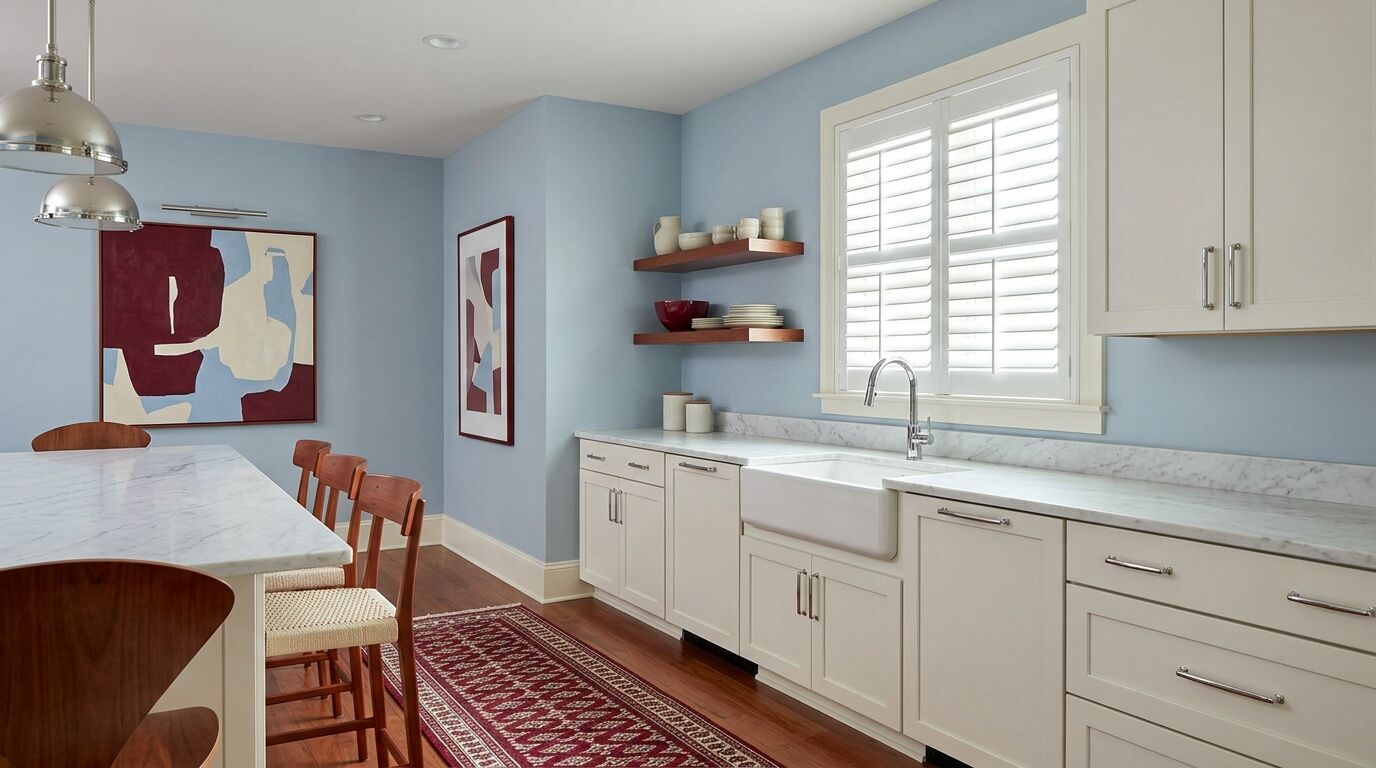
Two windows in a house get decided last and then cause more callbacks than every other window put together. One sits behind a kitchen faucet. The other sits over a bathtub, past the edge of the deck, where you cannot reach it without climbing in. They look like small easy windows. They are the two places I most often get asked to undo somebody else’s choice.
- Reach decides these windows before looks do. If working it means leaning across a wet counter or stepping into a tub, you will stop working it.
- Real wood warps in both rooms. Poly and composite shutters and faux wood blinds handle the damp. Hardwood and natural woven fibres do not.
- Fabric over a kitchen sink collects cooking grease, and grease does not vacuum out.
- Measure past the faucet and the window hardware, not past the glass. The tallest thing in that opening decides what will fit.
- An outside mount solves a shallow opening, a tight tile backsplash and an out-of-square builder frame all at once.
- Cordless or motorized in both rooms, with no exceptions worth making.
- A solar screen shade gives daytime privacy and none at all after dark with the light on. That matters more in a bathroom than anywhere else in the house.
- Whatever goes up has to wipe clean in place, without being taken down.
Reach Is the First Question
A kitchen counter stands at roughly thirty six inches and runs about two feet deep, with a sink and a faucet in the middle of it. The window sits above the backsplash behind all of that. To touch it you lean over the sink, usually across a wet counter, usually holding something.
A tub window is worse. The opening sits above a tub deck or a tiled surround, and the only way to reach it is to put a foot in the tub. People do that once, decide it is not worth it, and leave the covering in whatever position it was in on installation day.
So the control method matters more here than the fabric does. A cordless spring roller you can reach with one hand from the counter edge works. A tilt rod at the bottom of a shutter panel works. A shade you have to pull down by a cord you cannot reach does not, and on a tub window a motor stops being a luxury and starts being the only thing that gets used. We went through the reasoning behind cordless and motorized controls on its own, and both of these windows sit squarely in that argument.
The Kitchen Sink Window
Two things are happening at this window that happen nowhere else in the house. Steam comes up off the sink and off the range, and airborne cooking oil settles on everything within reach of the stove. That second one is the quiet killer. A woven wood shade or a textured fabric roman over a sink looks wonderful for about eighteen months and then holds a film you cannot get back out of the fibres.
The other complication is clearance. Kitchen faucets are tall now, and a gooseneck or a pull-down spray head often stands higher than the bottom of the window. A shade that rolls down into the path of the faucet will catch it every single time. Older casement windows over a sink add a crank handle that sticks straight out into the opening, and a cam lock on a single hung window does the same thing on a smaller scale.
That is why the measurement here is never taken off the glass. It comes off the outermost thing in or near the opening, and it is exactly the kind of detail behind why we measure your windows rather than letting you do it. A quarter inch of missed crank handle is a custom panel you cannot return.
What tends to go up over a sink: a poly shutter panel, a faux wood blind, or a vinyl or solar screen roller shade. All three wipe down. All three clear a faucet if they are mounted with that in mind.
The Bathtub Window
The bathroom window divides into two very different situations, and the deciding question is whether there is a shower over that tub.
If the tub is a soaking tub with no shower over it, you have humidity and no direct water. Steam rises, sits in the room, and settles on the window covering. That rules out real wood and untreated natural fibres, and it makes a fabric shade a gamble unless the bathroom has a fan that actually moves air.
If there is a shower over the tub and the window sits inside that wet zone, you have direct water hitting the covering. Nothing fabric belongs there. A poly or composite shutter, an aluminium blind or a vinyl roller are the honest options, and the shutter is what I specify most often because it takes a direct spray, wipes dry, and looks like part of the room rather than a utility choice.
Even the moisture-resistant materials have a limit. Splashes and wipe-downs are fine. A slat or a bottom rail that sits in standing water will eventually let water into the headrail and the lift mechanism, which is a repair rather than a wipe.
What Survives the Damp and What Does Not
Holds up well. Poly and composite shutters, which is the same reason they go in bathrooms generally. Faux wood blinds with a PVC or PVC-composite core, which do not absorb water and do not grow mildew. Aluminium blinds. Vinyl and solar screen roller shades.
Depends on the room. Cellular shades, which handle humidity in a well-ventilated bathroom and are a poor idea in a small one with a shower and no fan, because the cells hold damp air. Polyester roller fabrics, which do better than natural fibres and still want airflow.
Do not put these there. Hardwood shutters and real wood blinds, which swell, warp and split. Woven wood and bamboo shades, which mark and mildew. Cotton and linen romans and drapery anywhere near a sink or a tub.
The hardwood point surprises people who have their heart set on a wood shutter. It is the same trade-off we laid out in poly against hardwood shutters: hardwood gives you the wider louver and the grain, poly gives you a panel that does not care about steam. In a bathroom or over a sink, poly wins on merit.
Inside Mount, Outside Mount and the Tile Problem
An inside mount looks cleaner, so it is what people ask for. Three things in these two rooms often make it the wrong call.
The first is depth. Roller shades need flat depth behind the casing for the brackets before the roll will fit, and more again if you want the roll to sit fully inside the opening rather than proud of it. The exact figure moves by product, which is one of the things we check at the measure rather than guess at.
The second is tile. Backsplash tile frequently returns into the window reveal, and a tub surround does the same. That tile eats depth, it is rarely square, and it is not something you want to drill into if there is any way around it.
The third is squareness. Small openings in a builder home are the ones most likely to be out of square, and an inside-mounted panel in a crooked opening leaves a wedge of daylight down one side that you will notice every morning.
An outside mount fixes all three. It clears the tile, it hides an uneven opening, it covers the light gaps at the edges, and on a bathroom window it can be run wider than the opening for better privacy. The requirement is flat wall above and beside the window to fix into, which is worth confirming before anyone falls in love with the idea.
Privacy After Dark Is a Separate Question
Solar screen shades are popular over kitchen sinks because they keep the view of the backyard and cut the glare. They are rated by openness factor, and a lower number blocks more sun and gives more daytime privacy.
None of them give you privacy at night. Once the light is on inside and it is dark outside, the relationship reverses and a solar screen shows the room. In a kitchen most people can live with that. In a bathroom it is the whole reason the covering exists.
So a bathroom window wants something opaque when it is closed. A shutter with the louvers shut, a room-darkening or blackout roller, or a cellular shade in a private fabric. If the bathroom also wants daylight during the day without showing the room, a shade that lowers from the top and leaves the bottom closed is the configuration that solves it.
Cleaning Belongs in the Decision
Both of these windows get dirtier than any other window in the house, and both are awkward to take anything down from. So the test is simple. Can it be wiped clean in place, with a damp cloth, without unclipping anything?
Poly shutter louvers and faux wood slats pass that test. Vinyl and solar screen roller fabric passes it. A woven wood shade fails it, and a fabric roman fails it in a way that is permanent, because the mark left by grease or a water stain does not come out.
Never submerge any of it, whatever the material. Water gets into headrails, cord locks and tilt mechanisms and does not dry out of them.
What This Usually Ends Up Being
Over a kitchen sink, most often a white poly shutter or a faux wood blind, and a solar screen roller where the backyard view is worth keeping. Over a tub, a poly shutter almost every time, with a room-darkening roller as the alternative where the window is small or oddly placed.
Blinds and shades run about two to three weeks from order to installation. Shutters are typically six to eight weeks across the industry, and some manufacturers run longer in a busy season. Those are the ranges we work with rather than promises, and the real date is confirmed the day the order goes in.
If you are unsure which of these two situations you actually have, that is a five minute answer at the window. Sheila comes out, looks at the faucet, the tile, the depth and the fan, and tells you what will still be working in five years. More of the questions we get asked are answered on the FAQ page.
See it in your own light.
Every room measures differently. Sheila comes to your home, looks at your actual windows and light, and helps you choose what fits. No showroom pressure, no obligation.
Book a free consultationProduct options, pricing and lead times vary by manufacturer and by window. Details here are general guidance — your in-home consultation is where we confirm what actually fits your home.