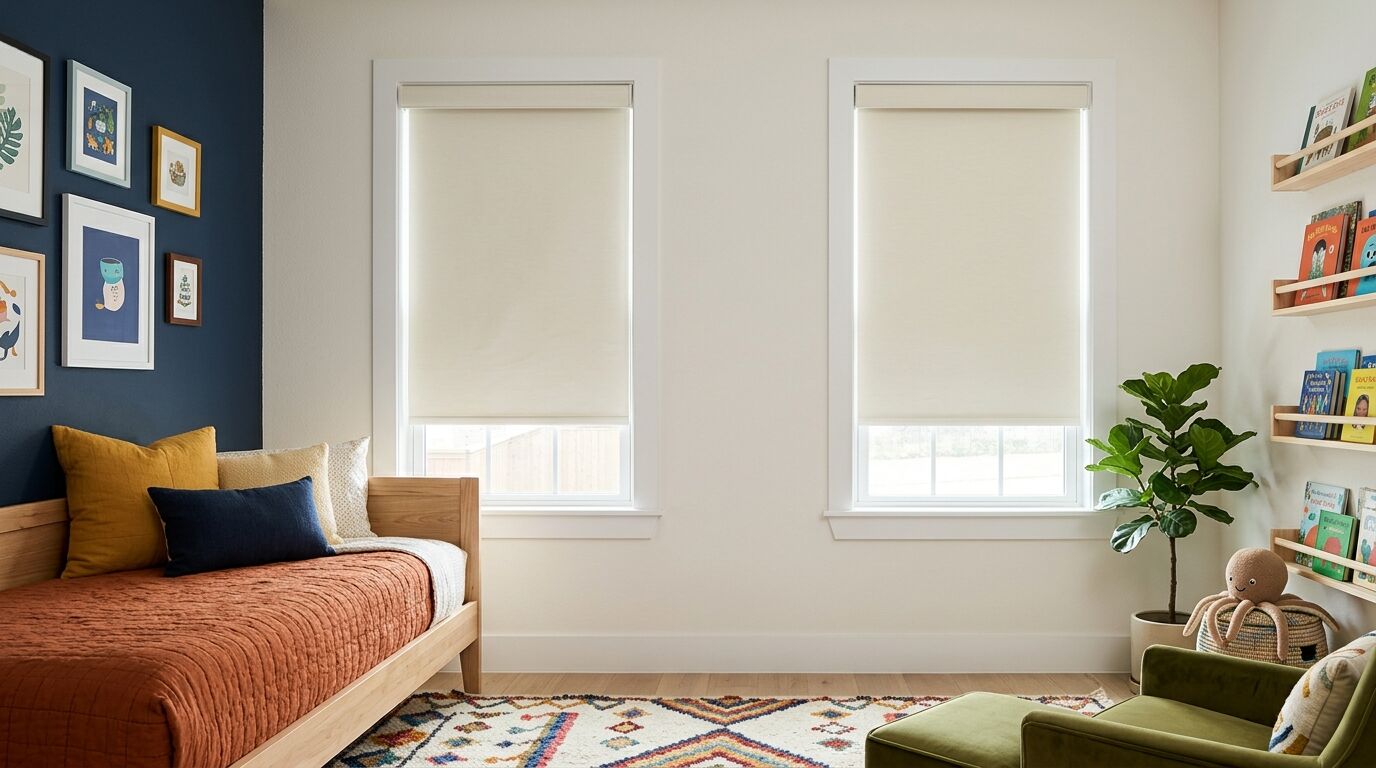
The cord question usually comes up about ten minutes into a consultation, and it comes up quietly. Somebody has a toddler who has just learned to climb, or a cat that already found the loop on the dining room blind. It is a fair thing to worry about, and the answer is more specific than "buy cordless." Here is what the hazard actually is, what changed in the industry standard, and which cordless option belongs in which room.
- Three different cords cause harm: the pull cord you operate, a continuous loop chain, and the thin inner cords running through the slats of a blind.
- CPSC data from October 2022: on average about nine children under five die each year from strangling in corded window coverings.
- The revised industry standard, ANSI/WCMA A100.1-2022, took effect on June 1, 2024 and pushed nearly all new window coverings, custom ones included, to cordless or unreachable cords.
- "Cordless" covers several mechanisms. Some still have a cord you cannot reach. Some have none at all.
- Shutters have no lift cord of any kind, which is why they get specified so often in kids rooms.
- Motorization removes the cord and the reach problem in one move, and battery motors need no electrician.
- The real risk in most houses is the older corded blinds already hanging there. There are specific steps for those.
The Three Cords That Cause Harm
Window covering cords are not all the same, and the differences decide what you replace first.
The operating cord is the one you pull to raise a shade or tilt a blind. Left at full length it hangs right at a small child's height.
The continuous loop is the closed chain or cord on a roller shade or a vertical blind. A loop is the dangerous shape, because nothing has to be tied for it to catch a neck. Loops are supposed to be anchored tight to the wall or the floor. On plenty of installations they never were.
The inner cords are the thin ones threaded down through the slats of a horizontal blind. They are easy to overlook because they look like part of the product rather than a cord. A child can pull a length of inner cord out sideways through the slats and turn it into a loop.
The numbers are worth stating once, plainly. CPSC counted more than 200 incidents involving children up to eight years old between January 2009 and December 2021, and a child died in 48 percent of them. On average about nine children under five die each year, per the same CPSC release from October 2022. Injuries in the non-fatal cases ran from a scar around the neck to permanent brain damage.
That is the whole reason the standard changed, and it is why we bring it up whether or not a client does.
What The Standard Requires Now
The recent history here is tangled enough that people get contradictory answers, so here is where it actually stands.
The governing document is the industry standard ANSI/WCMA A100.1-2022. It took effect on June 1, 2024 for products manufactured or imported after that date, and it eliminated free hanging operating cords, free hanging tilt cords and cord connectors from made-to-order custom window coverings. Stock products were already covered by the earlier 2018 revision.
CPSC had written its own federal rule for custom window coverings on top of that, with an effective date in 2023. The D.C. Circuit Court of Appeals vacated that rule in September 2023 following a challenge by the manufacturers association, which is why you will still find articles online describing a federal requirement that is not currently in force. The ANSI standard is the one doing the work today.
What it means for you is short. Anything ordered new is already built to the current standard. The exposure in your house is whatever was hanging there before.
Cordless Means Several Different Things
This is where the shopping gets confusing, because one word covers four mechanisms that behave differently.
Cordless lift. A spring inside the headrail balances the weight of the shade. You push the bottom rail up or pull it down with your hand and it stays where you leave it. Common on cellular shades, rollers and faux wood blinds. Honest caveat: a lift spring is a mechanical part, and after some years of hard use it can need adjusting. That is a service call, not a replacement.
Wand tilt. On blinds, a rigid plastic or metal wand replaces the old tilt cord. It is stiff, so it cannot form a loop, and it does not lengthen as the blind is lowered.
Continuous loop with a tensioner. Still a cord, anchored to the wall or the window frame under tension so no slack loop can form. Compliant, and useful on very wide or very heavy shades where a lift spring cannot carry the weight. Worth knowing this is not the same as cordless, because some households want no cord at all.
Motorized. Nothing hangs at the window. A remote, a wall switch, an app or a voice command does the lifting.
Ask which of those four you are being sold. On a made-to-order product all four are compliant, and only two of them are genuinely cordless.
Shutters Sidestep The Question Entirely
A shutter has nothing to lift. The panels swing open on hinges and the louvers pivot on a front tilt rod or on a hidden tilt bar buried in the stile. There is no lift cord in the product and there never was one.
That is a large part of why they end up in nurseries, playrooms and bedrooms so often. No cord to manage this year, none in ten years, and nothing a child can pull down on top of themselves. They are the premium end of the range, so this is not the budget way to solve the problem, but it is the permanent one.
The same goes for a cafe-height panel over a low window in a playroom, which covers the part of the glass a toddler can reach and leaves the top open for light.
Where Motorization Earns It
Motorization gets described as a luxury. In a house with young kids it does two useful jobs at once: no cord at the window, and no climbing on furniture to reach a shade.
The usual worry is that motorizing means opening up walls. Most retrofits run on battery power, either a rechargeable wand clipped to the headrail or a battery tube inside it, and no electrician is involved. Hardwiring belongs to new construction, where the low voltage runs get pulled before the drywall goes on.
Motorized shades pay off fastest on tall glass and stair landings, which is also exactly where a corded shade would need a cord long enough to be a real hazard. We went through the reach problem in detail in our post on covering a two-story great room window.
Pets Are A Different Problem
Cats and cords belong in the safety conversation for the same reason children do. A loop hanging beside a window is a toy, and a cat that gets a paw or its head through one is in trouble quickly and silently. The products that protect a toddler protect a cat, so nothing about the recommendation changes.
Dogs are a damage problem rather than a safety one. A dog that watches the street will get behind whatever is on that window. Fabric shades pull away at the bottom rail. Faux wood slats crease and snap at chest height where the dog pushes through. Vertical vanes pop off their carriers, which is a cheap repair and an ugly one until it happens.
If you have a dog that patrols a front window, say so at the consultation. On that one window the sensible answer is usually a hard product rather than fabric, and often a shutter, because a shutter panel takes a shoulder from a full grown retriever without any drama.
The Corded Blinds Already Hanging In Your House
Replacing every window at once is not realistic for most families, so treat it as triage. Rooms where a child sleeps or plays come first. Then rooms where a child is ever alone, even briefly. Then everything else.
For whatever stays up in the meantime, CPSC guidance is specific:
- Shorten every pull cord as far as it will go.
- Check that cord stops are fitted and adjusted so inner cords cannot be pulled out into a loop.
- Anchor continuous loop cords and chains to the wall or floor, and keep the tension tight.
- Move cribs, beds, furniture and toys away from windows and cords, preferably to a different wall.
One thing to know before you go hunting: the Window Covering Safety Council used to mail out free retrofit kits with cord stops and tension devices, and that program is suspended. Their own advice now is to install cordless products that meet the current standard rather than patch older corded ones. So a kit is not on its way, and the retrofit steps above are what you can do yourself in the meantime.
Worth adding: we will repair shutters and shades we did not originally sell. If an old blind in a kids room has a broken cord stop or a snapped tilt mechanism, it is worth a look before you assume the whole window has to be replaced.
Nurseries And Kids Rooms
Two things get decided in a nursery: cords and darkness. People often solve one and assume the other came along with it.
On cords, order cordless, and if the room allows it put the crib against a wall with no window on it at all. Even a compliant cord is one less thing to think about when it is nowhere near the crib.
On darkness, blackout fabric blocks light through the fabric and still leaks around the edges of a roller or roman shade unless the shade has side channels. That gap surprises people who paid for blackout and still have a bright stripe down each side of the window at 6am. We covered it properly in room-darkening versus blackout shades. For a nursery the combination that actually works is a cordless blackout roller running in side channels.
What To Expect On Timing
Cordless is standard on new orders now, so it is not an upgrade you have to chase or wait longer for.
Blinds and shades typically run 2 to 3 weeks from order to installation. Plantation shutters typically run 6 to 8 weeks across the industry, with some manufacturers stretching to 12 weeks in a busy season. Those are typical ranges rather than promises, and the exact timeline gets confirmed the day the order is placed.
If you want to work out what to ask before we come out, the questions homeowners ask us most cover the process end to end. Or call or text (972) 523-6399 and Sheila will come look at the actual rooms, in the actual light, with the actual kids underfoot.
See it in your own light.
Every room measures differently. Sheila comes to your home, looks at your actual windows and light, and helps you choose what fits. No showroom pressure, no obligation.
Book a free consultationProduct options, pricing and lead times vary by manufacturer and by window. Details here are general guidance — your in-home consultation is where we confirm what actually fits your home.