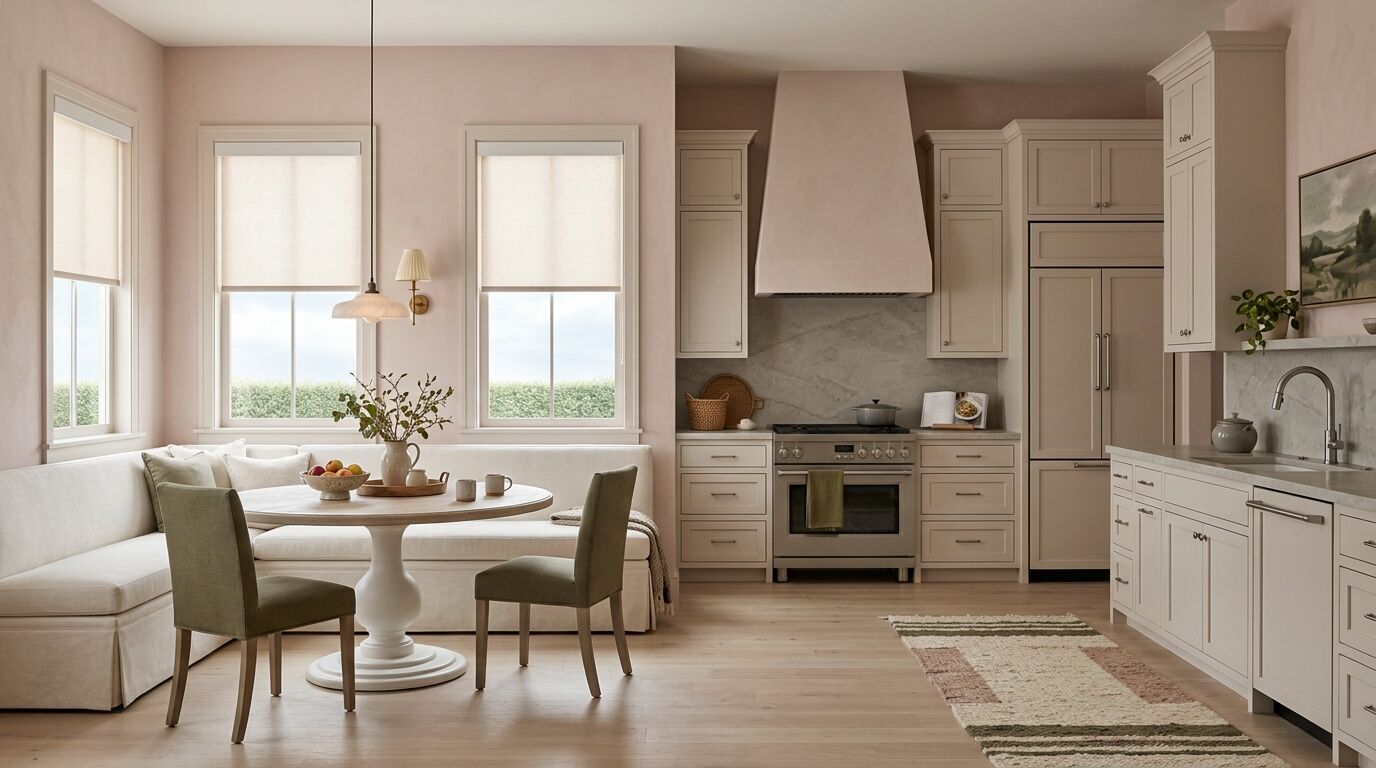
A breakfast nook window sits a few feet from a table where people eat, and often a few more from a stove. That changes what the covering has to do. It gets splashed, warmed and touched, and it faces whatever light the kitchen gets.
- Pick a covering you can wipe or vacuum, because a nook window collects crumbs, steam and cooking residue.
- Smooth fabrics and faux wood or poly surfaces clean more easily than loose weaves or heavy textures.
- Keep fabric and cords away from the range. A window beside a cooktop needs extra thought.
- Light-filtering fabric keeps morning glare off the table and still lets the room stay bright.
- Inside-mounted coverings stay clear of a banquette, chairs and a table pushed to the glass.
- Cordless or motorized operation helps when a bench or table blocks the reach.
Start With What Lands on the Window
A kitchen window gets a different kind of dirty than a bedroom window. Steam from a pot, a fine film of cooking oil, a splash from a sink, jam from a small hand. So before you think about color, think about how you'll clean it.
Smooth roller fabrics can usually be wiped with a damp cloth or vacuumed with a soft brush. Heavily textured or loosely woven materials hold dust and residue and are harder to freshen. Ask Sheila to show you the fabric sample, and rub a corner yourself. Our guide to cleaning shutters, shades and blinds goes through methods by material, and your shade's care instructions always come first.
Heat and Grease Near the Stove
If the nook is across the room from the range, the window rarely sees much more than the occasional splash. If it sits right beside the cooktop, treat it like the window over a sink: choose a surface that tolerates moisture, and keep long fabric and any cords well away from the burners.
Poly or composite shutters and faux wood blinds handle humidity better than real wood. We cover what works near water and steam in windows over a kitchen sink or bathtub. A good vent hood does more for your window coverings than any fabric choice, since it pulls steam and grease out before they settle.
Let the Light In Without the Glare
Breakfast happens early, and an east-facing nook can throw low sun straight across the table. A light-filtering shade softens that glare and keeps the room bright. A solar screen can cut the heat and glare while keeping some view, and the openness factor tells you how much sun it blocks. Lower openness blocks more sun and gives less view.
If your nook faces west, the afternoon is the problem instead. Our post on window treatments for west-facing windows in North Texas explains what helps there.
Mount Choices Around a Banquette or Table
Many nooks put a bench or a table right against the glass. An inside mount keeps the covering within the window frame, so a chair back or cushion never presses on it. Where a sill is deep enough, a shade can sit neatly inside it.
Reach matters too. If you have to climb on a bench to raise a shade, you won't use it. Cordless lift works for many windows, and motorized operation helps when the window is awkward to reach. A battery motor is common and doesn't need an electrician for most retrofits.
Match the Kitchen, Not Just the Nook
A nook usually opens to the kitchen and family room, so the covering is seen from several places. Keep it quiet and consistent with the other windows in sight. Our post on open plan window treatments explains how to match by sightline.
What Sheila Looks At First
At the free in-home consultation, Sheila looks at where the table and bench sit, how close the range is, which way the window faces and how much light hits the table at breakfast. Then she suggests a covering and a mount that fits the way you use the space. Everything is made to the window and installed for you.
Blinds and shades usually take 2 to 3 weeks from order to installation, and plantation shutters typically run 6 to 8 weeks, sometimes longer in a busy season. The exact timeline is confirmed the day you place the order. Read more about custom shades or book a consultation.
See it in your own light.
Every room measures differently. Sheila comes to your home, looks at your actual windows and light, and helps you choose what fits. No showroom pressure, no obligation.
Book a free consultationProduct options, pricing and lead times vary by manufacturer and by window. Details here are general guidance — your in-home consultation is where we confirm what actually fits your home.