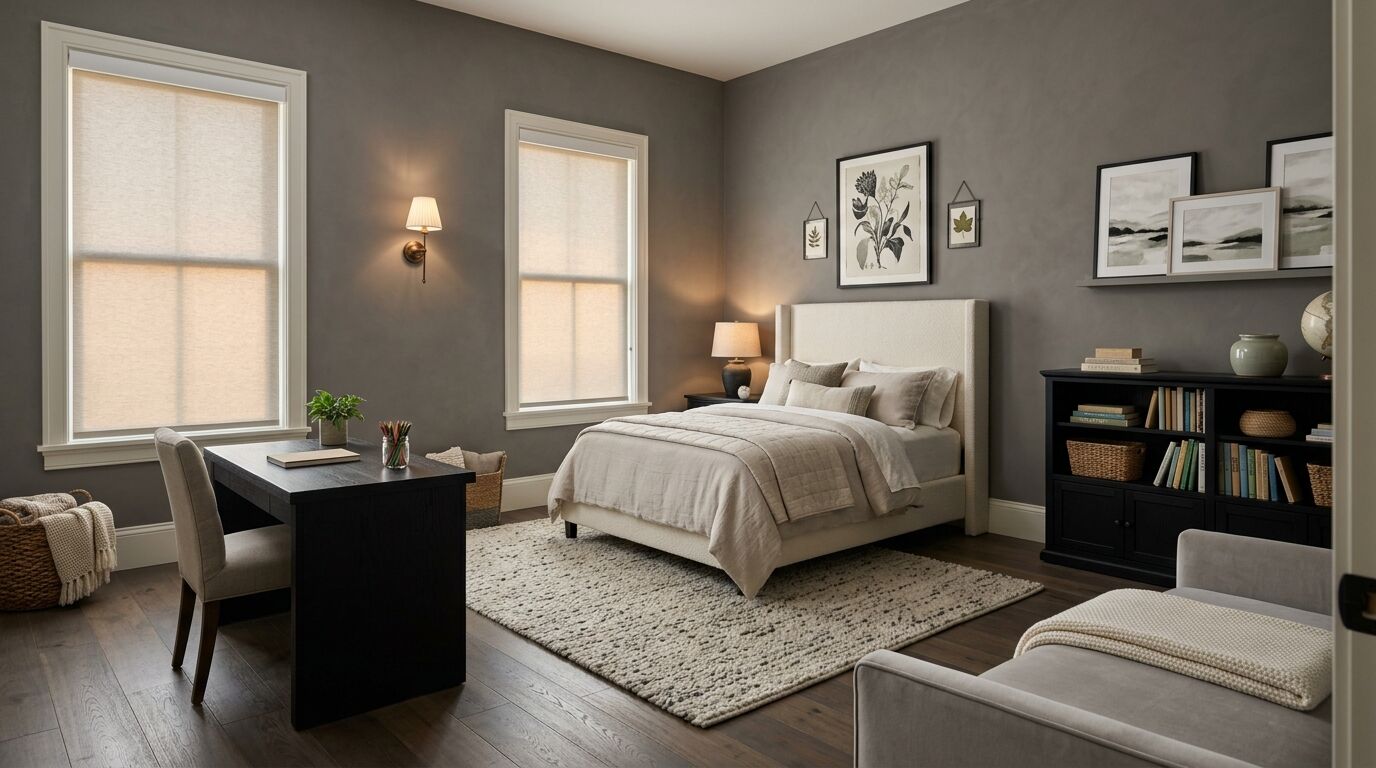
A nursery shade gets chosen for naps and for a baby who can't reach anything. Five years later that child is asking for a darker room, a desk by the window and a bedroom that doesn't look like a nursery. A few decisions made early can let one set of window coverings last through most of that.
- Choose cordless or motorized from the start. The U.S. Consumer Product Safety Commission has described accessible window covering cords as a strangulation risk to children 8 and younger.
- Keep the covering neutral and change the room with bedding, rugs and art, so the window doesn't date when the theme does.
- Pick a fabric you can wipe or vacuum, because kids' rooms get touched.
- Room-darkening and blackout are different, and edges matter more than fabric for a child who wakes at first light.
- Inside-mounted coverings stay clear of furniture, toys and a bed pushed under the window.
- Shutters have no cords and tolerate a lot of handling, which suits a room that gets used hard.
Start With Cords, Because Everything Else Can Change
You can swap bedding, repaint and rearrange furniture in an afternoon. You can't easily fix a covering that has a loop of cord hanging within reach. So the first question for any child's room is how the covering operates.
Cordless lift is the simplest answer. You push or pull the bottom bar and it stays where you leave it. Motorized shades remove the question entirely, since a remote or a wall switch does the work. Plantation shutters have no lift cord at all, only a tilt rod or a hidden mechanism. If you already own corded blinds, our post on cordless and motorized coverings around kids and pets covers what to look for.
Furniture matters too. A bed, crib, changing table or toy chest placed under a window puts a child close to whatever is hanging there. Where you can, set furniture away from the window wall, and tell us where the bed will go before we measure.
Choose a Neutral That Survives the Theme
Dinosaurs give way to horses, then to a teenager's favorite band. A covering in a bold print or a bright color has a short life. A soft oatmeal, warm white or pale grey fabric carries on through every phase, and the personality goes into the things that are easy to replace.
This is also where a bit of thought up front saves a second purchase. If you're likely to want something softer later, a neutral shade now leaves room to add drapery panels over it when the child is older. Our post on layering drapery over shades explains how the two work together.
Dark Enough for Naps and Early Mornings
North Texas summer light is up early and stays late. A child who naps at noon or goes to bed while it's still bright needs more than a thin fabric.
Room-darkening fabric cuts most of the light. Blackout fabric blocks light through the fabric itself. Either one can still leave a glow around the edges, and a bright line at the sides is often what wakes a light sleeper. If dark matters, ask about side channels or an inside mount with a close fit. We go through the difference in room-darkening versus blackout shades.
Some families want the room dark for sleep and bright for play. A dual roller shade, with a sheer and a darker fabric on one window, handles both without changing the hardware.
Fabrics That Handle Fingerprints
Children touch things. A smooth roller fabric can be wiped with a damp cloth or vacuumed with a soft brush attachment. A heavily textured or loosely woven material holds dust and crumbs and is harder to freshen. Ask Sheila to show you the fabric in your own light, and rub a corner of the sample yourself.
If anyone in the house has allergies, a fabric you can clean easily is worth more than one that only looks good in a catalog. Cleaning methods vary by fabric, so follow the care instructions that come with your shade.
Where Motorization Fits
Motorized shades suit a child's room for a practical reason: no cord, and a parent can close the shade from the hall at nap time. A battery motor is common and doesn't need an electrician for most retrofits. Keep the remote out of a toddler's reach, and later, when the child is old enough, handing over the remote can become part of the routine.
It's most useful on tall or awkward windows and less necessary on a small window beside a desk. Our guide to motorized shades explains how the options work.
What Sheila Measures First
At the free in-home consultation, Sheila looks at where the bed, desk and any reading chair will sit, which way the window faces and how much light comes in at the hours the child actually sleeps. Then she suggests a covering and a mount that fits the room as it will be used, not only as it looks today. Everything is made to the window and installed for you.
Blinds and shades usually take 2 to 3 weeks from order to installation, and plantation shutters typically run 6 to 8 weeks, sometimes longer in a busy season. The exact timeline is confirmed the day you place the order. If you're planning ahead for a new baby, build that time in. Read more about custom shades or book a consultation.
See it in your own light.
Every room measures differently. Sheila comes to your home, looks at your actual windows and light, and helps you choose what fits. No showroom pressure, no obligation.
Book a free consultationProduct options, pricing and lead times vary by manufacturer and by window. Details here are general guidance — your in-home consultation is where we confirm what actually fits your home.