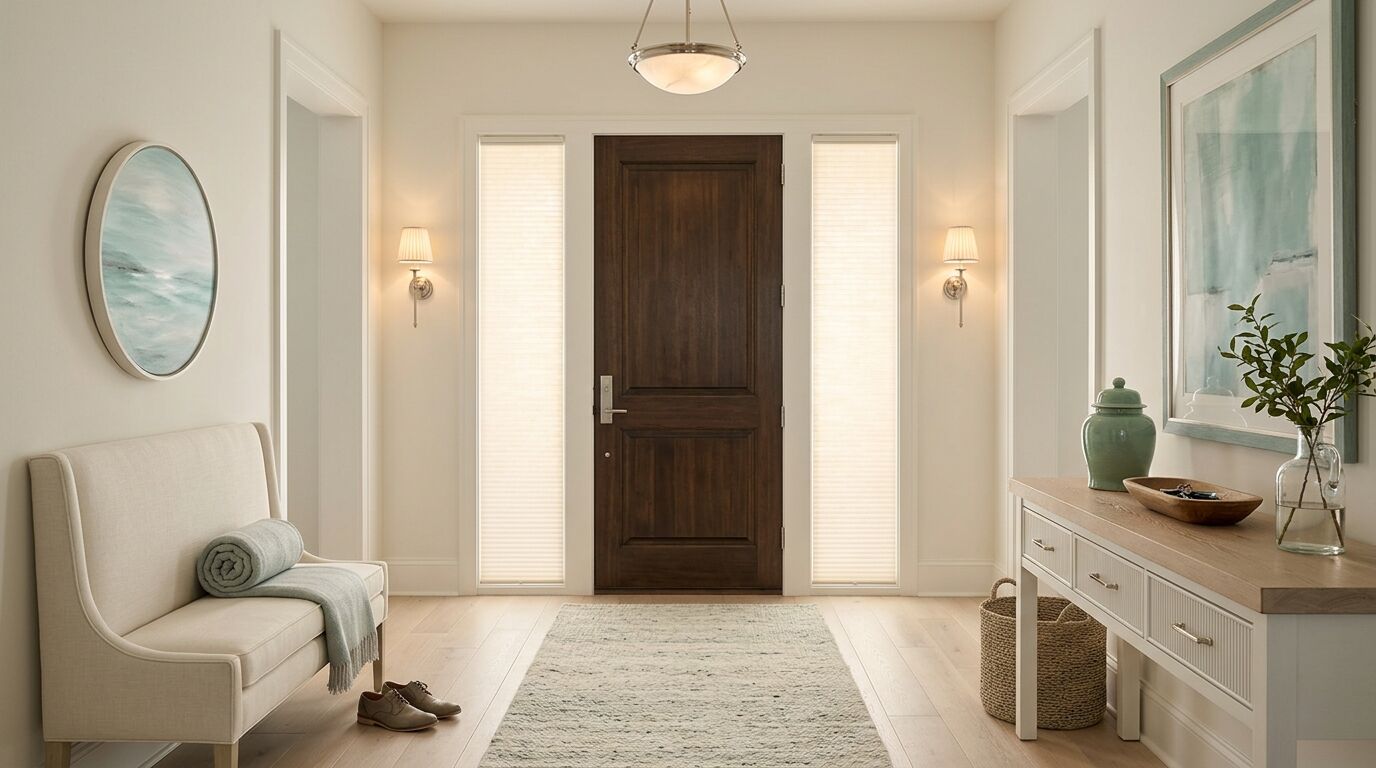
Sidelights let daylight into the entry, and they let the whole street see into your front hall. The glass is narrow, fixed and right next to a door that swings, so the usual advice about hanging a shade doesn't quite fit.
- Sidelights are fixed glass panels beside the front door. They don't open, so the covering only has to handle light and privacy.
- Cordless is the right call here. The entry is where kids, pets and delivery people pass, and a hanging cord at that spot is a poor idea.
- A light-filtering cellular shade softens the light by day. A room-darkening fabric gives more privacy when the hall lights are on at night.
- Glass in the door itself needs a covering that is held at the bottom so it can't swing when the door closes.
- Match the sidelight coverings to each other, and to the nearby windows, so the front of the house looks planned.
Why Sidelights Are Awkward
A sidelight is a tall, thin window. On a lot of North Texas homes it sits right at the front door, facing the street and often the afternoon sun. People who walk up can look straight through it, and the hall floor behind it takes the heat and the fading.
The frames are shallow too. Many sidelights have very little depth for a covering to sit inside. That's the detail Sheila checks first, because it decides whether a shade can mount inside the frame or has to go on the face of the trim.
What Works on Sidelights
A narrow cordless cellular shade is the usual starting point. The honeycomb cells diffuse the light, so the hall stays bright without a hard stripe of sun across the floor. Cells also trap air, which helps with the heat that comes through large panes of glass, though we won't promise a number on your bill.
A roller shade is another good fit. It stacks very small, so it leaves most of the narrow glass clear when it's raised. If you want daytime privacy and still want to see out, a solar fabric works, with one honest limit: solar screens don't give you privacy at night when the hall is lit. Our guide to solar shade openness factor explains how the percentages work.
Faux wood or wood blinds cut to the narrow width also work. The slats tilt, so you can shut out a direct view and still let light in. They suit a traditional entry well. You can browse the options on our custom blinds page.
Privacy by Day and by Night
In daylight, most light-filtering fabrics give good privacy from the outside, because the bright sun makes the inside look dark. At night it flips. With the hall lit, a light-filtering shade glows and can show shapes and movement from the street.
If that bothers you, choose a room-darkening fabric for the sidelights. It blocks more light through the fabric, so the glow is dimmer and the shapes disappear. Room-darkening isn't the same as blackout, and side edges can still leak a little light, which matters less in a hall than in a bedroom.
A top-down bottom-up shade is another answer. You can lower the top and leave the bottom closed, which keeps daylight coming in at the top while the eye-level view stays covered. We explain the mechanism in our post on top-down bottom-up shades.
The Glass in the Door Itself
Many front doors have a glass panel of their own. A hanging shade doesn't belong there, because every time the door closes it swings, and it can catch the edge of the frame. The better choice is a covering that is mounted to the door and held at the top and bottom. That keeps it still, and it keeps it from rubbing the door when you open it.
Ask about this during the measure. The door needs its own check for clearance, handle position and the swing of the door against the nearby wall.
Cords, Kids and Pets
The front hall is the busiest few feet in the house. A dangling cord next to the door is a hazard for small children and a toy for a dog. Cordless lifts remove it. We cover the safety side in our post on cordless and motorized coverings for kids and pets. If the sidelights are tall, a battery motor can raise and lower them without anyone reaching up.
Keep Both Sides Matching
Two sidelights with different coverings, or one open and one closed, look off from the street. Use the same product, the same color and the same mount on both. If your neighborhood has an HOA, check what the street is allowed to see. We go through that in our post on HOA window covering rules.
How to Decide
If you mainly want softer light, pick a light-filtering cellular or roller shade. If privacy at night matters, choose room-darkening. If the door has its own glass, plan a separate door-mounted covering. In all three cases, go cordless.
Sheila can stand in your entry, check the frame depth and show you fabrics against your own door and light. That's part of the free in-home consultation. Blinds and shades usually take 2 to 3 weeks from order to installation, and the exact timing is confirmed the day you order. Ask for a consultation and she'll take a look.
See it in your own light.
Every room measures differently. Sheila comes to your home, looks at your actual windows and light, and helps you choose what fits. No showroom pressure, no obligation.
Book a free consultationProduct options, pricing and lead times vary by manufacturer and by window. Details here are general guidance — your in-home consultation is where we confirm what actually fits your home.