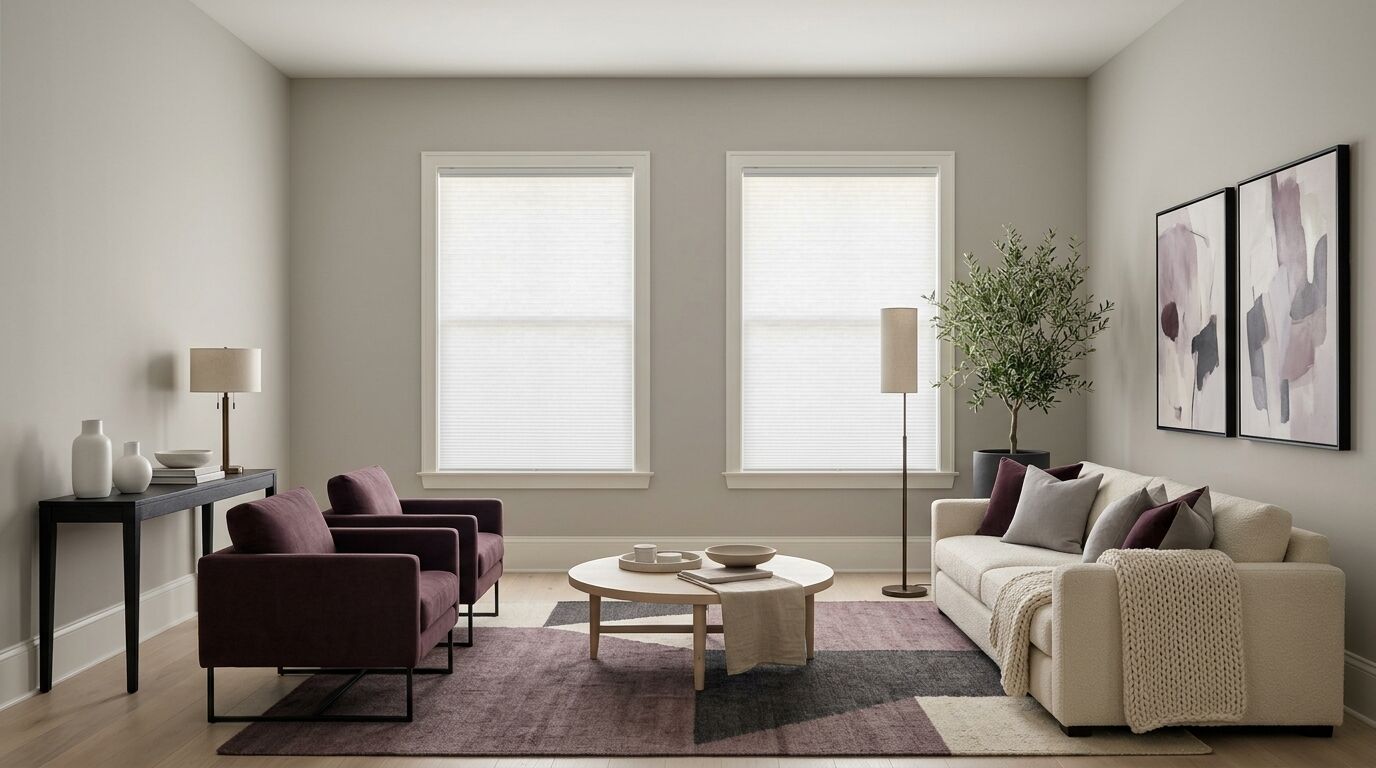
Plenty of front rooms in Frisco sit close enough to the street that anyone on the sidewalk can see straight in. So the shades stay down all day and the room stays dim. Top-down bottom-up shades are the one lift that answers that exact problem. The fabric covers the window from a rail at eye level down to the sill, and the glass above that rail stays clear. Light comes in over the top. Nobody walking a dog sees anything.
- One shade, two moving rails. The top rail lowers, the bottom rail raises, and each one moves independently of the other.
- The point of it is a window where you want cover at eye level and daylight above that: front rooms, bathrooms, ground-floor offices.
- This is a lift mechanism chosen when the shade is built. It cannot be added later to a shade you already own.
- It costs more than a standard lift, because there is a second mechanism in the headrail doing the work.
- Skip it on windows you cannot reach and in any room you actually want dark.
How Top-Down Bottom-Up Shades Work
A standard shade has one moving part. The bottom rail goes up and down, the top of the fabric stays fixed to the headrail, and the only question you get to answer is how much of the window is covered.
A top-down bottom-up shade adds a second moving rail. The top edge of the fabric is carried on a floating rail that hangs from the headrail on its own set of cords. Pull that rail down and the glass above it opens up. The bottom rail still works the way you expect. Move both and you can park a band of fabric anywhere in the opening you like.
The fabric itself stays under tension between the two rails, so the shade looks deliberate in every position rather than half finished. On a cellular shade the cells compress as the rails come together, which is why cellular is the fabric this lift was really designed around.
Most people end up using two positions and forgetting the rest. Fully closed at night, and the top rail dropped about a third of the way down during the day. The rest is nice to have.
Why Light From The Top Of A Window Is Better Light
Sunlight coming in high hits the ceiling first and spreads across it before it reaches you. Light coming in at seat height hits you in the face. Same window, same amount of glass, very different room.
That is the real argument for this lift, and it has nothing to do with privacy. A room lit from the top of the window has softer shadows and much less glare on a screen. You get to keep a bright room without sitting in a spotlight.
The privacy side is simple geometry. Someone standing on the sidewalk is looking into your house along a roughly level line at head height. Cover the bottom two-thirds of the glass and that line runs into fabric. The top third sits above their sightline and can stay open all day.
One honest local caveat. On a west-facing window in July, the high afternoon sun is exactly the part you were trying to block, and leaving the top open lets that heat and glare straight in. A west wall usually wants the opposite setup. Save this lift for the north, east and street-facing glass where heat is not the main complaint.
Street-Facing Rooms And Bathroom Windows: Where It Pays Off
Lots in the newer neighborhoods around Frisco and the towns north of it are narrow, and the front elevation sits close to the sidewalk. A formal sitting room or a front office off the entry is the classic case. Those rooms have good windows and almost nobody uses them, because the shades live in the down position.
Bathrooms are the other obvious one. A bathroom window is usually small, usually above a tub or beside a vanity, and you want it covered from about chest height down whenever the room is in use. Dropping the top rail a few inches gives the room daylight without giving the neighbors anything.
Other windows where it genuinely earns the upgrade:
- A ground-floor bedroom on a side yard or an alley, where you want morning light before you want to be seen.
- A dining room facing a neighbor's driveway across a narrow side setback.
- A home office with a low window behind the desk, where glare on the monitor is the daily complaint.
- A game room over a garage where the window sits low in the wall.
Notice the pattern. Every one of those is a window low enough to reach, in a room used during daylight, where the view out is not the reason the window is there.
Where Top-Down Bottom-Up Is Not Worth The Extra
Sheila talks people out of this one fairly often, usually for one of four reasons.
You cannot reach the top rail. A two-story great room window, a transom, a window over a kitchen sink or over a laundry counter. If you need a step stool to move the top rail, you will move it twice and then never again. Either motorize it or order a standard lift and spend the difference somewhere useful.
You want the room dark. A nursery, a media room, a primary bedroom for a light sleeper. The whole feature depends on leaving the top of the window open, so it works against you here. Worth knowing too: a shade of any kind lets daylight in around its edges on an inside mount, which is a separate problem covered in our post on what actually blocks the light.
Nobody can see in anyway. Back windows onto a fenced yard, second-floor windows facing a greenbelt, anything behind a row of mature trees. Pay for privacy you actually need.
You are ordering the whole house. The upgrade applies per shade. On a twenty-window order that adds up quickly, and most families use the feature on three or four windows. Put it where it does real work and use a standard lift everywhere else.
Which Shades Can Be Built This Way
The lift depends on fabric that can gather neatly between two rails and hold its shape there, so not every product offers it.
- Cellular and pleated shades. The natural home for this lift. The cells compress evenly and the stack stays tidy at any position. If someone says top-down bottom-up without naming a product, this is what they mean.
- Roman shades. Available and good looking, with more weight to move. Larger romans are worth motorizing for that reason.
- Woven wood shades. Available, usually with a liner. Woven wood lets light through the weave by nature, so it suits a room where softening the light is the goal rather than stopping it.
- Roller shades. Generally not. A roller winds onto a tube at the top of the window, so there is no second rail to lower. If you want that look with two zones, ask about a dual roller instead.
Shutters do not do this at all. A shutter panel is fixed in its frame and the louvers tilt. The shutter answer to the same problem is a cafe-style panel covering only the lower sash, which is a good conversation to have if you are already weighing custom shades for a front room against something more architectural.
Cordless, Corded Or Motorized
How you move the rails matters more here than on a standard shade, because there are two of them.
Cordless is what we specify almost every time. Internal tension holds each rail wherever you leave it, so you push the top rail down and lift the bottom rail by hand and nothing hangs loose. It looks clean and it removes the cord entirely, which matters in any house with young children. The Consumer Product Safety Commission has been clear for years that cordless window coverings are the only ones that remove the strangulation hazard, and custom orders across the industry have moved that direction.
Corded versions use two pull cords, one per rail. There is one detail nobody mentions until the shade is hanging: once the top rail is lowered, the support cords that carry it run visibly through the open glass above it. Some people never notice. Some people notice every day.
Motorized is the only sensible route on a shade you cannot reach, and it takes the effort out of a wide or heavy one. Not every fabric and size is offered with a motorized two-rail lift, so raise it early rather than after you have fallen for a fabric. Motors run on batteries for most retrofits, and so a retrofit rarely needs an electrician.
What To Settle Before You Order
Three things decide whether this goes smoothly.
First, it is not a retrofit. The second mechanism is built into the headrail at the factory, so it gets chosen at order and cannot be fitted to a shade already on your wall. If you are unsure, order it on the windows where you might want it rather than planning to upgrade later.
Second, mount depth. An inside mount needs enough flat depth in the window frame to take the headrail, and headrail depth varies by product line. That measurement gets taken in your home before anything is ordered, which is the whole reason we measure rather than letting you send numbers in.
Third, what the street sees. Many HOAs in Prosper, Celina and Frisco expect a uniform white or neutral backing on street-facing windows, and a front room is exactly where this lift belongs. Neutral fabrics cover that easily, but confirm your community's rule before you fall for a color.
Shades typically run about two to three weeks from order to installation, with the exact date confirmed the day the order is placed. If you want to see how this position looks on your own front windows before you commit, that is what the free in-home consultation is for. Sheila brings samples, measures the openings and shows you where the rails would sit in your own light.
See it in your own light.
Every room measures differently. Sheila comes to your home, looks at your actual windows and light, and helps you choose what fits. No showroom pressure, no obligation.
Book a free consultationProduct options, pricing and lead times vary by manufacturer and by window. Details here are general guidance — your in-home consultation is where we confirm what actually fits your home.