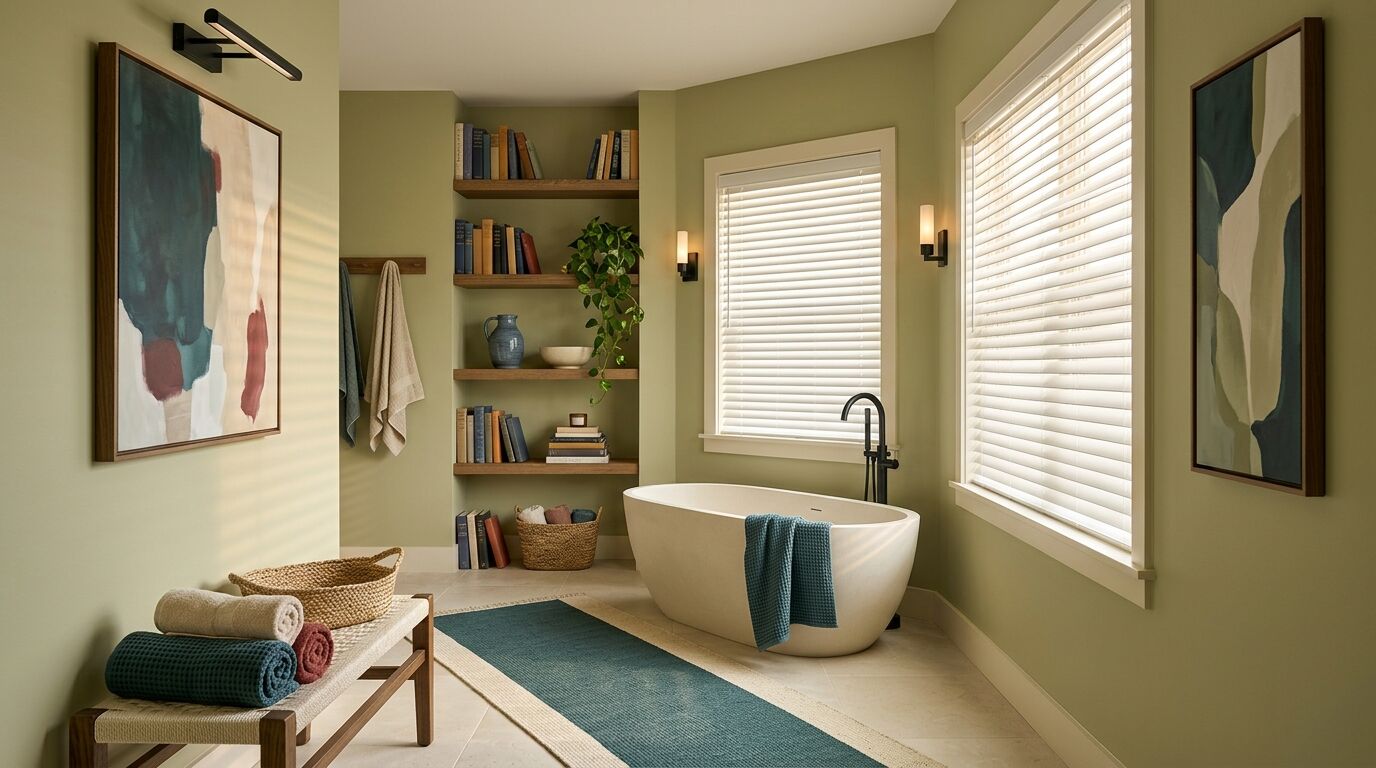
Most rooms in the house leave this choice open. A bathroom closes it. Steam twice a day, splashes off a tub deck and a window sitting a few feet from a shower head narrow the field fast, and the material you pick is most of the decision. Here is what actually separates faux wood from real wood, and where each one belongs in a North Texas house.
- Real wood blinds are milled from basswood. Faux wood is PVC, or a PVC and wood composite, moulded to look like a painted wood slat.
- Wood takes on moisture from the air. Once it does, slats swell across the grain, cup, and stop stacking flat.
- Faux wood does not absorb water, so a bathroom, a laundry room or a window over a kitchen sink is where it earns its place.
- Faux wood slats are denser than basswood, so the same blind weighs more. On a wide window that means a centre support bracket or splitting the opening into two blinds.
- Real wood is lighter, takes a stain, and comes in the widest slat sizes.
- Faux wood is the more budget-friendly of the two, and in a wet room it also happens to be the right one.
- Neither material likes standing water. Keep the bottom rail clear of a tub deck that puddles.
- A bathroom window has a second problem after moisture: privacy after dark, when the room is lit and the yard is not.
What The Two Materials Actually Are
Real wood blinds are almost always basswood. It is light for its stiffness, it mills cleanly, and it takes a stain evenly, which is why it became the default. A two inch basswood slat is a thin piece of timber with a finish on it, and it behaves like one.
Faux wood covers two different products, and the word gets used for both. One is extruded vinyl, a hollow or solid PVC slat. The other is a composite, wood flour mixed into PVC resin and moulded, which comes out denser and stiffer than plain vinyl and holds a painted finish better. Ask which one you are being quoted on. The difference shows up years later in how straight the slats still sit.
What Humidity Does To A Wood Slat
Wood takes on moisture from the air around it and gives it back when the air dries out. That movement happens across the grain rather than along it, so a slat that takes on water does not get longer. It gets slightly wider, and because the two faces do not absorb at the same rate, it cups.
Run that cycle every morning and every evening for a year and the failures are predictable. Slats stop stacking flat, so a closed blind shows uneven gaps of light instead of a clean line. The ladder cords bind against slats that no longer sit square. Finish slows all of this down. It does not stop it, because the routed cord holes and the cut ends of every slat are raw wood no matter how good the coating is.
A finish also does nothing about the other half of the problem, which is direct water. A splash off a shower door or a tub filler lands on a slat and sits there, and the spot it leaves does not come out.
Where Faux Wood Gives Something Up
Composite wins the moisture argument outright, so it is worth being straight about what you give up to get it.
- Weight. Slat for slat, PVC and composite are denser than basswood. The same blind is heavier in faux wood, which you feel every time you raise it and which the headrail feels for years.
- Width. That weight is why wide openings get a centre support bracket in the headrail, or get split into two blinds that operate separately. Both are normal. The one to avoid is a single wide faux wood blind with nothing supporting the middle, because that is where a bottom rail eventually starts to droop.
- Slat size. The widest slats, and the stained finishes, are generally a real wood option.
- The look. Grain on a faux wood slat is embossed and printed. In a bathroom, at the distance you actually stand from the window, almost nobody can tell. In a study with low afternoon sun raking across the slats, you can.
If those trade-offs matter more than the moisture does, you are probably not talking about a bathroom.
Which Rooms Get Which
The sorting is simple once you think in terms of what the air in the room does.
Faux wood: primary bathrooms, kids' bathrooms, powder rooms that share a wall with a shower, laundry rooms, mud rooms, and the window over the kitchen sink. Anywhere the air goes humid and comes back down again on a daily cycle.
Real wood: bedrooms, studies, formal dining rooms, a den, and any wide window where the extra weight would work against you. Real wood is also the answer when you are staining to match existing millwork, since a stained finish on real grain is something a moulded slat cannot copy.
Our full range of custom wood and faux wood blinds covers both, and on a whole-house order it is completely normal to run real wood through the dry rooms and composite in the wet ones. The slat width and the colour can be matched closely enough that the change does not read from the hallway.
The Rest Of What A Bathroom Window Has To Solve
Moisture gets all the attention. These are the things people call about afterwards.
Privacy after dark. A closed blind stops the view, but standard slats are routed with holes for the lift cords, and those holes read as small points of light from outside once the bathroom light is on. Routeless slats move the cord to the back edge and close that gap. On a window that faces a neighbour, ask for them.
Sightlines from the tub. A blind tilts, so you can hold privacy at eye level from the street and still see sky from inside the tub. Worth thinking about before you decide how high the window really needs to be covered.
Mount depth. Bathroom windows in new construction are often shallow, sometimes with a tiled return into the opening. An inside mount needs depth for the headrail, and if it is not there the blind goes outside the opening on the face of the wall instead. That is a measuring question, and it is one of several reasons windows over sinks and tubs get handled differently from the rest of the house.
Cords. In a kids' bathroom, cordless. No debate on this one.
Cleaning. Composite takes a damp cloth without any of the care a wood slat needs, which is most of the reason it lands in bathrooms in the first place. The cleaning routine for each material is short either way.
The Third Option Worth Pricing
Blinds are not the only moisture-tolerant answer for a bathroom window. A poly shutter is built from the same family of material, it holds its shape in a wet room, and it looks built in rather than hung on. It costs more than a composite blind and it is the option most people end up preferring once they see both on the window.
Whether that is worth it depends on the window and the room. A small frosted window above a toilet does not need a shutter. A tall window over a freestanding tub, sitting in the sightline of everyone who walks past the bathroom door, usually does. The trade-offs between the two shutter materials run along the same lines as the blinds do, and we walked through them in poly versus wood shutters.
How I Would Decide
If the window is in a room with a shower or a tub, buy the composite. The money you would spend on real wood there buys you a problem in about two years, and there is no finish and no maintenance routine that changes the physics.
Spend the difference somewhere it shows. A stained real wood blind in the study, or a poly shutter on the one bathroom window that everybody sees. Blinds and shades run two to three weeks from order to installation, so the wet rooms are the fast part of any whole-house project, and the exact timeline gets confirmed the day the order goes in.
Sheila measures every window herself and will tell you plainly which rooms need composite and which do not, including the ones where the cheaper material is the better answer.
See it in your own light.
Every room measures differently. Sheila comes to your home, looks at your actual windows and light, and helps you choose what fits. No showroom pressure, no obligation.
Book a free consultationProduct options, pricing and lead times vary by manufacturer and by window. Details here are general guidance — your in-home consultation is where we confirm what actually fits your home.