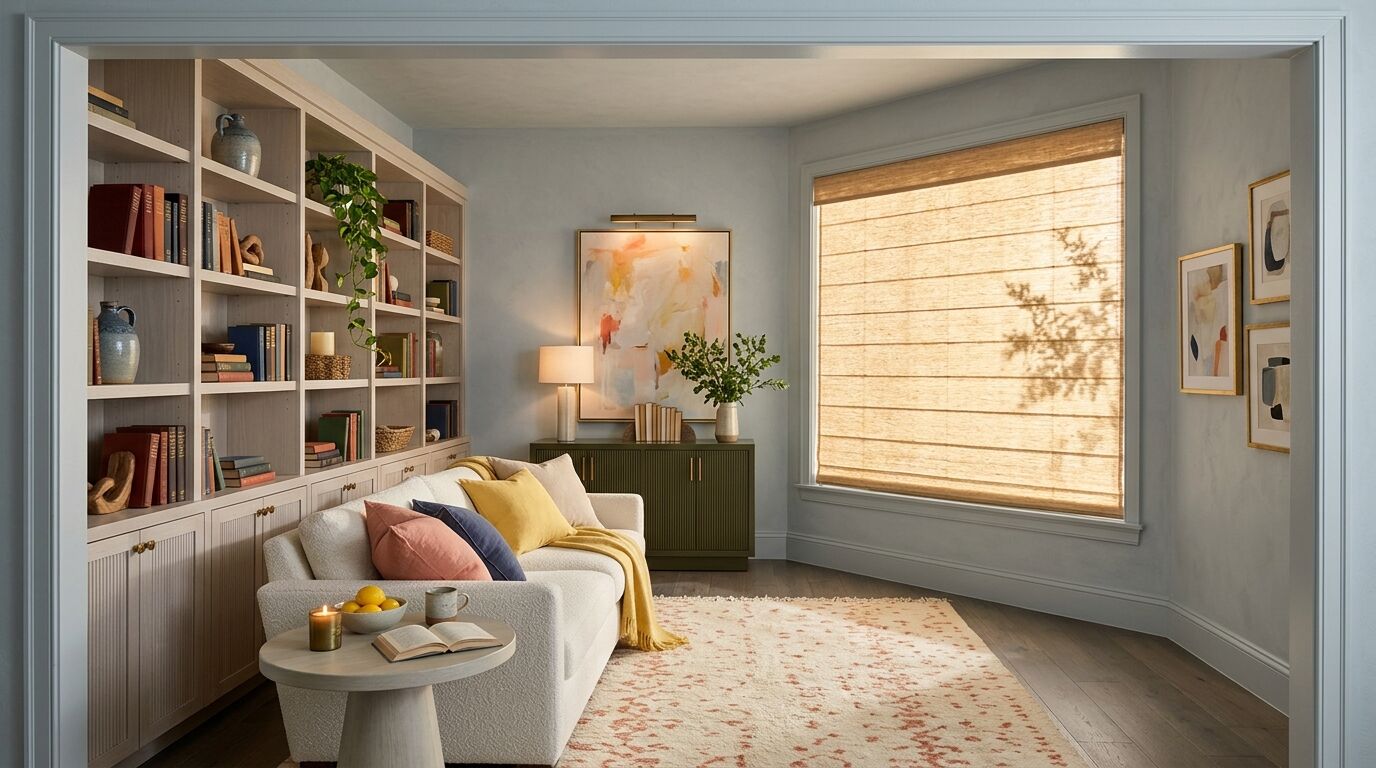
Woven wood is the one product people choose from a photograph before they know anything else about it. The texture does that. Bamboo, reed and grasses woven into a panel that reads warm and handmade against flat drywall. Then it hangs on a real window, the afternoon sun comes through the weave, and you find out what you actually bought.
- Woven wood is a natural fibre panel. No two are identical, and the sample you approve is representative rather than exact.
- Unlined, light passes straight through the gaps in the weave. The soft broken glow is the whole appeal.
- Daytime privacy comes from the brightness difference between outside and in. After dark with lamps on, an unlined woven wood shows shapes from the street.
- A privacy liner stops the see-through. A room darkening or blackout liner cuts most of the light through the panel itself.
- No liner fixes the edges. On an inside mount, light still comes down the sides and around the headrail.
- Raised, the panel gathers into a bundle with real depth at the top of the window. Decide where that sits before you order.
What Woven Wood Actually Is
The name covers a family of materials rather than one thing. Bamboo is the most common. Reed, jute, rattan, ramie and various grasses turn up too, usually mixed together and bound with a fine yarn. Some weaves work in thin wood strips for weight and structure.
Because the raw material grew in a field, it varies. Colour shifts between harvests. One panel can run a touch warmer than the next one off the same order. If you want four windows in a row to match to the eye, say so at the measure so they are ordered together. If you want dead uniform, a roller or a cellular is the honest answer, and both sit in the same custom shades range.
Most custom woven woods are built as a roman fold, so the panel gathers into soft horizontal folds as it rises. A few styles roll instead. Cordless lift is standard now and motorization is available, which matters on anything tall or behind furniture.
Why The Light Comes Through
Hold a woven wood sample up against a lamp. You can see daylight between the fibres. Those gaps are the weave doing what a weave does, and they are there in every natural woven product ever made.
That is why the unlined version glows. Sun hits the panel and the room fills with a soft broken light that shifts as the day moves. People pay for exactly this and they are right to.
Privacy works the way it does on a solar screen. During the day it is brighter outside than inside, so the lit face of the weave hides the room and nobody sees in with any useful detail. At night that reverses. Lamps on inside, dark outside, and an unlined woven wood will show movement and shapes from the sidewalk. This catches people out in a front room, and it is a question to settle before the order rather than after.
What A Liner Changes
A liner is a separate fabric hung behind the woven face. It folds with the shade and stays out of sight from inside the room. From the street it reads as plain neutral backing, which is also what most HOAs in the newer neighbourhoods want to see on a street-facing window.
There are three broad levels. A privacy liner blocks the see-through while still passing soft light, and it is what most people want in a main living room. A room darkening liner takes out most of the light. A blackout liner stops light through the fabric itself. The gap between those last two is real and worth understanding before you pick, and we went through it in room darkening versus blackout.
Lining costs you two things. The glow goes, which was the reason you wanted woven wood in the first place, so think hard before lining a room you love in the afternoon. And the liner adds bulk, so the folds sit fatter and the raised bundle grows.
The Edges Are The Part No Liner Reaches
A blackout liner on a woven wood gives you a dark room. It does not give you a darkroom.
An inside mount sits within the window opening with a small clearance gap at each side so the shade can travel without rubbing. Light comes down those two gaps whatever the liner is made of. Light also comes over the top around the headrail unless a valance closes it off.
If a room genuinely has to go dark, a nursery or a bedroom for somebody who sleeps during the day, there are two honest answers. Mount outside the opening with generous overlap at the sides and above, which kills most of the edge light. Or put drapery over the shade and let the panels close the perimeter, which is what layering drapery over shades does well.
Inside Mount Or Outside Mount
Inside mount is the usual call. The shade sits within the opening, the casing and sill stay visible, and the window keeps its architecture. In the newer homes around Frisco the trim is often worth showing, so burying it under a wide outside mount is a loss.
Outside mount earns its place in three situations. The opening is out of square and an inside mount would show a wedge of light at one side. The window is small and you want it to read larger. Or darkness matters more than trim. Mounted outside, order it wide enough to overlap the casing properly, because a couple of inches each side does more than people expect.
Mind The Stack
Woven wood is stiffer than a drapery fabric, so when the shade goes up the material gathers into a bundle with real depth. On a tall window that bundle can sit as a noticeable band across the top of the glass.
Two places this matters. Over a kitchen sink, where you want the window open and clear while you are standing at it. And on a window whose whole point is the view out. A valance hides the headrail and some of the bundle. On an outside mount you can also run the shade taller than the opening so the raised material parks above the glass rather than in it.
Woven Wood On Hot Texas Glass
Natural fibre in strong direct sun changes over the years. Colour softens and the material can grow more brittle. Every natural product does this, and it is worth knowing rather than being a reason to rule them out. What it should do is steer where they go in the house.
On a west wall that takes the full afternoon, plan for some change over time, or put the woven wood on the windows that get gentler light and let a solar screen carry the hot glass. On a north or east window, a woven wood holds its colour with very little change.
Choosing The Sample
Do not pick a woven wood on a kitchen counter under a ceiling light. Hold the sample flat against the actual window in the actual room and look at it with the sun behind it. A weave that looks tight and dark in your hand can read open and pale once daylight is pushing through it.
Ask to see it both ways on the same window, lined and unlined. That comparison decides the order more often than the colour does. Darker weaves cut more light and read richer against white trim. Pale weaves glow more and settle quietly into a light room.
Sheila brings the samples to the house and holds them on your own windows in your own light, which is the only place this decision can honestly be made. Shades typically run two to three weeks from order to installation, and the exact date is confirmed the day the order goes in.
See it in your own light.
Every room measures differently. Sheila comes to your home, looks at your actual windows and light, and helps you choose what fits. No showroom pressure, no obligation.
Book a free consultationProduct options, pricing and lead times vary by manufacturer and by window. Details here are general guidance — your in-home consultation is where we confirm what actually fits your home.