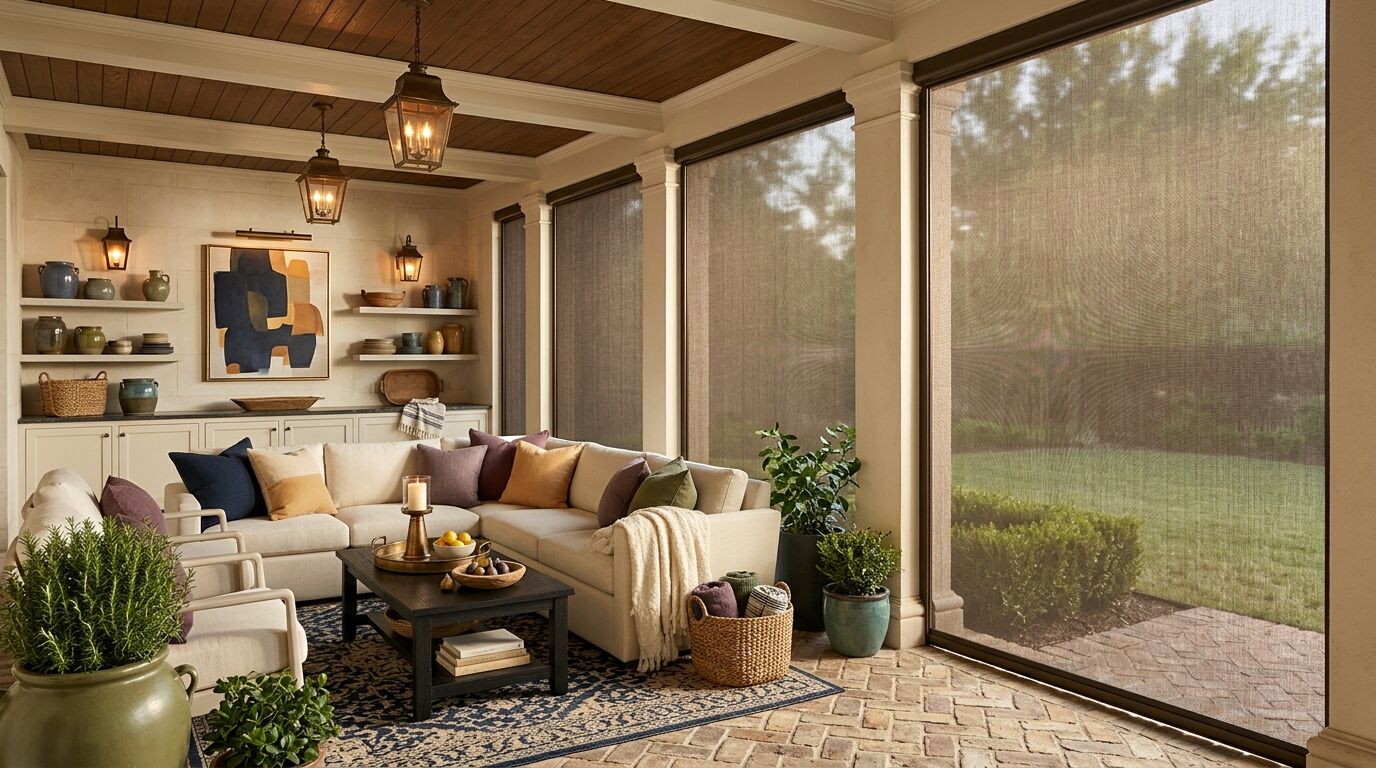
A covered patio in North Texas gets used for about four months of the year, and the roof is doing less of that work than people think. Shade handles noon in June. It does nothing about the March wind, nothing about the grit that settles into every cushion seam, nothing about the mosquitoes that arrive at dusk, and nothing about the low October sun that comes in sideways under the beams. Exterior screens close the open bays and hand you back most of spring and fall. What they will not hand you is a sunroom, and knowing exactly where that line falls is the difference between a patio you sit on in November and an expensive disappointment.
- Wind is the thing that actually ends an evening outside, and mesh screens are very good at it.
- National Weather Service records for DFW show March and April as the windiest months of the year, which is exactly when you want the patio.
- Screens cut the radiant heat and the glare. They do not lower the air temperature much, because air still moves through.
- In cold weather the logic flips: stop the wind and a patio heater finally does its job.
- A solar mesh is not an insect mesh. If bugs are the reason you are buying, the fabric has to be specified for bugs.
- Most bug and dust complaints trace to gaps at the bottom rail and the side channels, not to the weave.
- Screens only work under a solid roof with real depth. A slatted pergola is not a candidate.
- A screened patio is not conditioned space and does not count toward your home's finished square footage.
- Different bays can carry different fabric. The west face and the dining bays rarely want the same thing.
What Three-Season Actually Means
The phrase comes from the sunroom trade, where it has a fairly precise meaning. A three-season room is enclosed and finished, usable in spring, summer and fall, with little or no insulation and no connection to the house heating and cooling. A four-season room is a genuine addition: insulated walls, insulated glass, permitted as living space and tied into the home's system.
A screened covered patio sits below both of those, and that is the honest way to describe it. You keep the outdoor floor, the outdoor ceiling and the open air. What you gain is control over what blows through the bays.
That distinction matters at resale. Under ANSI Z765-2021, the measurement standard most appraisers now work to, a space only counts toward a home's finished living area if it is enclosed and heated to the same standard as the rest of the house. A screened patio does not meet that test, whatever it cost and however well it is finished. Anyone selling screens as added square footage is wrong about it.
Sold correctly, the pitch is simpler and truer. You already paid for this square footage when the house was built. Screens are what make you use it.
Wind and Dust Are the Easy Wins
Ask people why they stopped sitting outside in April and most of them say it was too hot. Push on it and the real answer is usually wind.
The National Weather Service's Fort Worth office keeps long-run wind records for DFW, and they show the mean wind speed peaking in March and April at about 12 miles an hour, the windiest stretch of the calendar. That lands precisely on the weeks the weather is otherwise perfect. Wind blows out the candles, lifts the napkins off the table, strips the warmth off your arms at seventy degrees, and carries the fine dust off a new-construction lot straight into the cushions.
A mesh screen breaks that up. The fabric does not seal the bay, so it does not stop air completely, and it is not meant to. What passes through is slower and spread out rather than gusting, which is the difference between a table you can set and one you cannot.
Whether it holds through a real gust comes down to the edges. A screen held in a proper side channel keeps contact down the full height of the bay under load. Cable-guided fabric can bow away from its edge and open a gap along the whole side, which is where the wind gets back in and takes the dust with it. That mechanism is worked through in the post on why track-guided screens hold up in Texas wind.
On dust and pollen, be realistic about what you are getting. The mesh catches a useful share of what blows in and it is not a filter. Fine dust still finds its way through the weave. The difference you will notice is on the horizontal surfaces: the table, the cushions and the floor stay clean for weeks rather than days, through a ragweed season that runs here from late August into November.
Bugs Come Down to the Fabric and the Edges
Mosquitoes are active in this part of Texas from spring through November, which covers almost the entire window a three-season patio is meant to buy back. So this is worth getting right at the order, not afterwards.
The mistake is assuming a screen is a screen. Solar mesh is woven to control heat and glare and is described by openness factor. Insect screening is woven to stop things getting through and is described by thread count. A dense solar fabric may well turn a mosquito away, but it was never designed or tested to, and the smaller biting insects go through it without slowing down. The full comparison is in the post on choosing outdoor shade fabric.
Then look at the edges, because that is where most patios actually fail. Insects find the wedge of daylight under a bottom rail that was cut straight while the paving slopes away for drainage. They find the corner where two bays meet. They find the side channel that bowed open in a breeze. Sealing those three places does more for a patio than moving to a tighter weave, and a tighter weave costs you airflow you will miss in August.
Heat Is Two Different Problems
People talk about a screened patio being cooler as though heat were one thing. It is two, and screens treat them very differently.
The first is radiant heat: direct sun landing on your skin, on the paving and on the furniture, plus the glare that makes you squint at the yard. A roof handles that at midday and gives up completely by late afternoon, when the sun drops below the beam line and comes in horizontally. This is the problem a solar mesh solves, and it solves it well. Drop the screens on the west face at five o'clock and the difference is immediate, both in how the space feels and in how much the paving and the cushions are storing up to release later.
The second is air temperature, and here you should set expectations low. Air moves through a mesh by design. On a 101 degree afternoon the patio will be close to 101 degrees behind the screens, minus whatever the shade and a good fan are worth. Screens make August tolerable in the evening. They do not make it cool.
In winter the logic runs the other way, and this is the part most people have not thought about. A patio heater warms people by radiation, the same way the sun does. Moving air strips that away as fast as the heater produces it. Stop the wind with a solid panel on the windward bay and the heater suddenly works, because the still air pocket under the roof holds the warmth long enough to feel. That is the single change that turns a patio from a three-season space into one you will use on a still January evening.
The Days You Are Actually Buying Back
Look at what the shoulder seasons here really offer before deciding what to spend.
The National Weather Service's 1991 to 2020 normals for DFW put the average October high at 78 degrees with a low of 57, and November at 67 and 46. March averages 69 and 48, April 76 and 55. Those are close to ideal numbers for eating outside, and they describe roughly four months of the year that most families across the North Dallas suburbs spend indoors anyway.
What spoils them is specific and short: the wind at six in the evening, the low sun straight down the length of the patio, the last of the mosquitoes in October, the first north wind in November. Every one of those is a screen problem with a screen answer.
The stretch you win is not summer. Summer is already covered by the roof and a fan. What you are buying is March through May at the front and late September through November at the back, plus the still evenings scattered through winter.
What a Screened Patio Is Not
Four honest limits, because the disappointments all come from one of them.
It is not insulated. On a 35 degree January morning the space will sit near outdoor temperature no matter what is hanging in the bays. Fabric stops air movement, and it has no meaningful insulating value.
It is not sealed. Air moves at the bottom rail, around the housings and at the column faces. On a patio that is a feature, because a fully sealed space with no air path traps moisture. If what you actually wanted was a sealed room, screens are the wrong product and you are looking at a permitted addition instead.
Clear vinyl panels, which people reach for wanting winter without losing the view, come with their own behaviour. They warm up fast in direct sun, they fog when warm damp air meets a cold panel, and they need an air gap somewhere or the condensation has nowhere to go. They also cloud and scratch over the years in a way mesh does not.
And it is not a fix for the wrong structure. Screens need a solid roof with enough depth to shelter the furniture, and columns or posts that can carry a track. A slatted pergola lets sun and rain straight through the top, so screening the sides changes very little.
Building It So It Works Both Ways
A patio that works in March and in November usually mixes its fabric rather than picking one.
A common plan puts a low-openness solar mesh on the west face where the afternoon sun lands, insect screening across the bays around the table where you eat at dusk, and one solid panel on the north or northwest bay that takes the winter wind. From the yard the run still reads as deliberate, because the housings, the tracks and the hardware match even where the fabric does not. Some bays can carry two fabrics in a double track, which is worth the extra on the one or two openings that genuinely have two jobs.
A few details decide how well it lives:
- The bottom rail wants to be cut to the actual fall of the paving, not to a level line, or you leave a gap down one side.
- Power needs a plan. Hardwired motors are cleaner on new work; battery motors suit a retrofit where there is no conduit in the columns.
- Controls should be easy enough that you use them. A wall switch by the door beats a remote that lives in a drawer, and many systems can be tied to a wind sensor that retracts them on its own.
- A fan matters more behind screens than in front of them, because you have slowed the natural breeze down on purpose.
What Gets Worked Out at Your House
Which bays to screen, and with what, is a decision that gets clear in about fifteen minutes standing on the actual patio. How deep the roof is. Which face takes the five o'clock sun. Where the wind comes from in March and where it comes from in January. Whether the paving falls away from the house and by how much. Whether you eat out there at dusk in June, which is the question that settles the insect answer.
Sheila comes out and works through it with you on the patio, with the fabric samples held up against your own yard in your own light. She measures the bays herself, the screens are built to those numbers, and the installation is handled by our installers. You can read more about how the systems are put together on the outdoor roller shades page, and book a free in-home consultation through the contact page or by calling or texting. There is no charge and no obligation, and if the honest answer for your patio is two bays rather than six, she will tell you that.
See it in your own light.
Every room measures differently. Sheila comes to your home, looks at your actual windows and light, and helps you choose what fits. No showroom pressure, no obligation.
Book a free consultationProduct options, pricing and lead times vary by manufacturer and by window. Details here are general guidance — your in-home consultation is where we confirm what actually fits your home.