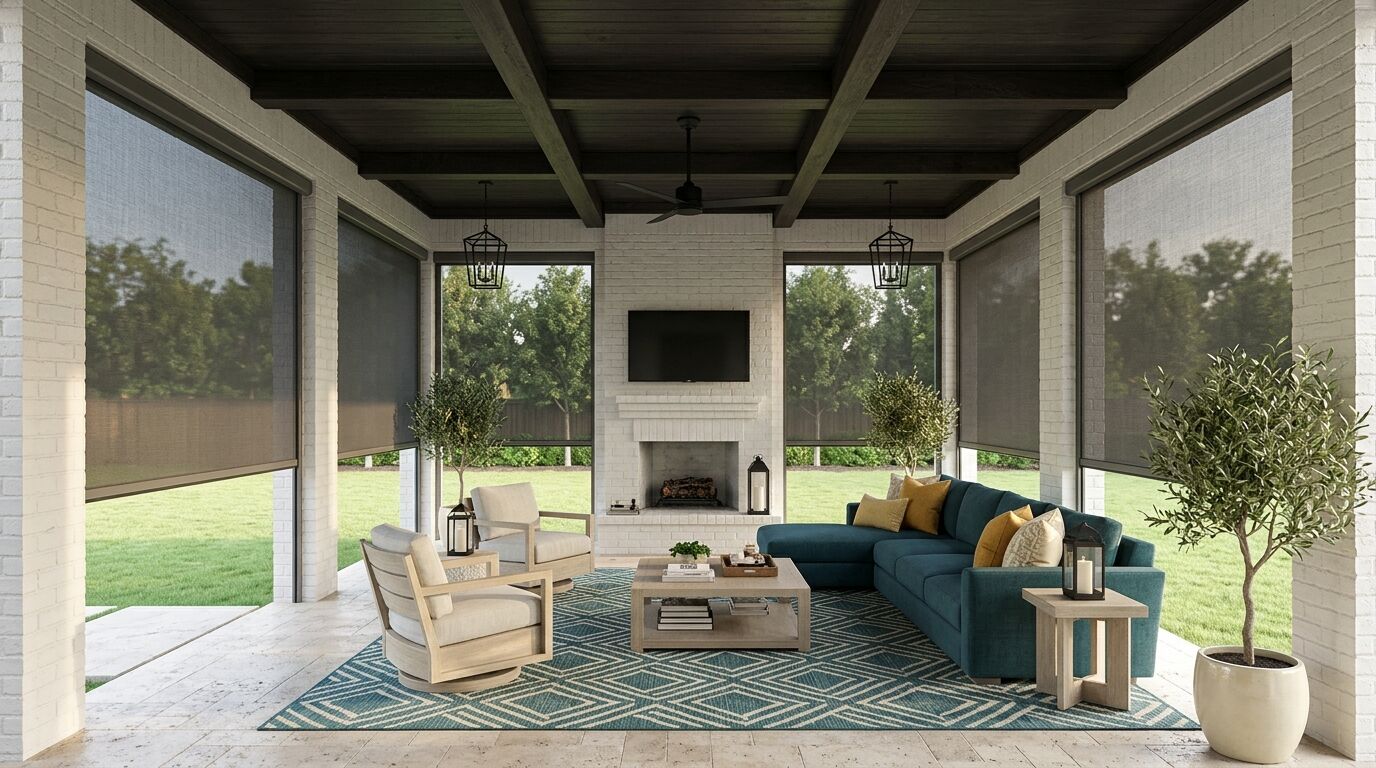
A patio screen is a fabric decision long before it is a motor decision. The housing, the track and the remote are close to the same on every bay of your patio. The fabric is what decides whether you can still see the yard at five in the afternoon, whether you get bitten at dusk, and whether the space feels open or shut. There are three broad choices, and picking well starts with being honest about which problem is actually ruining your patio.
- Open mesh cuts sun and glare, keeps the breeze and keeps the view. Solid fabric blocks wind and rain and closes the space in.
- Openness factor runs from about 1% to 14%. Lower blocks more sun and gives more daytime privacy, and you see less through it.
- Fabric colour changes the view as much as the openness number. Dark mesh reads clearer looking out. Light mesh bounces light back and looks hazier.
- A solar screen is not an insect screen. Sun mesh is woven for heat, and its openings can still pass mosquitoes.
- Insect screening is specified by thread count, commonly around 18 by 16 for mosquitoes and 20 by 20 or tighter for no-see-ums.
- Tighter weave means less air. A bug-tight patio in August feels stiller than an open one.
- Most bug complaints are gaps at the edges rather than the weave itself.
- No mesh gives privacy after dark with your lights on. Only solid opaque fabric does that.
- You do not have to choose one fabric for the whole patio. Different bays can carry different fabric.
Decide What Is Actually Ruining the Patio
People call about outdoor screens for three different reasons and often describe all three as "we can't use the patio."
The first is sun. The roof stops the sun at noon and does nothing at five, so the west side of the patio bakes and the glare is bad enough that nobody sits there. The second is bugs. The space is comfortable at dusk and that is exactly when the mosquitoes arrive. The third is weather, meaning wind, blowing rain and the dust that coats every cushion.
Those three problems want three different fabrics. A screen chosen for the first one will disappoint you at the second. Sorting out which one you are solving is the whole job, and it is the first thing worth working out before anyone talks fabric.
Open Mesh: The Default, and Usually the Right One
Open mesh is a woven fabric with real gaps through it, made from yarns coated to survive constant sun. It is what most people picture and what most patios end up with, because it fixes the sun problem without taking the outdoors away.
The number that describes it is the openness factor: the share of the fabric that is open weave rather than yarn. Patio mesh generally runs from about 1% to 14%. A 1% or 3% fabric is dense and dark to look through, blocks a lot of sun and reads nearly solid from the yard in daylight. A 10% or 14% fabric keeps a crisp view of the garden and lets a lot more light and heat past.
The trade sits in one sentence: every point of openness you gain in view, you give back in glare. On a west-facing bay taking the full afternoon, most people are happier at the low end and are surprised how much of the view survives. On a shaded north bay a more open fabric is usually plenty. How the mesh does that work is covered in the primer on how exterior screens actually work.
Colour Changes the View More Than the Number Does
Two screens at the same openness can look nothing alike, and the reason is the colour of the yarn.
Dark charcoal, bronze and black mesh absorbs the light that hits it. Very little bounces back toward you, so your eye reads through the weave instead of off it, and the view out stays clear while the glare drops. Almost everyone who compares two samples on their own patio picks the darker one for the view.
Light beige, sand and white mesh does the opposite. It reflects light back into the covered space, and that reflected light sits between you and the yard like a haze. The view is softer and the space feels brighter. Where light fabric earns its place is the look from the street or the back garden, since a pale screen reads gentler against a light-coloured house than a dark rectangle does.
If the view out matters most, go dark. If how the back of the house looks matters most, go light and accept a little more haze.
A Sun Screen Is Not a Bug Screen
This one catches people, and it is worth being blunt about. Solar mesh is engineered for heat and glare. Insect screening is engineered to stop things getting through. They are described by different measurements because they are doing different jobs.
Sun fabric is sold by openness percentage. Insect fabric is sold by thread count, the number of strands per inch in each direction. Standard insect screening around 18 by 16 keeps out mosquitoes and the usual flying insects. Tighter weaves, commonly 20 by 20 or finer, are made for no-see-ums, biting midges and small gnats, which pass straight through screening that handles mosquitoes without trouble.
A low-openness solar screen has small openings, and it may well stop a mosquito. It was never designed or tested to, and the smaller biting insects that show up around water and heavy planting will find their way in. If bugs are the reason you are buying, say so plainly at the consultation and get an insect-rated fabric on the bays where you sit and eat.
One honest cost comes with it. Tighter weave means less air moves through. A patio sealed against no-see-ums in August feels noticeably stiller than an open one, which is why fans matter more on a bug-screened porch than a sun-screened one.
Most Bug Problems Are Gaps, Not Weave
Before anyone sells you a tighter fabric, look at the edges. A screen that stops insects has to seal along every edge, and the fabric is rarely where it fails.
The places that let bugs in are the vertical sides where the fabric meets the track, the bottom rail where it lands on the paving, and the corners where two bays meet. A cable-guided screen can bow away from its edge under a breeze and open a gap along the whole side. A screen held in a proper side channel keeps contact down the full height, which is why track-retained systems do better on insects for the same reason they do better in wind. That mechanism is worked through in detail in the post on why track-guided screens hold up in Texas wind.
The floor matters too. Paving that slopes for drainage, and most covered patios do, leaves a wedge of daylight under a bottom rail cut straight. Insects find that gap long before they find the weave.
Solid and Clear Vinyl: Closing the Space In
Solid fabric is a different tool. There are no openings, so nothing comes through: no sun, no wind, no blowing rain, no dust. That is a real capability on the windward side of a patio in February, and it is why some outdoor rooms carry one solid panel among the mesh.
What you give up is everything mesh was giving you. The view goes. The airflow goes. Drop solid panels around a patio on a hot afternoon and you have made a small, warm, dark room out of a covered porch.
Clear vinyl is the middle option. It keeps daylight and the view while still stopping wind and rain, which makes it popular for winter dining. Be realistic about the rest of it. Clear vinyl warms up in direct sun the way a car does, it fogs when the air inside is warm and damp against a cold panel, and it needs a gap somewhere for air to move or the condensation has nowhere to go. It also scratches and clouds over the years in a way mesh does not.
In this climate, solid and clear panels are shoulder-season and winter tools. From May to September the fabric you want is mesh.
Privacy, Told Straight
Screens do give privacy, on a schedule.
During the day the light works for you. It is much brighter in the yard than under the patio roof, so a low-openness dark mesh reads close to solid from outside while you can see out through it perfectly well. That effect is real and it is one of the better reasons to choose a 3% fabric over a 10% one on a patio that faces a neighbour.
After dark it reverses. Turn on the patio lights and you become the bright side. The mesh that hid you at two in the afternoon shows your silhouette clearly at nine at night. Anyone who tells you a solar screen gives evening privacy is selling something.
If being unseen after dark is the point, the honest answer is a solid opaque panel on that side, with the view and the airflow traded away for it. Most people decide they would rather keep the view and pull the panel down only on the nights it matters.
You Can Mix Fabric Bay by Bay
A patio rarely has one exposure. The west bay is a sun problem, the bay behind the dining table is a bug problem, and the side that catches the north wind is a weather problem. Nothing says all of them get the same fabric.
A workable plan on a typical covered patio might put a 3% charcoal solar mesh on the west face, insect screening across the bays around the table, and one solid panel on the windward side for winter. From outside the run still looks deliberate, because the housings, the tracks and the hardware match even where the fabric does not.
Some systems will also carry two fabrics on the same bay in a double track, so the same opening can run mesh in July and a solid panel in January. It costs more per bay and it is worth it on the one or two bays that genuinely have two jobs.
What Gets Worked Out at Your House
Fabric choice is one of those decisions that looks simple on a website and gets clear in about ten minutes standing on the actual patio. Which bay takes the afternoon sun. How far the roof already shades it. Whether the neighbour's second storey looks down on you. Whether the paving falls away from the house. Whether you eat out there at dusk in June, which is the question that decides the bug answer.
Sheila brings the fabric samples to the patio and you look through them toward your own yard, in your own light, which is the only test that settles the openness question. She measures the bays herself and the screens are built to those numbers, then professionally installed. You can read more about the systems on the outdoor roller shades page, and book a free in-home consultation through the contact page or by calling or texting. There is no charge and no obligation, and if the honest answer for your patio is one screen on one bay, she will tell you that.
See it in your own light.
Every room measures differently. Sheila comes to your home, looks at your actual windows and light, and helps you choose what fits. No showroom pressure, no obligation.
Book a free consultationProduct options, pricing and lead times vary by manufacturer and by window. Details here are general guidance — your in-home consultation is where we confirm what actually fits your home.