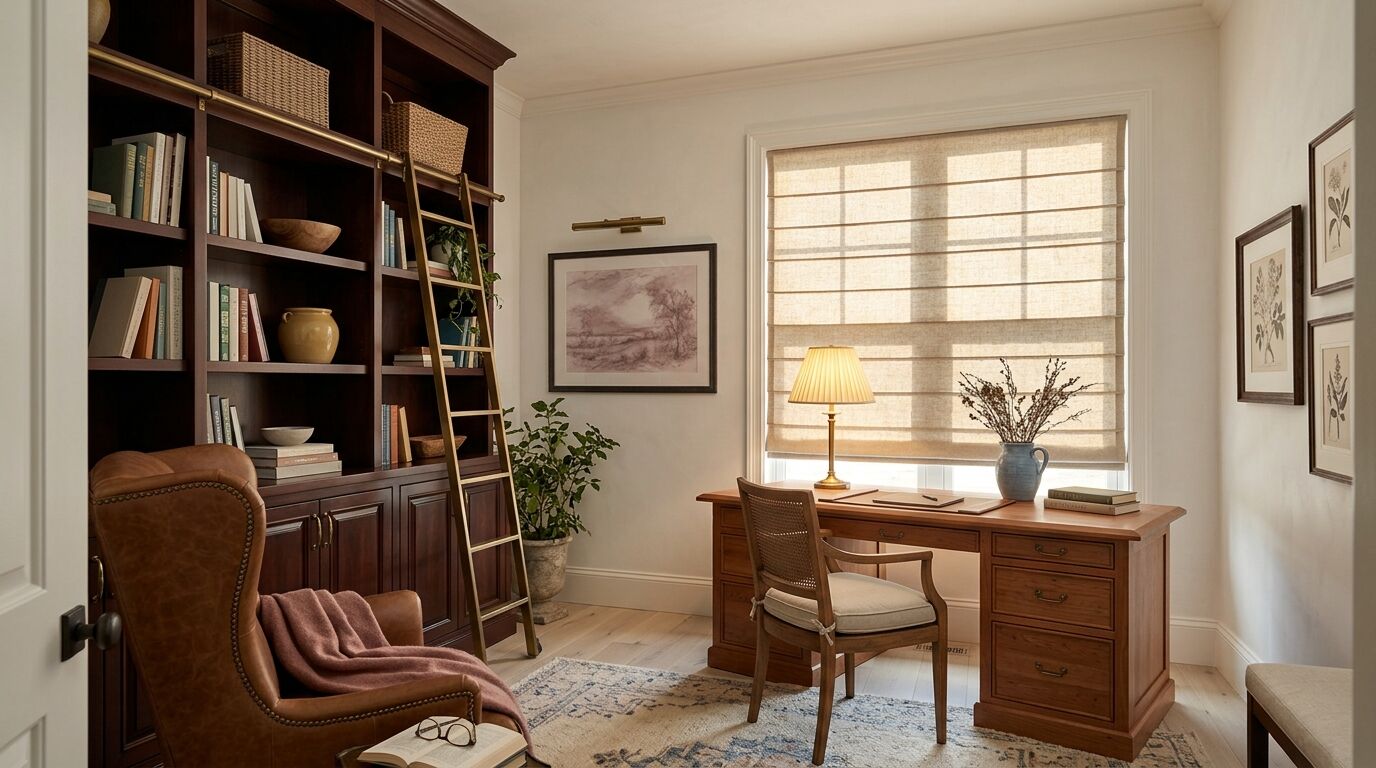
Roman shades all look like the same product in a catalog photo. Hang three of them in a room and you'll see three different personalities. The difference is the fold: how the fabric stacks when it's raised, and what it does when it's lowered. Flat, hobbled and relaxed are the three you'll be choosing between, and the right one depends on the fabric, the room and how tailored you want the window to look.
- A flat Roman shade hangs as one smooth panel when lowered and folds into neat pleats only as it rises.
- A hobbled Roman shade keeps soft, overlapping folds showing even when it's fully down, which uses more fabric and reads as more formal.
- A relaxed Roman shade has no crisp pleats. The hem sweeps in a gentle curve, and it suits lighter, more casual fabrics.
- Patterned fabric usually looks best flat. Solid or lightly textured fabric shows off hobbled folds.
- Every Roman shade stacks at the top when raised, so decide early whether that stack should cover glass or clear it.
- Roman shades soften light but leak it at the edges. A room that needs to go dark needs a plan for that.
What Makes a Roman Shade a Roman Shade
A Roman shade is a single piece of fabric that folds upward in horizontal pleats as you raise it. Unlike a roller shade, which winds onto a tube, a Roman shade stacks on itself. That's why the fabric is so visible. It's the whole point of the product.
Behind the fabric there are rings and cords, or a cordless lift mechanism, that pull the pleats up evenly. The fold style is decided by how the fabric is built and where those pull points sit. It's a sewing decision as much as a hardware one, and it's made when the shade is ordered, which is why it's worth choosing on purpose instead of by default.
Flat Roman Shades: The Clean Panel
A flat Roman shade, sometimes called a flat fold, lies smooth when it's lowered. There are no folds on the face of the fabric. Raise it and the pleats form neatly at the top.
That smooth face is what makes flat the best choice for fabric with a pattern. A stripe, a check or a large print stays uninterrupted from top to bottom instead of getting chopped up by folds. It's also the fold that stacks the slimmest when the shade is raised, so it's a good fit on a window where you want the glass to stay as clear as possible.
Flat suits clean-lined, transitional and modern rooms, kitchen windows, home offices and the glass beside a French door. If you like the look of a tailored roller shade but want the warmth of real fabric, flat is where to start.
Hobbled Roman Shades: The Tailored Waterfall
A hobbled Roman shade, also called a looped or classic fold, keeps its folds on view. Each pleat overlaps the one below it, so even fully lowered the shade has a soft cascade of fabric down the window.
Because the folds are built into the shade, it takes more fabric than a flat one, and it stacks thicker when raised. In return you get depth and shadow across the face of the fabric, and the shade reads like an upholstered piece more than a covering. Solid colors and subtle textures do the most with it. A busy print tends to get lost in the folds.
This is the fold for a formal dining room, a primary bedroom or a sitting room where the window is a feature. It also pairs well with drapery, and our post on layering drapery over shades covers how to keep that combination from feeling heavy.
Relaxed Roman Shades: The Soft Curve
A relaxed Roman shade drops the crisp pleats altogether. The fabric hangs in a gentle curve and the hem sweeps softly at the bottom. It looks like a piece of linen someone hung by hand, and that's the appeal.
Light, natural fabrics look best here. Linen and cotton blends drape the way the style intends. It suits casual rooms, a farmhouse kitchen, a reading nook, a guest room, a bathroom with a relaxed feel. The trade-off is that the soft shape is less precise. The fold won't sit as evenly as a flat shade, and you're choosing that irregularity on purpose. Ask Sheila how a given fabric will behave on this fold before you commit, since the same fabric can hang quite differently in hobbled and relaxed.
Fabric, Lining and Light Control
The fold and the fabric work together, so pick them together. A heavy, structured fabric holds a hobbled fold well. A light, loose weave belongs on a relaxed one. A patterned fabric wants a flat panel.
Lining is the second decision. An unlined shade glows with daylight, which many rooms want. A light-filtering lining softens glare and helps protect floors and furniture from Texas sun, which fades things faster than most people expect. A blackout lining blocks light through the fabric, but a Roman shade still lets light leak in around the edges unless it's built with a way to seal them. That gap is a large part of why room-darkening and true blackout aren't the same thing, and our post on room-darkening versus blackout shades explains it plainly. If a bedroom or media room needs to go dark, say so at the consultation so the shade is planned for it.
The Stack: What Happens When It's Raised
Every Roman shade has a stack, the bundle of folded fabric that gathers at the top when the shade is raised. A flat fold stacks thinnest. A hobbled fold stacks thickest. On an inside mount, that stack covers some of the glass even when the shade is fully up.
On a large window with a view, that matters. You can mount the shade higher on the wall so the stack clears the glass, or you can accept the stack as part of the look. Neither choice is wrong. It's just easier to make it on paper than after the shade is hanging. This is one of the things measured on site, and it's another reason we don't ask you to measure for yourself.
Cords, Safety and Lift Options
Roman shades have traditionally used cords to lift the fabric, and cords are a documented hazard for young children. The federal government has a federal cord safety standard for custom window coverings, and cordless lifts are now common. If there are kids or pets in the house, ask for cordless or motorized, which remove the dangling cord entirely. It's a practical choice more than a lecture, and it's available on most fold styles.
How to Choose for Your Room
Start with the room, then the fabric, then the fold.
Pick flat when the fabric has a pattern, the room is modern or transitional, or you want the slimmest stack.
Pick hobbled when the window is a feature, the fabric is a solid or a subtle texture, and the room is formal or traditional.
Pick relaxed when the fabric is a light natural weave and the room is casual.
If you're covering several windows you can see from one spot, use one fold across all of them. Mixing folds in a single sightline looks like a mistake, even when each shade is lovely by itself.
Roman shades typically run 2 to 3 weeks from order to installation. That's a normal range rather than a promise, and the exact date is confirmed the day the order goes in.
Seeing the Fold on Your Own Window
A fold looks different on a small fabric swatch than on a five-foot window in your own light. Sheila brings fabric samples to your home, holds them against the actual glass, and shows you how each fold will fall before anything is ordered. Custom shades are made to your window and can't be returned, so seeing it first matters. You can browse the options on our custom shades page, and when you're ready, book a free in-home consultation.
See it in your own light.
Every room measures differently. Sheila comes to your home, looks at your actual windows and light, and helps you choose what fits. No showroom pressure, no obligation.
Book a free consultationProduct options, pricing and lead times vary by manufacturer and by window. Details here are general guidance — your in-home consultation is where we confirm what actually fits your home.