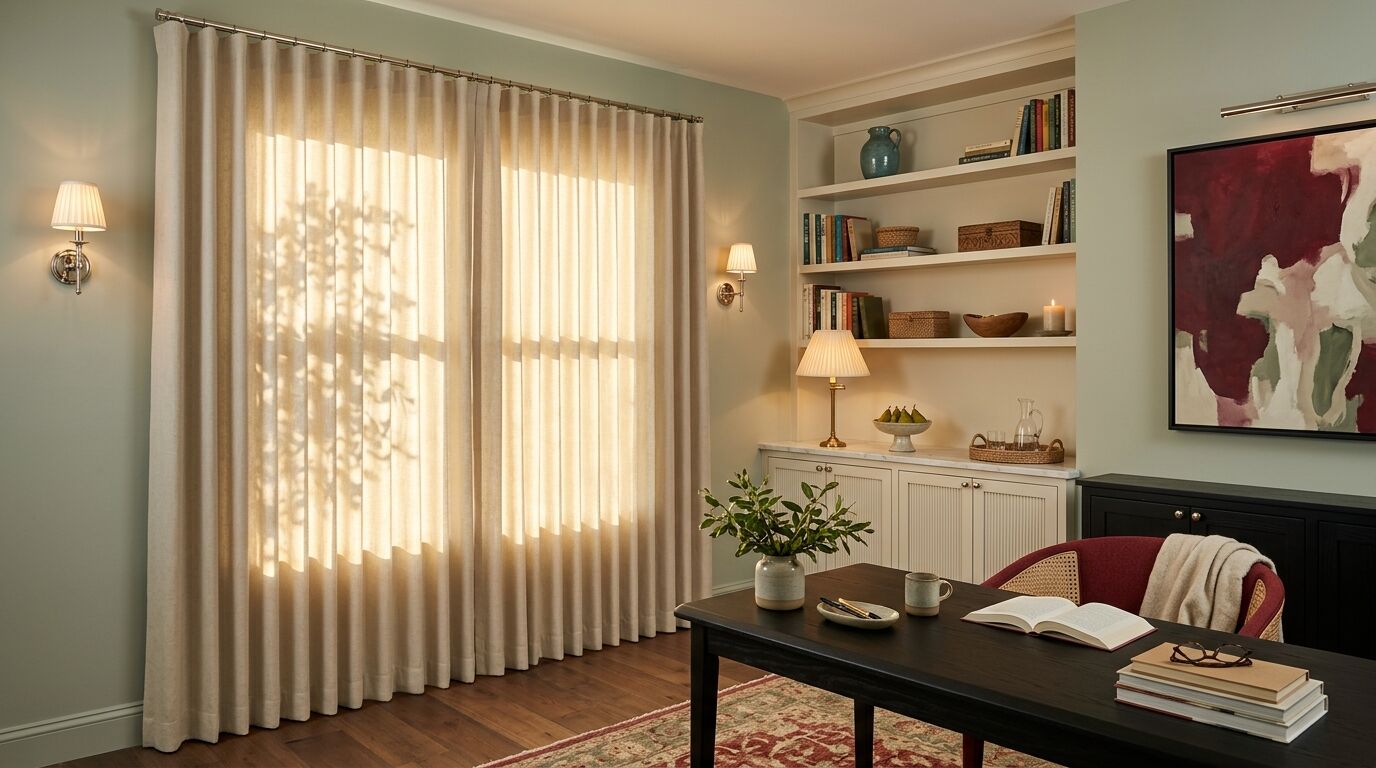
Most people choose the fabric first and settle the top of the panel in the last five minutes of the appointment. The top is the part that decides how the folds break, what hardware you are buying, how the panel behaves when somebody pulls it, and how much of your window disappears when the drapery is open. Two headings cover most of what we sell. Here is how they actually differ.
- The heading is the top few inches of a drapery panel plus the hardware it hangs on. It sets the fold shape, the hardware and the stack.
- Pinch pleat is sewn. The workroom gathers fabric into folds and tacks them a few inches below the top edge, then the panel hangs on rings or pins.
- Ripplefold has no sewn pleat. A snap tape along the top clips to carriers on a track, and the carrier spacing forces the fabric into a continuous S curve.
- Ripplefold needs its own track. It will not hang on a decorative rod, so the rod stops being part of the room.
- Ripplefold fullness gets ordered as a number, commonly 60, 80, 100 or 120 percent. More fullness means tighter waves and a wider stack.
- Stack back is the part nobody plans for. Run the track or rod well past the glass so the open panels sit on wall.
- Ripplefold traverses smoothly and suits motorization. Pinch pleat looks better standing still on a rod you want people to see.
- Heavy interlined fabric fights the S curve. Medium weight cloth ripples best.
What a Heading Actually Is
The heading is the top three or four inches of the panel and the hardware it hangs from. Small piece of the panel. It controls almost everything you notice: how deep the folds are, whether they stay even after ten years of handling, how the panel moves when you pull it, and how much wall it needs when it is open.
Fabric gets all the attention at a consultation because fabric is the part you can hold. The heading is the part you look at every day from across the room.
Pinch Pleat: Sewn Into the Panel
A pinch pleat is built by the workroom. They gather a measured amount of fabric into two or three folds, pinch those folds together and tack them about four inches down from the top edge. Above the tack the fabric fans open. Below it the folds fall into the body of the panel and carry down toward the hem.
Because the shape is sewn in, the panel keeps it wherever you hang it. Rings on a decorative rod, or pins into a traverse rod. That matters more than it sounds. If you want an aged bronze rod with a real finial to be part of the room, pinch pleat is how you get there.
The look reads traditional, and there is a reason it has been the default for a century. A well made pinch pleat has depth and shadow at the top that a flat heading never gets.
The Pinch Pleat Family
Pinch pleat is a category, not one thing. The version changes the whole feeling of the panel.
- Three finger, also called French pleat. Three folds per pleat, tacked low. The classic. Full, formal, lots of shadow.
- Two finger. Two folds instead of three. Leaner and flatter at the top, a little less fabric in each pleat, and it suits a simpler room.
- Euro pleat, also called top tack. Same gathering, but tacked right at the top edge so nothing fans above the rod. The folds start immediately below the ring and run straight down. This is the one people ask for most often right now in transitional rooms.
- Goblet. The pleat is opened at the top and padded so it stands up like a cup. Formal and architectural. It wants a tall window and a fabric with enough body to hold the shape.
If a client likes the idea of drapery but not the fussiness of a traditional fan, Euro pleat usually solves it in one step.
Ripplefold: Shaped by the Track
Ripplefold has no sewn pleat anywhere in it. A tape with snaps runs along the top of the panel. Those snaps clip onto carriers that ride in a track, and the carriers are linked to each other by a cord at a fixed spacing.
That spacing is the whole trick. Once the panel is clipped on and pulled across, the fabric has nowhere to go except into a continuous S, forward and back, the same depth the entire way along. No pleat holds it. The geometry of the track does.
The result is very even, and it stays even. A sewn pleat can go soft and uneven after years of somebody dragging the lead edge shut in a hurry. A ripplefold panel re-forms itself every time it closes, because the carriers have not moved.
The trade is the hardware. Ripplefold is a track system: ceiling mounted, recessed into a pocket in the ceiling, or wall mounted on brackets. It can be painted out so it disappears. What it cannot do is hang from a decorative rod with rings. If the rod was going to be a design element, ripplefold takes that option off the table.
Fullness, and the Number You Get Asked For
Fullness is how much more fabric sits in the panel than the width it has to cover. On a pinch pleat the workroom builds it into the sewing, and a properly full panel is typically somewhere around two to two and a half times the rod width.
On ripplefold it is set by the carrier spacing instead, and it gets ordered as a percentage. Sixty, eighty, one hundred and one hundred twenty are the usual steps. Closer carriers mean more waves, each one narrower and tighter. Wider carriers mean fewer waves, each one broader and lazier.
Most of what we install lands at eighty or one hundred. Sixty gives a relaxed flat wave that looks right on a wide sheer across a slider. One hundred twenty is dense and formal, and it takes up the most wall when the panels open.
Stack Back, Which Ruins More Windows Than Fabric Does
Stack back is the width a panel occupies when it is pushed fully open. It is the most common drapery regret I hear, because people plan the closed look carefully and never picture the open one. Then they lose a foot of glass on each side of the window they paid extra for.
A rough planning number workrooms use for a pair is about a third of the rod width, split between the two sides. Treat that as an estimate, not a spec. Heavier cloth stacks wider. More fullness stacks wider. An interlined panel stacks much wider than the same fabric unlined, which is one more reason what goes behind the face fabric belongs in this conversation and not a separate one.
At matching fullness, ripplefold usually stacks a little wider than pinch pleat, because the carriers themselves take up room as they collect at the end of the track.
The fix is the same for both. Run the track or rod well past the window on each side so the open panel parks over wall instead of over glass. On a wide slider that can mean a foot or more of extra track per side. Done on purpose it looks generous, and it gives you the entire view back.
Which One Suits Which Room
Ripplefold earns its keep where drapery actually moves. A wide slider that gets opened every evening. A long run of glass across a great room. A primary bedroom where the panels close every night and open every morning. It also works well in a room with a lower ceiling or a busy wall, because the track vanishes and your eye goes straight to the fabric.
Pinch pleat is the better answer when the panels are mostly decorative, when the rod is meant to be seen, and in a formal dining room or a two story entry where that traditional fan at the top is part of the point. It is also more forgiving on an awkward window, since it does not need a long straight continuous track run.
Neither one is the upgrade. They solve the top of the panel two different ways, and the room decides.
Fabric Changes the Answer
A continuous S curve needs cloth that will take a curve. Medium weight linen blends, poly sheers and soft drapery weight velvets ripple beautifully. A heavy interlined silk fights it, and you get flat spots where the fabric simply refuses to bend where the carrier wants it to.
So if you have your heart set on a substantial interlined panel with real body and weight, pinch pleat handles that fabric better. Go the other way and a light sheer on a pinch pleat can look thin at the top, where ripplefold would have given it a shape.
The same logic applies when drapery is going over something. Panels layered at the sides of a window that already has a shade behind them are usually stationary, and stationary panels are pinch pleat territory. We went through that combination in more detail in the post on layering drapery over shades.
Motorization
Ripplefold and motors get along. The track is already a track, so a motor drives a master carrier along it and the panel opens the same distance at the same speed every time. It is the tidiest motorized drapery available, and on a tall west facing wall of glass it is the version I recommend without much hesitation.
Pinch pleat motorizes too, on a motorized traverse rod, and it works fine. The hardware is bulkier, and the pleats at the lead edge see more handling over the years. If motorized drapery is the plan from the start, it is worth reading how the same decisions play out across motorized shades and drapery before the order goes in.
How We Settle It
Three questions take care of it most days. Does this panel actually close, or is it decoration beside a shade? Is the rod meant to be seen? And how much wall is there on each side to park the stack?
Then Sheila measures. Not just the window: the wall on each side, the ceiling height, and where the track or rod can physically go. Those numbers decide whether the panels you want will look right, and no fabric swatch can tell you that. If you are weighing headings for a room right now, a free in-home consultation is the fastest way to see both options against your own light, and you can start with our custom drapery and panels page.
See it in your own light.
Every room measures differently. Sheila comes to your home, looks at your actual windows and light, and helps you choose what fits. No showroom pressure, no obligation.
Book a free consultationProduct options, pricing and lead times vary by manufacturer and by window. Details here are general guidance — your in-home consultation is where we confirm what actually fits your home.