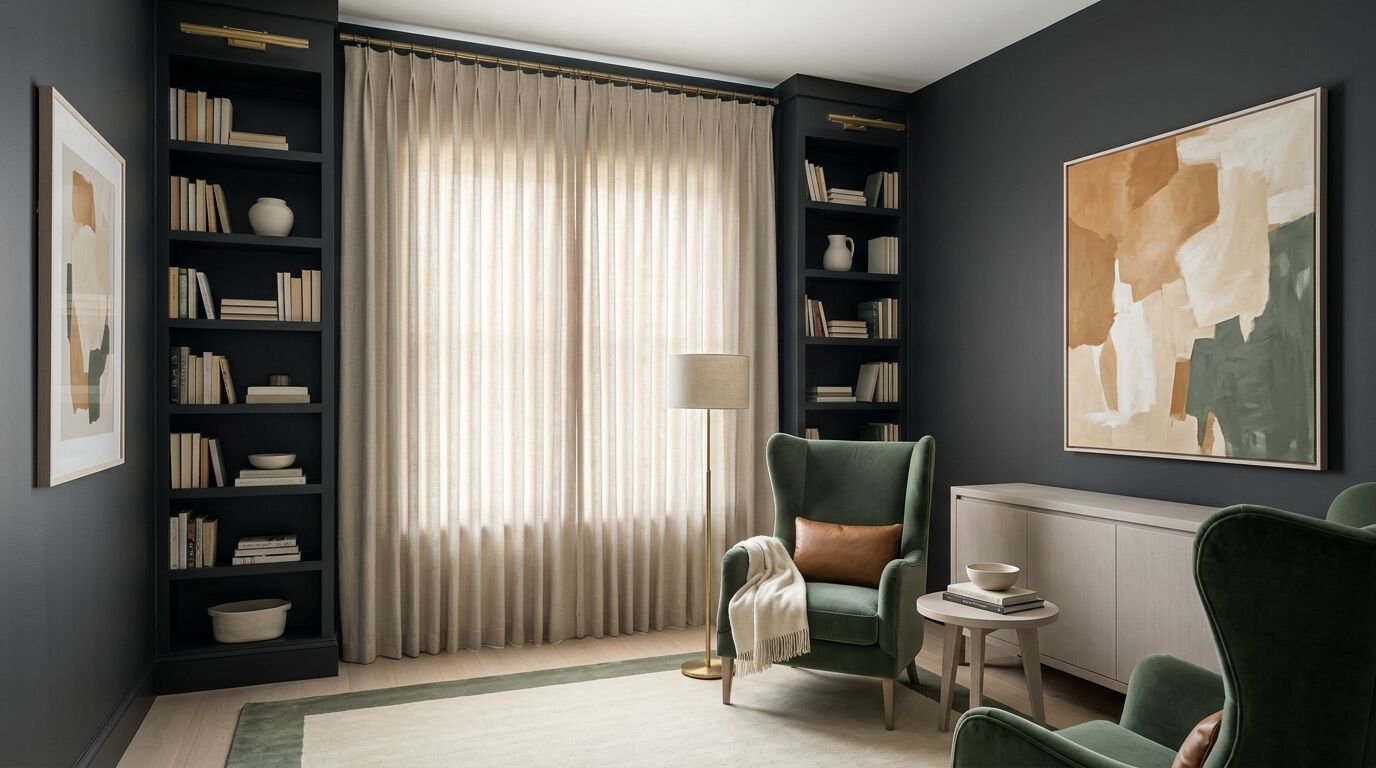
Nobody walks into a consultation asking about lining. They bring a photo of a room they like, we talk about fabric, and lining gets decided in about forty seconds near the end. Then it turns out to be the part that determines how the panel folds, how dark the bedroom goes, what the street sees at night and whether the fabric still looks right in three summers. Here is what each one does.
- Lining gives a panel the weight it needs to fold. An unlined panel hangs flat and limp no matter how good the face fabric is.
- Standard cotton lining is the default for most rooms. It blurs the view in, adds body, and takes the sun off the face fabric.
- Room-darkening lining, often sold as dim out, is a dense woven cloth with no coating. It cuts most of the light and still folds softly.
- Blackout lining is a coated cloth with an opaque core. It stops light through the fabric completely and hangs stiffer because of it.
- Interlining is a soft brushed layer sandwiched between face fabric and lining. It is what makes a panel look expensive.
- No lining makes a room dark on its own. Light comes over the rod, down the sides and under the hem.
- On a west window, lining is sun protection for the face fabric first and light control second.
- Keep the lining colour the same on every street-facing window in the house.
What Lining Is Actually For
Three jobs, and they pull in different directions. Lining adds weight so the panel folds into deep even columns instead of hanging like a bedsheet. It blocks or filters light. And it sits between the sun and your face fabric, which is the job people forget until a linen panel on a west window has gone two shades paler down one edge.
In North Texas that third job is the one I care about most. Afternoon sun through unprotected glass is hard on textiles, which is the same reason it is hard on floors, rugs and upholstery. A lining takes that hit so the fabric you actually chose does not.
Unlined
An unlined panel is one layer of cloth. Light comes through it, the weave glows, and the colour of the fabric reads differently in the morning than it does at four in the afternoon. On a sheer or a loose linen that effect is the whole point.
What you give up is body. Unlined panels fold shallowly and they move in the air conditioning. They also fade faster and they show the window behind them as a bright rectangle once the sun is on that side of the house.
Unlined works on a sheer, on a north window that never takes direct sun, and on a window where a shade behind the panels is already doing the real work. Everywhere else it reads as unfinished.
Standard Lining
A plain woven cotton or poly-cotton backing, usually white or ivory. This is what most of our panels get, and for most rooms it is the right answer without much debate.
It gives the panel enough weight to fold properly, softens the light instead of stopping it, blurs the view in during the day, and protects the face fabric. A room with standard-lined panels closed at midday goes soft and shaded rather than dark.
Room-Darkening Lining
Sometimes sold as dim out. It is a dense woven cloth, often a three-pass weave, with no coating on it. It stops a lot of light without going opaque, and because it is woven rather than coated it still breaks into a soft rounded fold.
This is the one I reach for in a primary bedroom where somebody wants the room properly dim but also wants the drapery to look like drapery. It is the honest middle. If you want the full comparison of what darkening and blacking out really mean, we went through it on room-darkening against blackout shades, and the same logic applies to fabric panels.
Blackout Lining
Blackout lining is a base cloth coated in layers of acrylic foam around an opaque core. Two pass and three pass describe how many coats went on. Through the cloth itself, no light gets by.
The trade is in the hand. Coated lining is stiffer and heavier than woven, so the folds are flatter and a little more architectural. On a full pinch-pleat panel that reads fine. On a soft casual heading it can look boardy.
Blackout belongs in a nursery, a media room and a bedroom where somebody sleeps during the day. It is worth saying plainly that blackout lining does not blackout a room by itself, which is the next section.
Interlining
Interlining is a separate soft brushed layer, a flannel in effect, sewn in between the face fabric and the lining. You never see it. You see everything it does.
Interlined panels have rounded edges instead of creased ones, deeper folds, and enough mass that they hang dead still. They also take some heat off the glass and quiet the room a little. This is the construction behind the drapery in the rooms people photograph.
It costs more and it is worth it where the drapery is the feature. On stationary side panels flanking a shade it is money better spent elsewhere, which is one of the choices we talk through when layering drapery over a shade.
Lining Does Not Make a Room Dark by Itself
This is the single most common disappointment with drapery, and it has nothing to do with the lining you picked. Blackout lining stops light through the cloth. The light then goes around it: over the top of the rod, down the two side edges, through the gap where the panels meet, and under the hem.
Getting a room genuinely dark takes the hardware. Mount the rod high and extend it well past the opening on both sides. Return the panels to the wall so the outer edges are closed off. Overlap the leading edges in the middle. Run the hem to the floor. Even then, most people who want a properly dark room end up with a shade behind the panels doing the light control while the drapery does the look.
Which Colour the Lining Should Be
White or ivory, nearly always, and the same one on every window the street can see. That uniform backing is what gives a house one consistent look from outside, and it is what most HOA language around here is after.
The choice between white and ivory usually comes down to your trim and to any shutters already in the front rooms. If the front of the house has white plantation shutters, the drapery lining upstairs should not read cream against them.
How We Decide It
At the consultation we look at which way the window faces, what the room is used for, whether anything else is already on that window, and how the panel is meant to hang. Those four answers pick the lining, and they pick it before we talk about cost.
Drapery is made to order and the timeline varies more than blinds or shutters do, because workroom schedules and fabric availability both move. We confirm the real date the day the order is placed. If you want more on how we quote and build, the common questions page covers the process, and custom drapery covers what we make.
See it in your own light.
Every room measures differently. Sheila comes to your home, looks at your actual windows and light, and helps you choose what fits. No showroom pressure, no obligation.
Book a free consultationProduct options, pricing and lead times vary by manufacturer and by window. Details here are general guidance — your in-home consultation is where we confirm what actually fits your home.