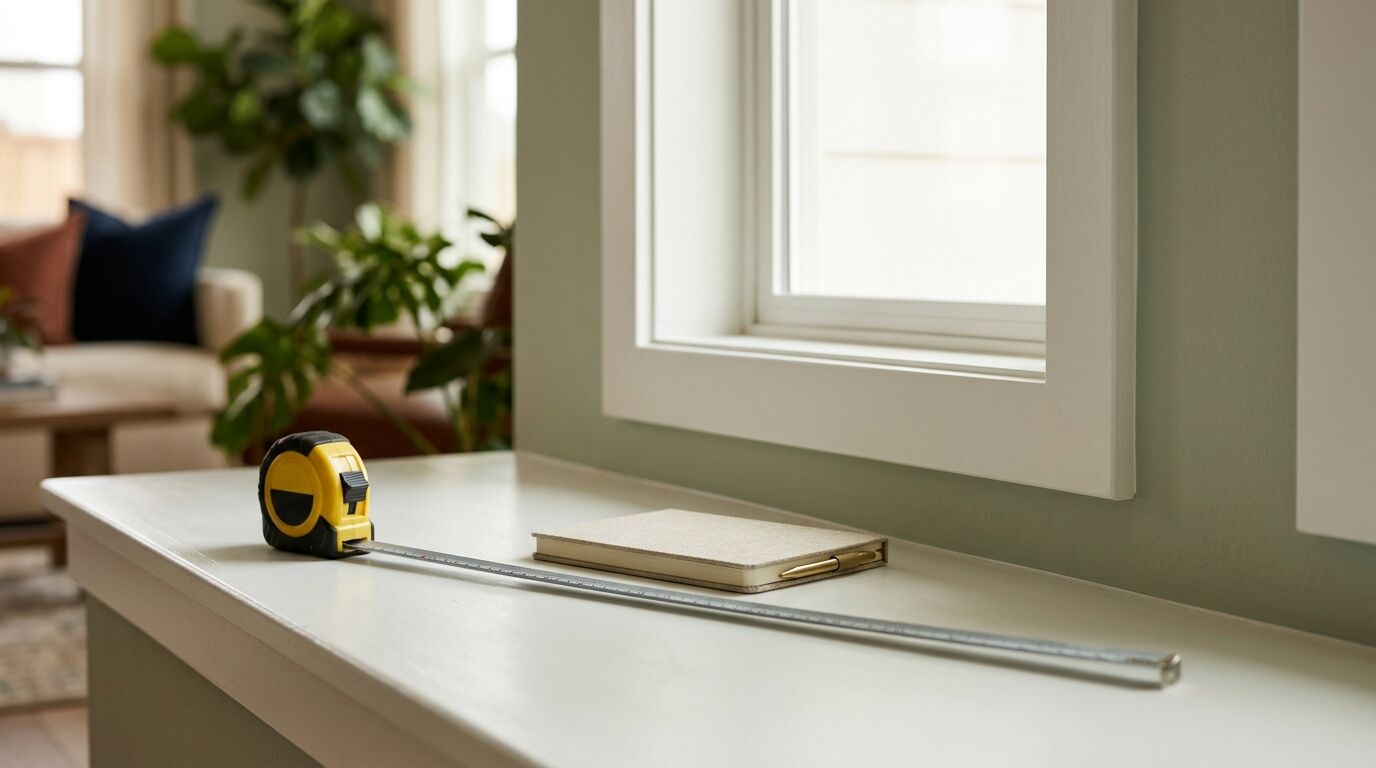
Sooner or later somebody asks whether they can measure the windows themselves and email the numbers over. It is a fair question and I never take it badly. Pulling a tape across a window is the easy part. Knowing which of the readings to keep, and what the factory is going to do with them, is what decides whether the shade covers your glass or sits a quarter inch shy of it. Here is how a real measure goes, and where home measurements usually come apart.
- Decide the mount first. An inside mount sits in the window opening. An outside mount covers the opening plus some wall around it. Measuring for one and ordering the other is the most common way a window ends up wrong.
- Take three widths and three heights on every window. Openings are almost never the same top to bottom.
- Use a steel tape. Cloth and plastic tapes sag and stretch, and the error always runs the same direction.
- Write width first, then height. The whole trade orders width by height.
- Never take your own deduction. The factory takes one. Deduct twice and the product cannot cover the glass.
- Measure the depth of the opening. It decides which products can mount inside at all, and it is the reading people skip.
- Check the diagonals. A new build is rarely square, and out of square turns into a wedge of daylight after the product is already built.
- Custom window coverings are made to your numbers and cannot be returned or recut.
Decide the Mount Before You Pick Up the Tape
An inside mount sits inside the window opening, against the frame. It shows off your trim and gives the cleanest look, and it asks for two things: enough depth for the product to sit in, and an opening close enough to square that the gaps down the sides stay even.
An outside mount fixes to the wall or to the face of the trim above the window and covers the opening with overlap on every side. It is the answer when depth is short, when the opening is racked, when a crank or a lock is in the way, or when you want the glass covered edge to edge for a dark bedroom.
Both are right answers. They are simply measured differently, and the two sets of numbers are not interchangeable. Measure for an inside mount, order an outside mount, and you get a shade that floats undersized on the wall.
The Six Readings a Measure Actually Takes
Width goes in three places: top, middle and bottom. Height goes in three: left, centre and right. Write all six down instead of the one that looks about right.
For an inside mount the width you order is the narrowest of the three. A product built to the widest reading binds against the frame partway down, and there is no fixing that on installation day.
Height is less tidy than the internet makes it sound. Which reading you use depends on the product, on whether the sill slopes, and on how the bottom rail is meant to land on it. Measuring guides contradict each other here because they are describing different products. It is a judgement call, made window by window.
Then record it width by height, in that order, every single time. Reversing the pair is the most common ordering error there is, and on a tall narrow window the result is unmistakable.
Depth Is the Reading People Skip
Measure from the face of the glass back to the front edge of the opening, in more than one spot. That number decides whether a product can mount inside the opening at all, and how far the headrail will stand proud of the wall if it can.
Depth requirements vary a lot by product and by manufacturer, so the number worth having is the one attached to the product you actually choose, not a rule of thumb from a shopping site.
Several things quietly eat depth. A casement crank. An alarm sensor in the top corner. Tilt latches on a double hung sash. And drywall returns, which deserve their own paragraph.
New construction around here often skips wood jambs and casing and wraps the opening in drywall instead. It looks clean and it saves the builder money. It also leaves you a pocket that is shallower than it appears and rarely dead straight, and a mounting bracket that wants a flat true surface has nowhere good to land. Nobody measuring their own windows thinks to check that, because the wall looks fine.
Windows Are Rarely Square, Especially in a New Build
Measure corner to corner, both ways. If the two diagonals match, the opening is square. If they do not, the opening is racked, and the difference between those numbers is how much.
A little out of square is normal. Framing moves, houses settle, and a slab sitting on North Texas clay moves more than most. A small discrepancy gets absorbed by the product. A bigger one shows up as a wedge of daylight down one side of an inside mounted shade, which nobody sees on the order form and everybody sees at breakfast.
Past what a product can hide, the fix is an outside mount, or a shutter with a frame wide enough to cover the discrepancy. That call gets made before the order goes in. It cannot be made after the box arrives. In newer homes around Prosper I check the diagonals on tall stair windows almost as a reflex, because those are the ones that tend to be furthest off and the hardest to reach afterward.
Shutters Get Measured Differently Again
A shutter is a frame with hinged panels in it, built to sit in the opening as a unit. Squareness matters more than it does for a fabric shade, and the frame style gets chosen from what the measure finds rather than from a catalogue.
Deductions matter most here. Every shutter manufacturer subtracts its own set amount from the opening size so the panels swing and latch properly. They want the exact opening. If you deduct first and they deduct again, the shutter arrives undersized and there is nothing to do but build it a second time.
Shaped windows come off a template rather than two numbers. Arches, eyebrows, angled tops and sidelights all get traced and verified in place, which is a different job from running a tape. We went through how those are built in our post on covering arched and angled windows.
Why This Is Different From Buying Off a Shelf
Custom window coverings are cut, sewn and assembled to the numbers on your order. There is no restocking shelf for a shade that is 34 and a quarter inches wide by 61 and a half inches tall. If the number is wrong, the product is scrap, and the cost of that lands on somebody.
Which is the whole reason the in-home measure exists. Sheila measures the windows she is going to install into, in the room, with the crank handle and the drywall return and the racked corner all sitting right there in front of her. If a window needs an outside mount, she knows it standing at the window, before anything is ordered.
It also puts the responsibility in the right place. When we measure and something does not fit, we make it right. When numbers arrive from a homeowner, nobody can honestly promise that.
What Happens After the Measure
Blinds and shades typically run 2 to 3 weeks from order to installation. Plantation shutters typically run 6 to 8 weeks across the industry, with some manufacturers stretching to 12 weeks in a busy season. Those are typical ranges rather than promises, and the exact timeline is confirmed the day the order is placed.
Installation is ours too, which closes the loop: the person who took the numbers is accountable for the panel that goes on the wall.
If you want to know what else to ask before we come out, the questions homeowners ask us most walk through the process end to end. When you are ready, book a free in-home consultation or call or text (972) 523-6399, and Sheila will bring the tape.
See it in your own light.
Every room measures differently. Sheila comes to your home, looks at your actual windows and light, and helps you choose what fits. No showroom pressure, no obligation.
Book a free consultationProduct options, pricing and lead times vary by manufacturer and by window. Details here are general guidance — your in-home consultation is where we confirm what actually fits your home.