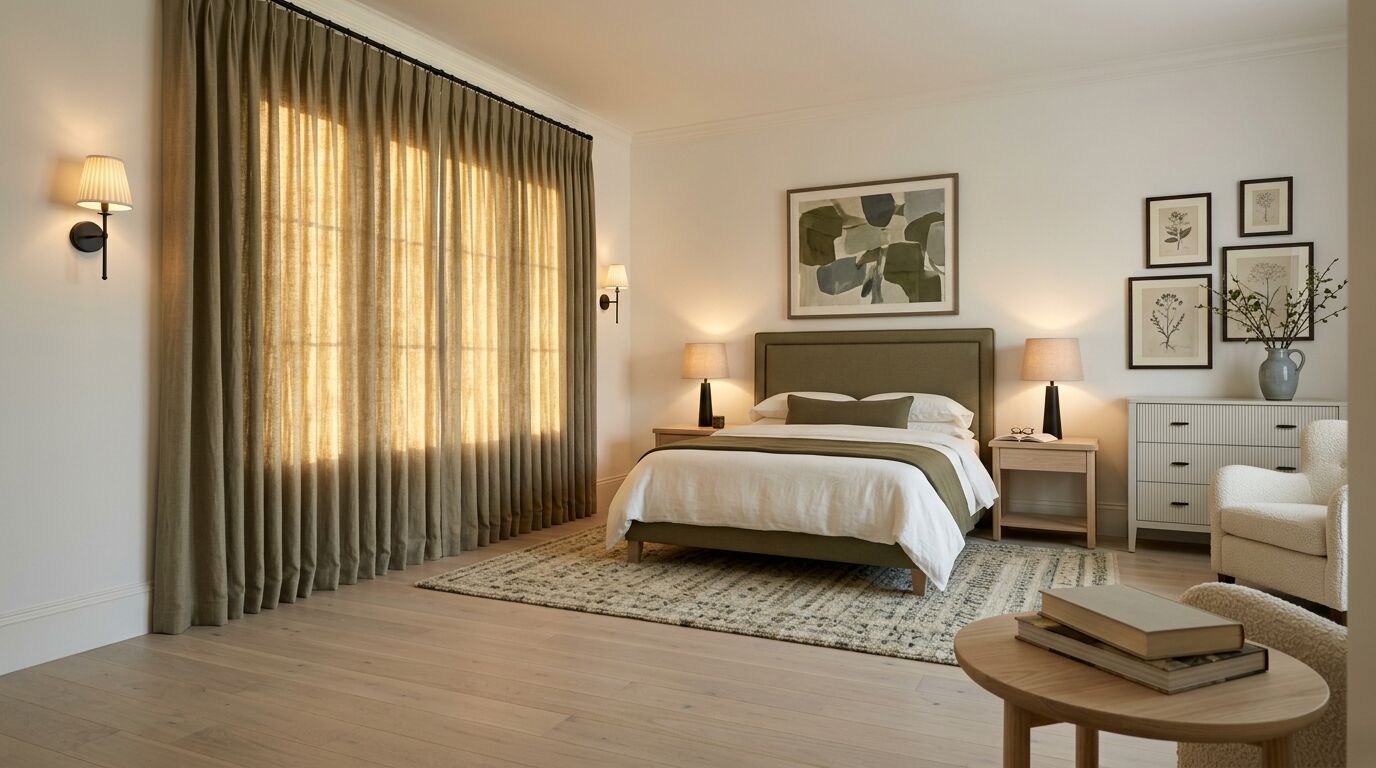
Custom drapery that looks thin and a little sad usually has nothing wrong with the fabric. The panels are just too narrow for the window. Fullness is the amount of fabric you put into each foot of rod or track, and it decides how a drapery hangs more than almost any other choice.
- Fullness is the width of the fabric before it is gathered, compared with the width of the finished drapery.
- Many workrooms plan around two to two and a half times the track or rod width for pleated headings. Your exact figure depends on the heading and the fabric.
- Light, airy fabrics need more fullness than heavy ones to avoid looking flat.
- Drapery that is too narrow stays visibly stretched when it is closed and never shows the folds you chose it for.
- Sheila works out fullness window by window when she measures, so you do not have to do the arithmetic.
What Fullness Actually Means
Picture a panel hanging flat against the wall, with no folds at all. That is one times fullness. Now imagine the same panel gathered into pleats or waves so it only spans half that distance. You have doubled the fabric without making the finished panel any wider. That is two times fullness.
The ratio is simple. Take the width of the fabric before it is gathered and divide it by the width the drapery will cover once it is hung. The extra fabric is what turns into folds. Without it, the drapery has nothing to fold, and a flat panel across a window reads as a curtain someone hung in a hurry.
Why Skimpy Drapery Looks Wrong
Folds do three jobs at once. They give the fabric depth and shadow, which is what you are paying a workroom to make. They let the panels hang straight rather than pulling sideways. And when drapery is open, they let it stack back into a neat bundle rather than a stiff slab sitting across the glass.
When there is not enough fabric, you can usually see it. The folds are shallow and far apart. The leading edges pull toward the window. The hem swings. People often blame the fabric, or the heading style, and order something else. The better fix is usually more width in the same fabric.
How Much Fullness Different Headings Need
As a general working rule, pinch pleat and other tailored pleated headings are planned at around two to two and a half times the finished width. A continuous wave heading such as ripplefold is set by how far apart the carriers sit on the track, so its fullness is built into the spacing. Our post on ripplefold versus pinch pleat goes through how the two headings behave in a room.
Those are rules of thumb, not fixed numbers. Different workrooms work to different figures, and the right amount for your window depends on the heading, the fabric and how formal you want the result to look. We confirm the figure on your order rather than guessing from a chart.
Fabric Weight Changes the Answer
A heavy, tightly woven fabric carries its own weight. It falls into deep, soft folds with relatively little extra width. A thin linen or a sheer needs more fabric to build the same effect, because there is nothing in it to hold a fold open. A sheer panel planned at the same fullness as a thick velvet will look washed out and flat.
Lining matters too. An interlined panel hangs fuller on its own, while an unlined one takes more width to look the same. If you are still deciding what goes behind the face fabric, we wrote about unlined, blackout and interlined drapery.
The Width of the Window Is Not the Width of the Drapery
This is where many first orders go wrong. Fullness applies to the track or rod, not to the glass. Good drapery is hung wider than the window so that, when it is open, the panels rest on the wall and the whole window is visible. A track that stops at the edge of the frame forces the stacked fabric to sit across the glass, and the window looks smaller than it is.
So there are two measurements doing two different things. The track width sets how far the drapery reaches. The fullness ratio sets how much fabric is needed to fill that reach. Get the first wrong and the window looks cramped. Get the second wrong and the drapery looks thin.
Why We Measure Before We Quote Fabric
Fabric widths come in fixed sizes, and panels are made from joined widths. A window that needs a little more than three widths will often be made with four, so the real fullness lands slightly above or below the target. Sheila looks at how many widths each panel needs and chooses the ones that keep the folds even. That is the sort of decision that is hard to make from a calculator and easy to make standing in the room.
She also considers how the drapery will be used. Panels that stay closed all day behave differently from panels that open every morning, and a wide window that is rarely touched can carry a different ratio from a door that gets used constantly.
Before You Order
Think about where you want the stacked fabric to rest when the drapery is open, and whether the room needs the panels to close fully at night. Mention if there are furniture pieces, a radiator or a corner that limits how far the track can extend. Those details change the fabric needed more than people expect.
Pricing depends on the fabric, the heading, the lining and the size of the window, so we do not quote numbers here. Lead time varies too much between fabrics and workrooms to give a range. If you are weighing drapery for a room, book a free in-home consultation and we will look at your custom drapery options together, with your windows in front of us.
See it in your own light.
Every room measures differently. Sheila comes to your home, looks at your actual windows and light, and helps you choose what fits. No showroom pressure, no obligation.
Book a free consultationProduct options, pricing and lead times vary by manufacturer and by window. Details here are general guidance — your in-home consultation is where we confirm what actually fits your home.