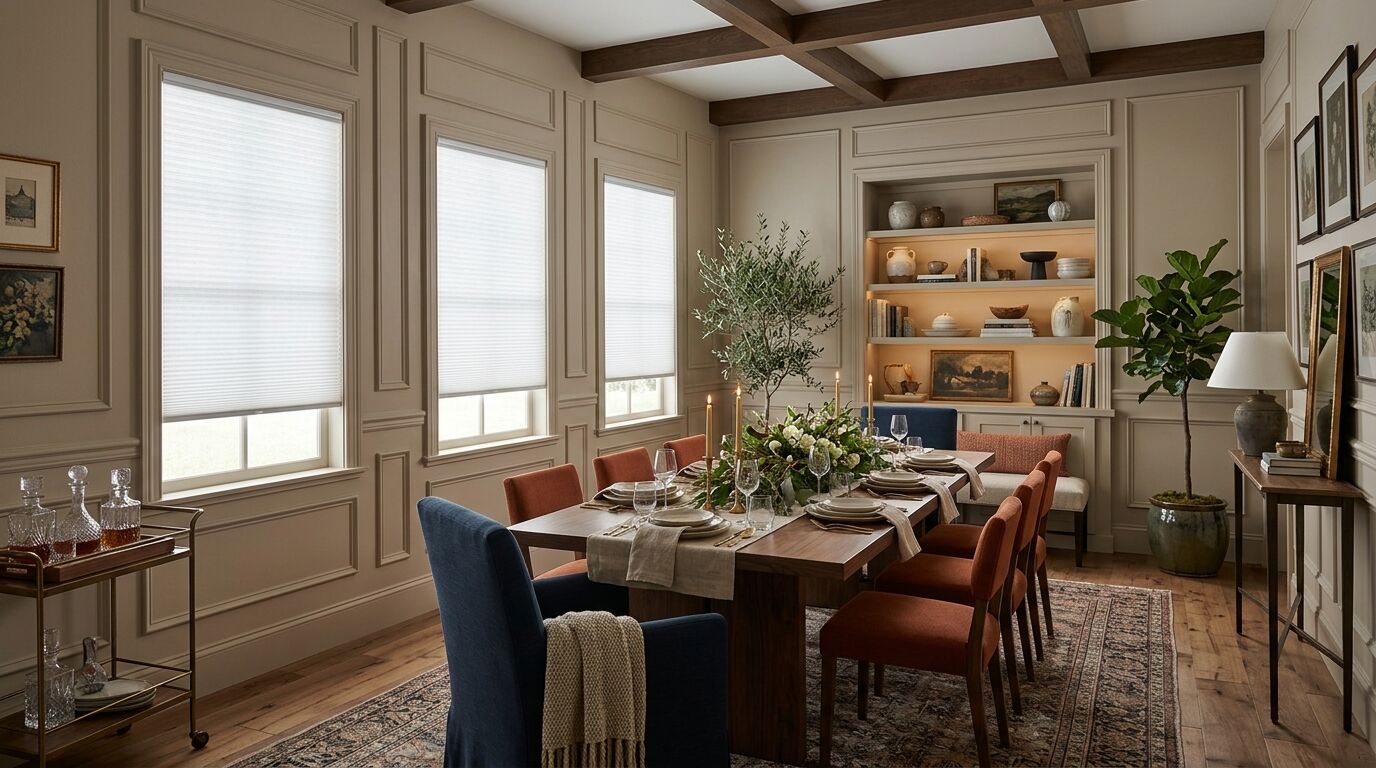
People buy cellular shades for the energy story and then never hear how the thing actually works. The honeycomb is doing one job. Each cell holds a pocket of still air between your room and the glass, and still air is a poor conductor of heat. That is the whole mechanism. Every choice that makes one cellular shade perform better than another comes back to how much still air it holds and how well it keeps that air from moving.
- The air in the cells is the insulator. The fabric is there to hold it still.
- Fit matters more than fabric. A gap at the jamb lets room air slide behind the shade and touch the glass, which skips the insulation entirely.
- Double cell holds two air pockets in series instead of one. Worth it on big glass and in bedrooms.
- Side channels enclose the edges. They are the single biggest upgrade you can make to how a cellular shade performs.
- In North Texas the harder problem is sun coming in, so on brutal west glass the cellular shade works best behind something that stops the sun outside.
- Light filtering versus room darkening is a separate decision from insulation. Do not assume one buys you the other.
The Cells Are Holding Air, and the Air Is the Insulator
Glass is a good conductor. On a January morning the inside face of your window is cold, and the warm air in the room gives up its heat to it. On an August afternoon the same pane runs hot and pushes that heat back at you. Either way the window is the weak spot in the wall.
Air is terrible at conducting heat, which makes it useful, but only while it holds still. Moving air carries heat along with it. So the trick with any air-based insulation is to trap the air in spaces small enough that it cannot set up a circulating current inside them.
That is what the honeycomb does. Look at a cellular shade end-on and you see a row of small chambers running the width of the fabric, each one sealed off from the ones above and below it. Lower the shade and you have hung a wall of small still-air pockets across the opening. Same principle as the gas gap in a double pane window, or the loft in a winter coat.
Which is why the fabric itself is almost beside the point. Two shades in identical fabric will perform differently if one holds more air than the other, and a heavier fabric with no cell structure behind it does very little.
Fit Does More Than Fabric
Here is the part that gets skipped, and it is where most of the disappointment comes from.
Air at the glass is always in motion. In winter it cools, gets heavier and slides down the pane. In summer it heats and rises. Either way it has to be replaced, so it pulls fresh room air in from somewhere. If there is a gap between the edge of your shade and the window jamb, that is where the air comes from. A loop sets up: room air slips behind the shade, touches the glass, exchanges heat, and comes back out the other side. Your beautiful honeycomb is sitting right there watching it happen.
So the goal on every install is to close the perimeter. An inside mount cut to a tight tolerance leaves a small gap on each side, which is normal and acceptable on most windows. An outside mount that overlaps the frame generously does better, because the fabric covers the opening rather than sitting inside it.
The real fix is side channels. Those are tracks fitted to the jambs that the fabric edge rides inside, so the pocket behind the shade is genuinely enclosed rather than open at the sides. Industry references on window attachments put the insulating gain from a cellular shade with tight-fitting side tracks well above the same shade hung open at the edges, and it is the same reason the light leak disappears. If a room is worth insulating properly, it is worth channels.
Channels also cost more and they change how the shade looks and operates, so they are a room-by-room decision rather than a whole-house one.
Single Cell, Double Cell and How Big the Cell Is
Two variables, and they do different things.
Number of cells. A single cell shade is one row of chambers. A double cell is two rows nested together, so heat crossing the shade has to pass through two air pockets in a row rather than one. That stacks up a little thicker at the top of the window and costs more, and on glass that is genuinely working it earns its keep. On a small window in a hallway you will never notice the difference.
Cell size. Cellular fabrics come in a range of cell widths, commonly from around three eighths of an inch up to three quarters and larger on tall windows. A bigger cell is a deeper air pocket and stacks less compactly. A smaller cell gives you a tighter, neater stack at the top of the opening and suits small windows and shallow mounting depth. Both insulate. The choice is usually driven by the window rather than by performance.
Scale matters too. A large cell on a small bathroom window looks coarse, and a tiny cell across a wide patio door looks fussy. Match the cell to the opening and the shade reads correctly in the room.
One thing worth knowing before you fall for a fabric: cellular shades carry two layers of fabric plus air, which does absorb some sound in a room. Nobody should buy them as acoustic treatment, but in a bare-floored office or a room with a hard ceiling, people notice the difference.
What This Means in a North Texas House
Our climate is cooling-dominated and our glass is enormous. New construction in Frisco, Prosper and Celina routinely comes with west and south elevations that are half window, and those rooms turn into ovens by four in the afternoon.
A cellular shade helps two ways there. It slows the heat conducting through the pane, and it puts a barrier between you and the radiant heat coming off hot glass. A room where the seating sits within a few feet of a west window is much more usable with the shades down.
The honest limit is this: by the time the sun has come through the glass, the energy is inside the house. An interior shade can only slow how fast that heat spreads into the room. Stopping it outside is a different order of result, which is why we keep recommending exterior solar screens and patio shades on the worst exposures and running interior shades behind them. Our post on west-facing windows in North Texas gets into that sequence in more detail.
Winter is the smaller half of the year here, and it still matters on the handful of nights that drop hard. A lowered cellular shade on a big window makes the room next to it noticeably less drafty at night, and that is conduction being slowed rather than any air sealing you have done to the house.
What we will not do is quote you a percentage. Savings figures depend on your glazing, your orientation, your thermostat habits and whether the shades are actually down when the sun is on them. The mechanism is real. The number is yours, not ours.
Where a Different Product Is the Better Answer
We sell plenty of cellular shades and we talk people out of them regularly.
Windows you want to look through during the day. A cellular shade is opaque to view when it is down. If your main reason for the window is the backyard, a solar screen shade with a stated openness factor keeps the view and cuts the glare, and it will not insulate the way a honeycomb does. Pick which job you want.
Rooms where you want the architecture. Shutters are built-in louvered panels that become part of the window and stay with the house. If that is the look you are after, no fabric shade will get you there.
Kitchens over a range. Cellular fabric collects cooking film and does not wipe. The cells hold dust and clean carefully rather than easily. A hard product does better in that spot.
Bedrooms where you need real darkness. Room darkening and blackout are not the same thing, and a cellular shade in a light-filtering fabric glows softly and shows shapes behind it when a lamp is on inside. Room-darkening fabric plus side channels is what actually gets a bedroom dark. Our post on room darkening versus blackout covers where the light really gets in.
The Choices That Change How Yours Perform
Once you have decided on cellular, a short list of specs does most of the work.
Mount type and depth, decided at the window, because a shallow frame may not take an inside mount cleanly and an outside mount usually seals better anyway. Cell count and cell size, matched to the size of the opening. Fabric opacity, chosen room by room rather than for the whole house. Side channels wherever darkness or performance matters. And cordless or motorized operation, which is the safe choice in any room a child or a pet uses because there is no dangling cord, and the sensible choice on anything tall enough that you would need a stool.
On timing, blinds and shades typically run 2 to 3 weeks from order to installation. That is a normal range rather than a promise, and the actual date gets confirmed the day the order goes in.
Getting the Spec Right on Your Own Windows
Nearly all of this is decided at the window itself. How deep the frame is, which way the room faces, how much sun lands on that glass in July, whether the room needs to go dark, and how the shade will look next to the ones in the next room over.
Sheila measures your actual windows in your actual light and specs each room for what it is doing, rather than putting the same shade on all thirty openings. Custom shades are cut to your window and cannot be returned, which is why the measure happens in person. You can see the fabrics, cell options and operating hardware on our custom shades page, and when you want an answer for your own house, book a free in-home consultation.
See it in your own light.
Every room measures differently. Sheila comes to your home, looks at your actual windows and light, and helps you choose what fits. No showroom pressure, no obligation.
Book a free consultationProduct options, pricing and lead times vary by manufacturer and by window. Details here are general guidance — your in-home consultation is where we confirm what actually fits your home.