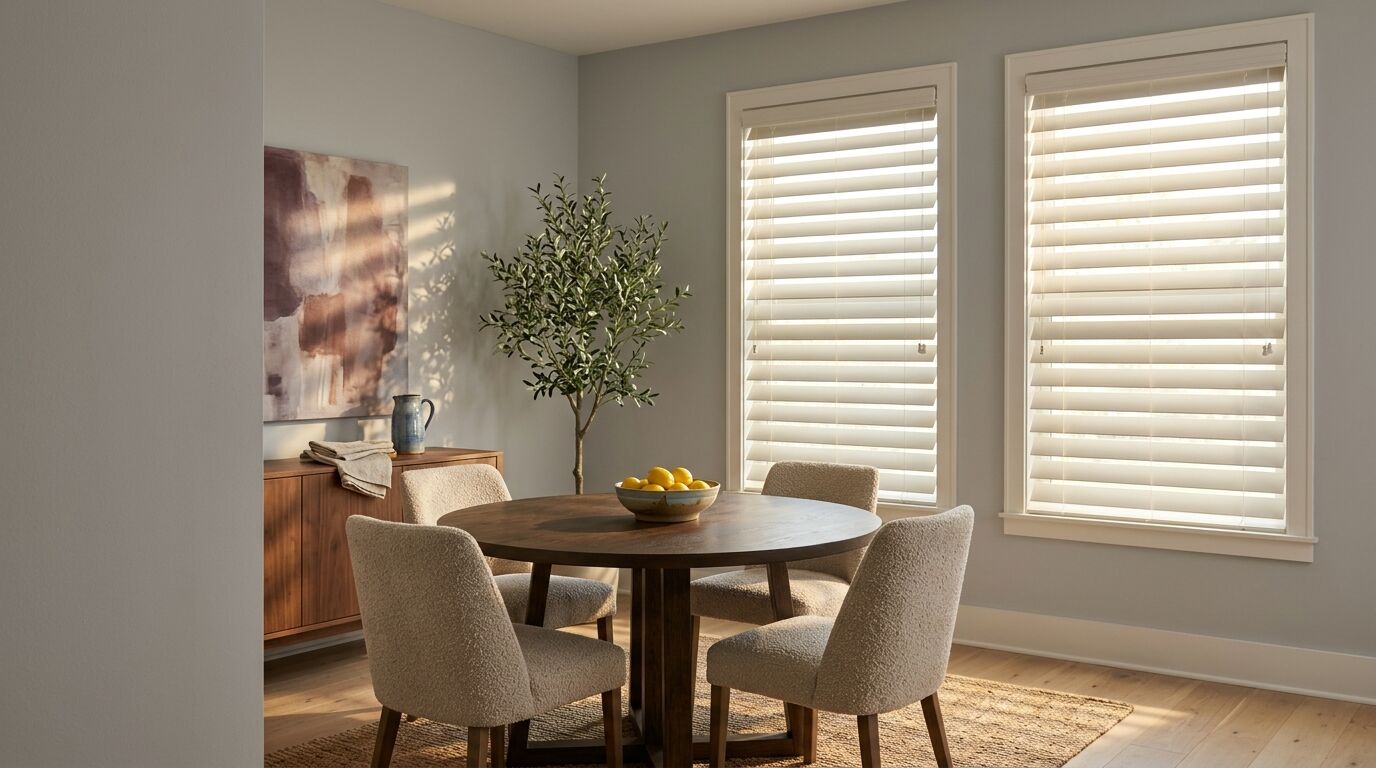
Most blinds come in three slat widths: 1 inch, 2 inch and 2.5 inch. The first question almost everyone asks is which one blocks the most light, and the honest answer is that slat width barely moves that number. What it actually changes is how much you see through the blind once it's tilted open, how thick the stack looks once it's raised, and how many lines your eye reads across the window.
- All three widths close to about the same coverage. Slat width is mostly a view and a scale decision.
- Fewer, wider slats mean more open area when tilted, so you see more of the yard and get broader bands of light.
- 2 inch is the middle size and where most homes here land.
- Wider slats stack thicker at the headrail once the blind is raised, which matters on a window where every inch of glass counts.
- 1 inch still earns its place on small or shallow windows and in a more traditional room.
- Fewer, wider slats take less time to dust.
- Match one width to every window you can see from a single spot, and vary only where a window forces your hand.
What Slat Width Actually Changes
A slat is a flat blade pinned at each end so it can rotate from flat open to nearly closed. The drop is fixed by your window height, so a wider slat simply means fewer of them fit down that same drop.
That single fact drives most of the rest. A tall window filled with 1 inch slats carries a lot of horizontal lines. The same window in 2.5 inch carries far fewer, so tilted open you see more of the yard through bigger gaps and the room reads calmer. Tilted closed, more lines read finer and more traditional, and fewer lines read cleaner and more current.
Why Closed Coverage Barely Changes
Closed, each slat rotates until it overlaps the one below it, and the manufacturer sizes that overlap to the slat, so a closed 1 inch blind and a closed 2.5 inch blind cover the opening about the same. Slat width isn't doing the work there.
Where light actually gets in is at the edges, where the blind meets the frame, and in a faint line along each slat joint. A wider slat has fewer joints across the drop, so there are a few less of those faint lines. It's a small difference, not one to choose a size on.
If a nursery or a media room needs to go properly dark, slat width won't get you there and neither will any horizontal blind on its own. That's the difference between room-darkening and true blackout, and it's worth reading before you assume any covering will do it.
View and Privacy When the Slats Are Open
This is where slat width earns its keep. Tilt a 2.5 inch blind open and you're looking through a handful of wide gaps. Tilt a 1 inch blind to the same angle and you're looking through many narrow ones, which reads busier and blocks more of the view even though the total open area is similar.
Privacy moves the same direction. Fewer, wider slats leave a bigger gap at any given tilt angle, so someone outside can see a bit further into the room at that angle. A notch steeper on the tilt closes most of that gap while still letting in soft, indirect light, so it's rarely a reason to rule 2.5 inch out on a street-facing window. It's a habit to build into how you use the blind, not a flaw in the product.
Headrail, Stack Height and Big Windows
When a blind is raised, the slats fold up against the headrail in a stack. A wider slat folds into a thicker stack than a narrow one does, so on a window where the top few inches of glass already carry something else (a valance, a low header, a beam), plan for that stack at the measure.
On a wide picture window or a sliding glass door, fewer moving parts also means a simpler mechanism across a long run. That's a real reason 2 and 2.5 inch turn up so often on large, open-concept windows: fewer slats to keep aligned, fewer cords or wands to route, and a cleaner look raised as well as lowered.
Scale: Matching Width to the Window
Slat width has to relate to the size of the opening it sits in, and this is where regret usually lives.
Put 2.5 inch slats in a small powder room or laundry window and you get five or six of them. The blind stops reading as a window covering and starts reading like an odd piece of hardware stuck in the wall. Run 1 inch slats up a tall two-story window and you get a wall of fine horizontal lines that reads as texture more than as a window.
A quick check before you commit: count how many slats will land in the drop. Very few and the blind reads heavy. Very many and the window reads striped. The middle is where a blind looks like it belongs to the window it's covering.
Where 1 Inch Still Belongs
1 inch mini blinds haven't gone away, and they aren't just a budget fallback. They're the right call on a small or shallow window, a kitchen sink window, a laundry room, or a bathroom where a deep headrail doesn't fit the frame. They also give finer control over the exact angle of light, which matters in a room used at a desk or a sink rather than a room you mostly walk through.
Material plays into this too. Our post on faux wood versus real wood blinds covers which material holds up where, and it's worth reading alongside slat width since the two decisions usually get made together.
How to Choose, Room by Room
Start at 2 inch and let the window argue you out of it.
Go up to 2.5 inch when the window is large, it's a sliding door or a picture window, there's a view worth keeping, and the room leans open or transitional. Wider slats give you the most view back when they're open and they're the fastest to keep clean since there are fewer of them.
Drop to 1 inch when the window is small, the frame is shallow, the room leans traditional, or you want finer control over the exact tilt angle at a desk or a sink.
Then ask the question people forget: one width for the whole house, or a mix? Mixing across a single sightline is what gets regretted later. If you can stand in the kitchen and see the nook and the family room at once, those windows should share a slat width. Where a window forces a different size, put it somewhere the eye can't compare the two side by side, like a laundry room or a bathroom off a hall.
Cordless and motorized lift options exist at every slat width, and they're worth asking about if there are kids or pets in the house, since they remove the dangling cord entirely. On timing, blinds and shades typically run 2 to 3 weeks from order to installation. That's a normal range rather than a promise, and the exact date is confirmed the day the order goes in.
Seeing It Against Your Own Window
A slat sample in a showroom photo tells you almost nothing about how it will read in your actual room. Held against your own window, in your own light, the width usually decides itself in about ten seconds.
Sheila brings the samples to you, checks the frame depth and the window size on every opening, and recommends a width based on what's actually there, since custom blinds are built to your window and can't be returned once ordered. You can see the styles and finishes on our custom blinds page, and when you're ready for an answer on your own windows, book a free in-home consultation.
See it in your own light.
Every room measures differently. Sheila comes to your home, looks at your actual windows and light, and helps you choose what fits. No showroom pressure, no obligation.
Book a free consultationProduct options, pricing and lead times vary by manufacturer and by window. Details here are general guidance — your in-home consultation is where we confirm what actually fits your home.