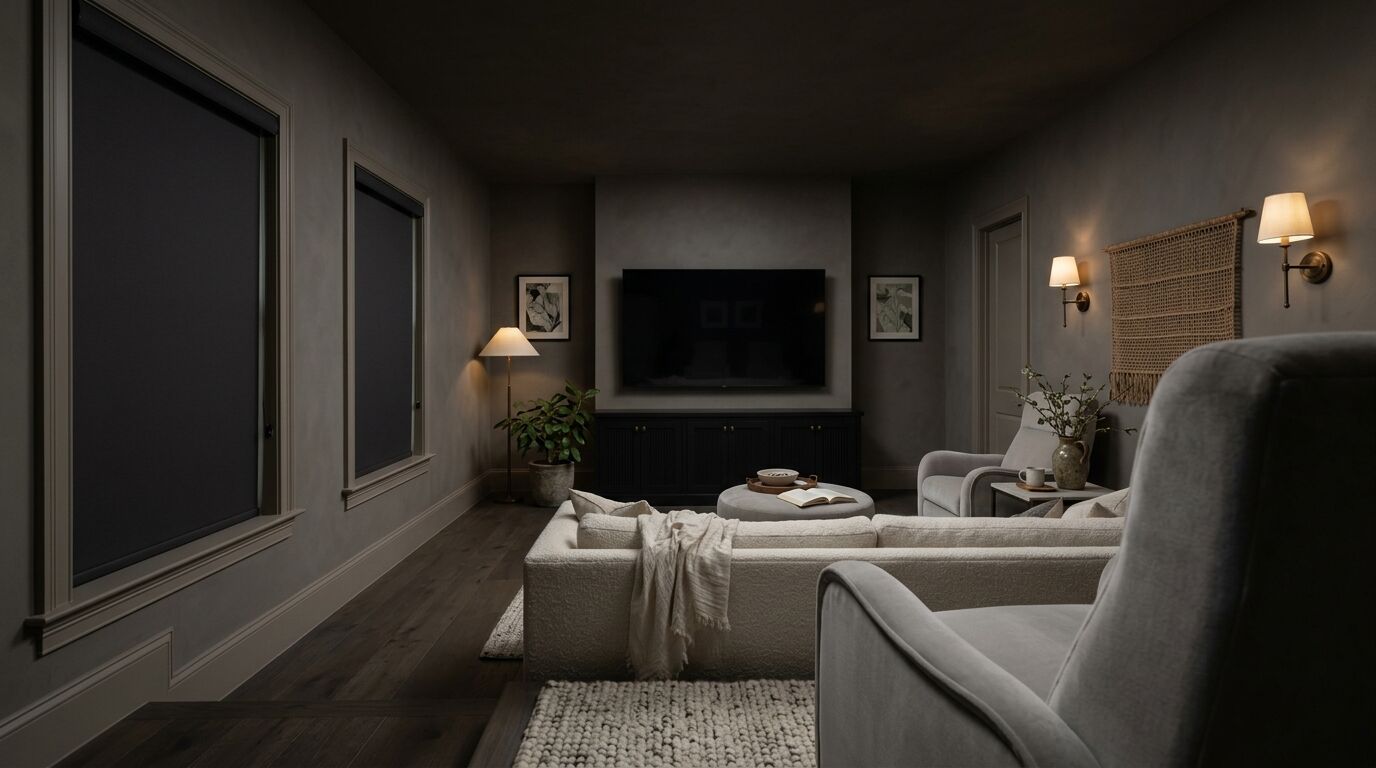
A bedroom only has to be dark enough to sleep. A media room has to be dark enough that a bright sliver down one edge of a window doesn't land on the picture. That's a tougher standard, and it's why blackout fabric on its own so often disappoints in a theater room.
- Stray daylight washes out the dark parts of a screen first, so a media room needs the window sealed, not just covered.
- Blackout fabric stops light passing through the cloth. It does nothing about the gaps around it.
- Side channels, a closed cassette at the top and a bar that lands on the sill close the four usual light paths.
- Channels need depth in the window frame, which gets checked at the measure before anything is ordered.
- A dark, matte room side on the fabric keeps the shade itself from throwing light back into the room.
- Motorizing the shades turns "movie time" into one button.
Why a Media Room Is Fussier Than a Bedroom
Your eyes adjust to a dark room within a few minutes, and once they have, a thin line of daylight at the edge of a shade looks like a neon tube. On a screen it does something worse. Light bouncing around the room lifts the black areas of the picture toward grey, so a dark scene loses its shadow detail and the whole image looks flatter.
A projector with a pull-down screen is the most sensitive setup, because the screen is built to reflect light and it reflects the room's light too. A wall-mounted TV copes better with a bright room, but a window across from it can still throw a glare onto the glass. Either way, the goal is the same: a room where the only light that matters is coming from the screen.
That's also why home theater window coverings are a different shopping question than bedroom ones. We covered the fabric side of this in room-darkening vs blackout shades. Here the focus is the window itself, and what it takes to close it.
Where the Light Gets In
On an inside-mounted roller shade there are four paths, and the fabric is none of them.
The sides come first. A custom shade is built a little narrower than the opening so the fabric never rubs the frame as it travels. That clearance is the gap. In newer homes where the framing is slightly out of square, it can run wider on one side than the other.
The top is next. An open roller leaves the tube exposed, and daylight slips over the roll and down the back of the fabric. The bottom follows, where the bar rarely touches the sill and light bounces up off the ledge. The fourth path is the fabric itself, which only matters if the material isn't a true blackout.
Draperies add a problem that nobody mentions: they hang in front of the window, so every gap between the panels and the wall is open. Hung alone, they rarely black out a room completely.
Side Channels, Cassette and Sill: What Seals a Window
Side channel blackout shades solve the problem with hardware rather than fabric. A slim track is fixed vertically on each side of the opening, and the edge of the shade runs inside it, so there's no straight line left from the glass to the room.
Paired with a closed headbox at the top and a bottom bar that seats against the sill, that closes all four paths. This is the setup to ask about for a dedicated theater. Light gaps are what you're paying to remove, and a system built around the edges does that better than a heavier fabric ever will.
The catch is space. Channels need depth in the window frame to sit properly, and not every window has it. On a shallow frame the answer is usually an outside mount, where the shade hangs on the wall or casing and overlaps the opening by several inches all round. It looks bulkier, but in a room that's mostly dark anyway, nobody is studying the window trim. Sheila checks frame depth on every window during the measure so the right mount gets chosen before the order goes in.
Fabric Colour and Which Side Faces In
Once the gaps are closed, the shade itself becomes a surface in the room. A pale, glossy fabric on the room side can pick up light from the screen and throw some of it back at you. A darker, matte face absorbs it instead.
Many blackout fabrics are made with a different colour on each face, so you can have a dark side toward the room and a lighter side toward the street. That second point matters in Prosper and Frisco, where HOA guidelines often ask for a uniform white or neutral look from the street. Ask to see both faces of a sample, not just the one you'll live with indoors.
Cellular shades in a blackout version are another option, and they add insulation, which helps if the media room sits on a west wall. Our guide to custom shades shows the range, and the trade-offs between roller and cellular come down to the look you want and how much depth the frame allows.
Windows Aren't the Only Leak
If you've sealed the windows and the room still isn't dark, look at the rest of it. A glass-panel door to the hallway, a transom over the entry, sidelights, a skylight and the gap under a door all let light in. Even small indicator lights on equipment can bother some people in a dark room.
Shutters and blinds are lovely, but they can't black out a media room. Light comes through the louver gaps and around the panel edges. If a room has plantation shutters on its windows already, a blackout shade can sit behind or in front of them, and we can talk through what makes sense for that opening.
Making It Easy to Use
A theater room tends to get used for more than movies. It's a playroom on Saturday morning and a place to watch the game on Sunday. A motorized shade lets you go from daylight to dark with a button or a voice command, and a single scene can lower every shade in the room at once. We wrote about how that works day to day in our post on smart home shades.
Cordless and motorized shades also remove the chain or cord, which is the safer choice around kids and pets. In a family media room, that's worth considering even if you don't care about the remote.
What to Settle Before You Order
Decide which windows face the screen and which are behind the seats, because glare from the first matters most. Decide how dark the room needs to be: a projector setup is far less forgiving than a TV. Check the frame depth at every window to settle channels or outside mount. Pick a lift, and choose the room-side colour with the screen in mind.
Custom shades are made to your window and can't be returned, which is why Sheila measures in person, in the light of the actual room. Blinds and shades typically run 2 to 3 weeks from order to installation. That's a normal range rather than a promise, and the exact timing is confirmed the day the order is placed.
Pricing depends on the product, the size, the material and how many windows are in the room, so we don't quote numbers here. If you're setting up a theater or a game room, book a free in-home consultation and we'll look at the windows together.
See it in your own light.
Every room measures differently. Sheila comes to your home, looks at your actual windows and light, and helps you choose what fits. No showroom pressure, no obligation.
Book a free consultationProduct options, pricing and lead times vary by manufacturer and by window. Details here are general guidance — your in-home consultation is where we confirm what actually fits your home.