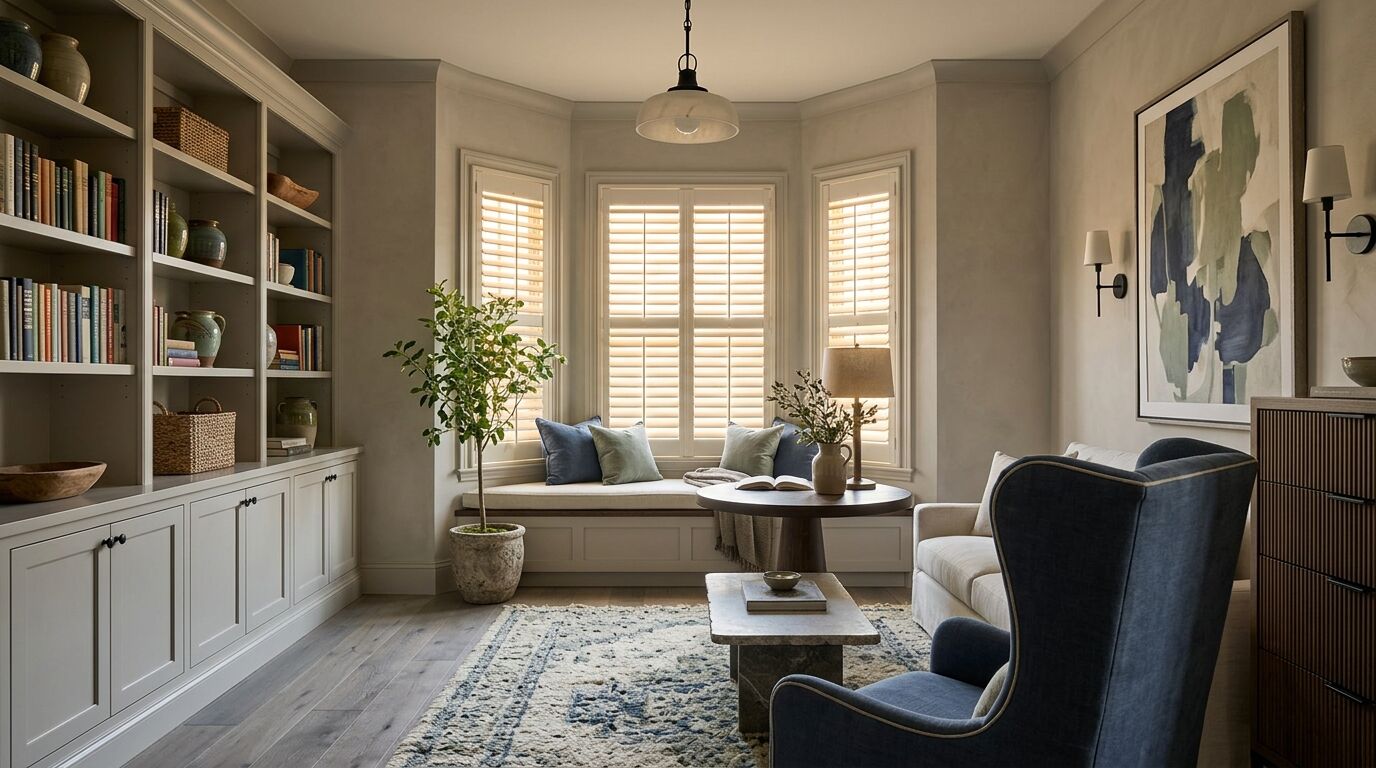
A bay window looks like one big window, so people order it like one. It's really three, or five, set at angles, and the corners between them decide whether the finished result looks built-in or bolted on.
- A bay usually has a center window and two angled sides. A bow has four or more windows in a gentle curve.
- Each section is covered as its own window, and the sections are ordered together so they match.
- Frame depth decides whether you can mount inside the opening or have to mount outside it.
- Shutters, shades and blinds all work in a bay, and the corners are where they differ.
- Drapery on a bay needs a different plan, because a straight rod can't follow the angles.
Bay or Bow: What You Actually Have
A bay window has one window facing straight out and two angled side windows. A box bay is similar but its sides meet the wall at 90 degrees. A bow window is a set of four or more windows that form a curve, as Blinds.com describes it. In newer North Texas homes you'll see bays in breakfast nooks, primary bedrooms and front dining rooms, and bows on the back of a great room.
Count the sections before you do anything else. Every one of them is a separate piece of glass that needs its own covering.
Why the Corners Matter
On a flat wall, two shades side by side only have to line up with each other. In a bay, the frames meet at an angle, and the coverings have to clear that corner without bumping, overlapping or leaving a gap that shows light.
That's why a bay isn't a place to guess. The Shutter Store's measuring guide has you measure each section separately and order them together so the finish and color match. It also notes that the angle between sections can be anywhere between 90 and 180 degrees, and that's exactly the number a tape measure doesn't give you.
Inside Mount or Outside Mount
Frame depth is the first question. Shutters need depth for the louvers to tilt without hitting the glass or a window lock, and the wider the louver, the more depth it takes. Shades and blinds are slimmer, so they fit more bays inside the opening.
If the frame is deep enough, an inside mount looks cleanest, with each section sitting in its own opening. If the bay is shallow, or the sections are joined as one continuous opening, an outside mount on a frame around the bay gets around the problem. Sheila checks the depth section by section at the measure, since the windows in one bay aren't always identical.
Shutters in a Bay
Custom plantation shutters suit a bay well when the geometry is right, because they're built to each section and stay with the house. Adjacent sections are usually hinged so the panels fold clear of each other, and the corner is handled by a purpose-built frame rather than a trimmed-down standard one.
The thing to watch is how the panels open. In a shallow bay there may not be room for a panel to swing, so the plan has to account for it. Our post on shutters on French and sliding doors covers a similar question of clearance.
Shades and Blinds in a Bay
Shades and blinds are the lower-profile answer. One covering per section, in the same fabric and the same mount, reads as a single treatment when it's lowered together. Bold patterns can look busy across several windows, so a quiet fabric tends to work best.
This is also where motorization earns its keep. Three or five shades that have to be raised one at a time get ignored. A battery motor lets you group them and move them together, and we covered how in our post on grouping motorized shades on one remote. Cordless or motorized lifts also keep cords out of reach, which matters in a nook where children sit.
Drapery Around a Bay
A straight rod can't follow a bay. A curved rod or a track bent to the angles can, and it has to be made to your measurements. Many people skip it and hang drapery on the wall either side of the bay, then use a shade or shutter on the glass itself. That keeps the view and the window seat free.
How to Decide
Start with the depth and the number of sections, then decide how much light and privacy you want in that spot. A window seat under a bay is a favorite place to sit, so the covering should be easy to operate from there.
The easiest way to get it right is to have someone stand in the bay with a tape and a level. Sheila does exactly that during the free in-home consultation, and she'll show you options against your own light. Blinds and shades usually take 2 to 3 weeks from order to installation. Plantation shutters typically run 6 to 8 weeks, and some manufacturers take up to 12 in a busy season. The exact timing is confirmed the day you order. If you're in Frisco, see our window treatments in Frisco page, or ask for a consultation.
See it in your own light.
Every room measures differently. Sheila comes to your home, looks at your actual windows and light, and helps you choose what fits. No showroom pressure, no obligation.
Book a free consultationProduct options, pricing and lead times vary by manufacturer and by window. Details here are general guidance — your in-home consultation is where we confirm what actually fits your home.