By four in the afternoon in August, a west-facing room in North Texas stops being a room anyone wants to sit in. The sun drops low enough to come straight through the glass instead of over the roof, and everything it lands on gets hot. Here is what actually helps on those windows, and what only looks like it will.
- West sun arrives low and direct in the afternoon, so your roof overhang stops doing anything for you.
- Solar screen shades are the usual answer for glare in a room you still want to see out of. Openness factor is the number that matters.
- Cellular shades do the most against heat, because trapped air inside the cells slows it down at the glass.
- On two-story great room windows, reach is the real problem, and that is what motorization solves.
Why West Glass Behaves Differently
Morning sun on an east window is over by ten or eleven. West sun shows up during the hottest part of the day and stays until it sets.
The angle is what makes it worse. From roughly three in the afternoon through sunset in the summer, the sun sits low in the sky and comes in almost level with the floor. Your roof overhang was designed to shade high midday sun. It does nothing for light arriving sideways.
That is why a west room can feel fine at noon and unbearable at five, and why families end up closing off the back of the house every afternoon. The U.S. Department of Energy estimates that heat gain and heat loss through windows account for 25 to 30 percent of residential heating and cooling energy use, which is a fair reminder that glass does more work in a house than most people assume.
Solar Screen Shades Keep the View
These are the ones most people land on for a living room or a kitchen with a west wall. The fabric is a woven mesh that cuts glare and direct sun at the glass while you can still see the yard through it.
The spec to pay attention to is openness factor, which runs from about 1 percent to about 14 percent. A lower number means a tighter weave: more sun blocked and less of the view. Something in the 3 percent range is a common pick on a hard west wall. A 5 or 10 percent fabric keeps more of the view and lets more light through, which is fine if glare is the complaint and heat is secondary.
One honest limit. Solar screens give you daytime privacy only. After dark, with your lamps on, people outside can see in. Anyone who tells you otherwise is selling. If the room needs privacy at night, you want a second layer or a different product. Our page on custom shades and solar screens walks through the fabric options.
Cellular Shades When the Room Runs Hot
Cellular shades, also called honeycomb, are built from folded fabric that forms sealed pockets of air across the window. Air is a poor conductor of heat, so those pockets sit between the hot glass and your room and slow the transfer down. That is a real mechanism, not marketing.
How much it helps depends on your window, your glass and your house, so treat any specific dollar figure you read online with suspicion. What you can count on is that a west bedroom with cellular shades stays more comfortable in the late afternoon than the same room with bare glass.
Two words worth separating here. Room-darkening and blackout are not the same thing. Blackout fabric blocks light through the fabric itself, but any roller or cellular shade still leaks a little light around the edges unless it has side channels. If a west-facing bedroom needs true dark for a napping toddler, plan for that from the start.
Shutters on a West Wall
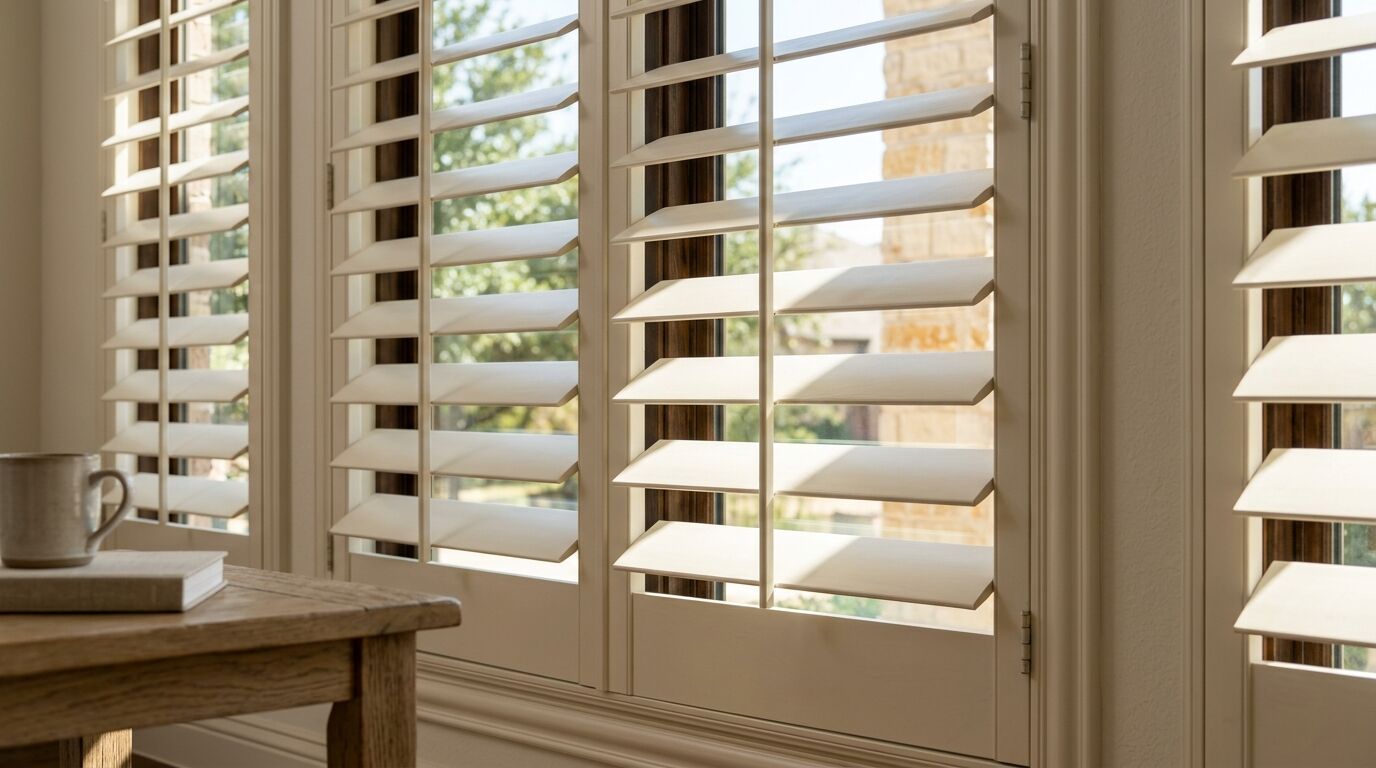
Shutters handle a west window well because solid louvers close tighter than slats and cover the opening more completely. Closed up at five in the afternoon, a shutter panel shuts the sun down hard.
There is also a trick people miss. Tilt the louvers upward rather than closed, and the light bounces off the ceiling instead of hitting you in the eye. The room stays usable and bright without the glare on the television.
For a hot west window, poly or composite is usually the right material. It resists the warping that heat and sun cause over years, and it holds a crisp white without yellowing. Hardwood belongs in the rooms where you want the widest louver and the grain, which are typically not the ones taking direct afternoon sun.
Two-Story Great Room Windows
Almost every newer home around here has them: a stack of tall windows above the main run of glass, facing west, throwing light across the whole first floor. They are also fifteen feet up.
The product question is easy. Solar screens or cellular shades both work up there. The problem is that nobody is getting a ladder out twice a day, so an upper window with a manual shade ends up permanently down or permanently up.
That is the case for motorized shades. Battery-powered motors handle most retrofits with no electrician and no rewiring, and you can set the uppers to close on a schedule so the room is already shaded before the sun gets there. A common setup is motorized shades on the tall glass and shutters on the windows you can reach.
Layering the Worst Windows
Some windows need two things. A solar screen at the glass takes the glare and the direct heat, and drapery panels on either side give you the option to close the room down at night.
In a tall room, panels do something else worth knowing about: they soften the echo. A great room with hard floors, a lot of glass and no fabric anywhere sounds like a gymnasium, and most people blame the ceiling height.
What About Fading Floors
This is a legitimate worry in Texas, and it comes up on nearly every consultation. Direct sun fades wood floors, rugs, leather and artwork, and a west wall delivers the most of it.
No window covering stops fading completely, and be careful with anyone who promises a specific percentage. What a covering does is cut the hours of direct exposure on the floor, which slows the process down. If you have a hardwood floor running up to a west window, that alone is often reason enough to cover the glass properly.
Where to Start
Walk the house at about five in the afternoon in the summer, which is the only honest way to know which windows are actually the problem. Most homes have two or three, not ten.
Then match the room to the product. Living areas where you want the view: solar screens. Bedrooms where you want the room cool and dark: cellular. Front-facing and everyday rooms where you want the built-in look: shutters. Tall glass: motorized, whatever the fabric.
If you would rather have somebody look at it with you, Sheila does the consultation herself, in your house, in your afternoon light. She works with homeowners across Frisco, Prosper, Celina, McKinney and the surrounding area. Call or text (972) 523-6399 and she will come measure the windows that are giving you trouble.
See it in your own light.
Every room measures differently. Sheila comes to your home, looks at your actual windows and light, and helps you choose what fits. No showroom pressure, no obligation.
Book a free consultationProduct options, pricing and lead times vary by manufacturer and by window. Details here are general guidance — your in-home consultation is where we confirm what actually fits your home.