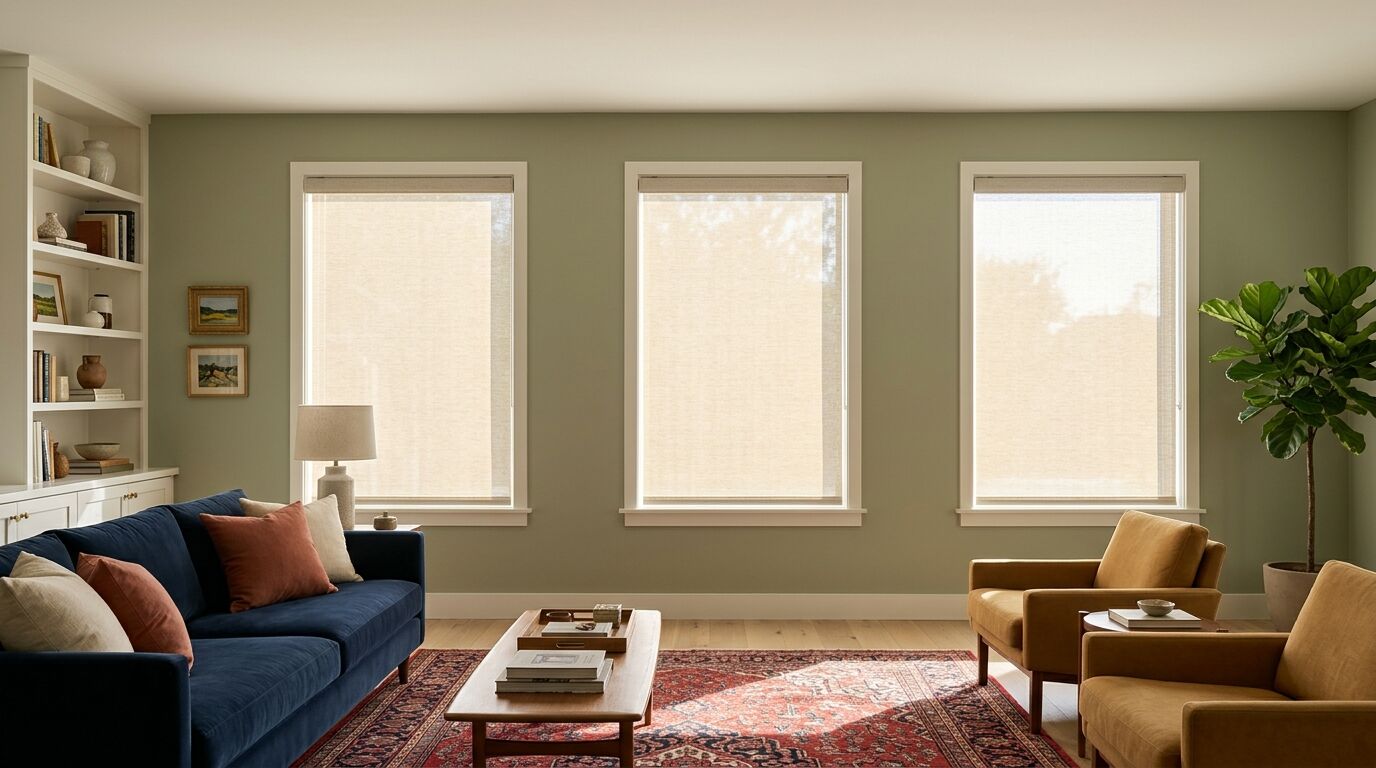
People rarely call about fading. They call about a stripe. A band of pale oak running across the floor where the afternoon light lands, or a rectangle of darker wood that turns up the day a rug finally gets moved. By then it has been happening for two or three years and nobody watched it happen. Texas sun is patient and the change it makes is permanent, and it comes in through the exact windows you bought the house for.
- UV is the largest single cause of fading but not the only one. The National Fenestration Rating Council puts UV at roughly 40 to 60 percent of the damage, with visible light, heat, humidity, the age of a fabric and its dyes accounting for the rest.
- Low-e glass reflects a good share of UV and is not a complete answer. NFRC states low-e coated glass reflects up to 74 percent of UV, against about 40 percent for ordinary insulating glass.
- Wood floors do not only lighten. Depending on species and finish they can darken instead, which is why a shifted rug leaves a dark ghost rather than a pale one.
- Rugs, sofas and stacks of books all act as masks. The mark you get is the shape of whatever was sitting there.
- Something physical between the sun and the room, for part of the day, is what actually slows this down.
- West and south-facing glass is where the money goes first.
- No window covering stops fading. It buys you years.
What Is Actually Bleaching the Room
Sunlight arriving at your window is three things at once: ultraviolet, visible light and infrared heat. All three take part in fading, along with humidity and the chemistry of the dye or finish itself.
UV does the most. In its fact sheet on ultraviolet radiation and fading, the National Fenestration Rating Council attributes about 40 to 60 percent of fading damage to UV radiation, and notes that visible light, heat, humidity, the age of the fabric and the dyes used all contribute as well.
Two things follow from that. First, UV control is worth doing, because it is the biggest lever available. Second, blocking every bit of UV would still leave you with visible light landing on the floor, and visible light on its own will keep working on a dye. Anyone who promises you a product that ends fading is selling something.
Low-E Glass Helps More Than People Think and Less Than They Hope
Almost every home built here in the last fifteen years came with low-e glass, and a lot of homeowners take that to mean the fading question is settled.
NFRC's numbers are worth knowing. Clear single-pane glass reflects roughly 25 percent of incoming UV. Ordinary insulating glass reflects up to about 40 percent. Low-e coated glass reflects up to 74 percent. That is a real improvement and your builder did you a favour.
It also means a quarter or more of the UV is still arriving, every clear afternoon, on top of the full load of visible light and heat that low-e coatings are not built to stop. On a west wall in July that adds up fast.
Wood Changes Colour, It Does Not Simply Fade
Raw hardwood is photosensitive. Light changes its colour over time and the direction depends on the species. Some woods bleach lighter. Cherry famously deepens toward red. American walnut tends to lose depth and go softer and browner.
Stain and finish change the outcome again. A pigmented stain can bleach on a different timetable than the wood under it, so a floor can go patchy rather than evenly lighter. Oil-modified polyurethane ambers on its own as it ages, independent of anything the sun does.
This is why the ghost under a rug is sometimes darker than the floor around it and sometimes lighter, and why the two halves of a room that met the sun differently never quite match again after refinishing. The exposure difference lives in the wood, not only in the surface coat.
The Rug Line Nobody Plans For
Anything sitting on a floor in the sun is a mask. Rugs, sofa feet, a dog bed, a plant stand, a stack of magazines left in the same spot all summer. The floor under them stays where it started while everything around them moves on.
Two habits cost nothing. Rotate area rugs a couple of times a year, and shift the larger furniture slightly when you do. Even a few inches breaks up a hard edge into something gradual that the eye forgives.
Rugs themselves fade, and wool and silk fade faster than the floor they are protecting. A hand-knotted rug with a west-facing window on it is often the most valuable thing in the room and the least protected. Same for leather upholstery, which stiffens and lightens where the sun sits on it, and for art on paper, which has no recovery at all.
What Actually Works at the Window
Every option here works the same basic way. It puts material between the sun and the room for part of the day. They differ in how much view you keep while it is doing that.
Solar screen shades. The usual answer for a room you want to keep looking out of. The fabric is a woven mesh rated by openness factor, roughly 1 percent to 14 percent, and that single number sets everything. A 3 percent screen cuts a lot of sun and glare and keeps a soft view outward. A 10 percent screen keeps the view sharp and lets more through. Lower openness also gives more daytime privacy from the street. None of them do anything at night once your lamps are on. We go through these in more detail on our custom shades page.
Cellular shades. The honeycomb structure traps air, so these do more for heat than a flat fabric does. Room-darkening and blackout cell fabrics stop the most light of anything in the shade category, and they stop the view along with it. Good for a west bedroom, wrong for a room you sit in during daylight.
Plantation shutters. Louvers give you an adjustment nothing else has. Tilt them upward and you throw the light onto the ceiling instead of onto the floor, keeping the room bright while taking the direct beam off your rug. On a hot sunny window, poly shutters are the right build, since real wood in that kind of heat is asking for trouble.
Lined drapery. A lining is the working half of a drapery panel. It shields the face fabric so the panel itself lasts in the sun, and blackout or interlined constructions stop considerably more light than an unlined panel. Drapery pairs well with a solar screen: the screen handles the daily glare, the panels close when you want the room dark.
Where to Spend First
If you are covering a house in stages, sort the rooms by exposure and by what is in them.
West-facing glass is the priority in North Texas. From spring through September the sun drops into those windows around mid-afternoon and stays there until it sets, at the hottest part of the day and the lowest angle, which is why it reaches so far into the room. We wrote about that problem specifically in our guide to treating west-facing windows in North Texas. South-facing glass runs a longer, gentler exposure across the whole middle of the day and matters most in winter, when the sun is low.
Then look at what is in the room. Hardwood, a wool rug, leather seating, a piano, art on paper. A guest bedroom with carpet and a duvet can wait. A great room with white oak floors and a rug you chose carefully cannot.
Two-story great rooms are their own case. The upper bank of windows on those walls is usually the one doing the damage, and it is also the one nobody can reach, so it stays uncovered for years. That is the honest argument for motorization on tall glass: a shade you can schedule actually gets used at 3pm, and a manual one twenty feet up never does. In Frisco homes with tall rear-facing window walls that upper bank is nearly always where I start.
Being Straight About the Limits
Sunlight will change your floors and your furniture. The only house where that does not happen is a house nobody wants to live in.
What you get to choose is how fast, and whether the change lands evenly across a room or as a hard-edged stripe by the back windows. Covering the worst two or three hours a day on the worst two or three windows does most of the available work. That is a modest project, not a whole-house one.
You will notice I have not put a percentage on any of it. Fading depends on your glass, your orientation, your overhang, your species of wood and the dye in your rug, and anyone quoting you a single number for how much a shade saves your floor made that number up.
If you want to know which of your windows are the ones doing it, that is the sort of thing worth looking at in person, in your actual light. Book a free in-home consultation or call or text (972) 523-6399, and Sheila will walk the house with you.
See it in your own light.
Every room measures differently. Sheila comes to your home, looks at your actual windows and light, and helps you choose what fits. No showroom pressure, no obligation.
Book a free consultationProduct options, pricing and lead times vary by manufacturer and by window. Details here are general guidance — your in-home consultation is where we confirm what actually fits your home.