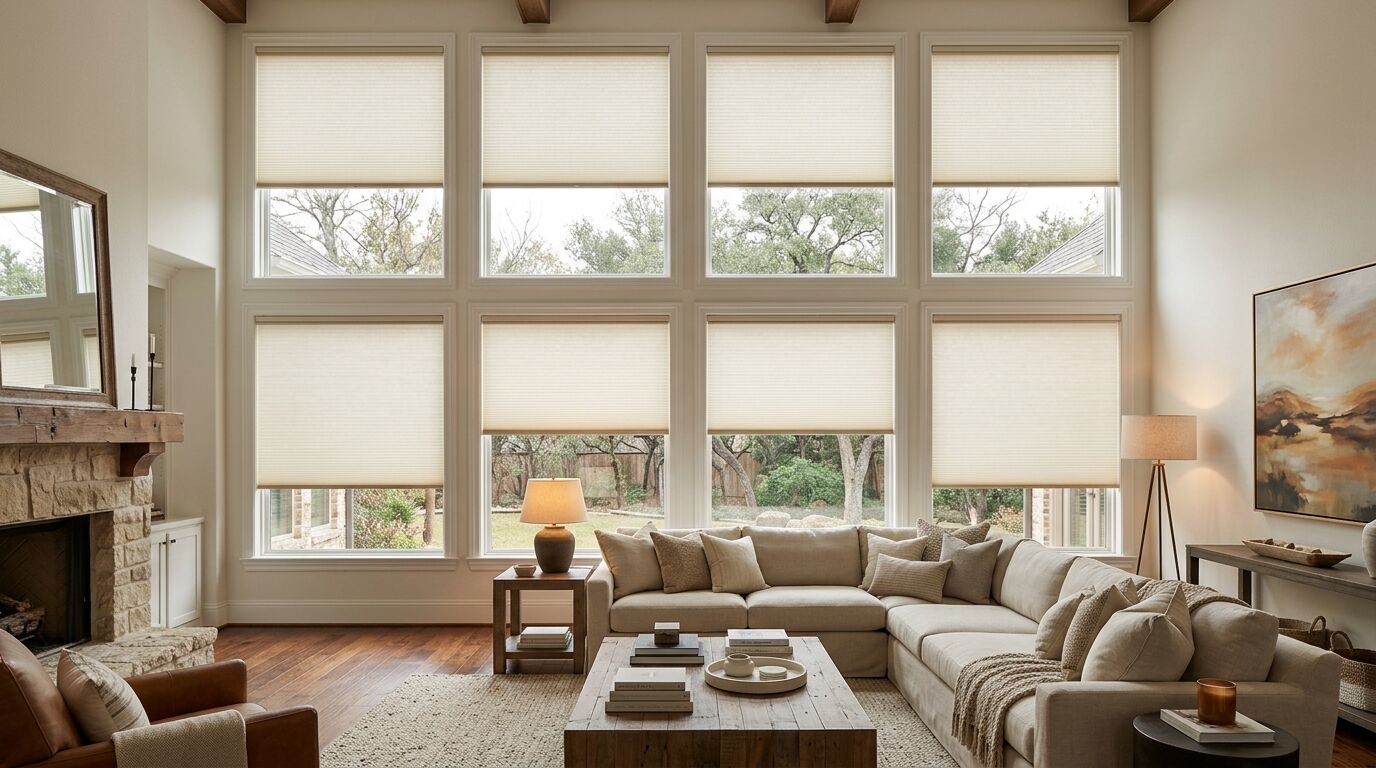
A two-story great room window is the reason a lot of people in Prosper and Frisco call about window coverings at all. The glass looks wonderful in January and turns the room into a greenhouse by July, and nobody in the house can reach it. Almost every regret we see on tall windows traces back to two decisions made early: where you break the window, and how you plan to operate the part you cannot touch. Get those two right and the fabric choice is the easy part.
- A two-story window is really two windows. The lower bank is a privacy and glare problem at eye level. The upper bank is a heat, fade and reach problem.
- Covering the upper and lower banks as two separate treatments usually looks better and works better than one enormous shade.
- Motorize whatever you cannot reach. Battery motors handle most retrofits with no electrician and no wiring.
- Ask how the motor gets recharged before you order, not after the installer leaves.
- Any corded product on a tall window means a very long cord. Cordless and motorized options remove it.
Why Tall Windows Turn Into Regrets
The most common outcome on a two-story window wall is a treatment that nobody ever moves. It gets installed, it looks right in the photos, and then it stays exactly where the installer left it for five years. Once that happens you have paid for a window covering and received a fixed decorative panel.
Reach is the whole reason. A great room in a newer North Texas home often runs sixteen to twenty feet at the ridge, and the upper windows sit well past what a step ladder gets you to. So the wand never gets pulled and the shade never comes down, which means the room still cooks at four in the afternoon and the sun keeps working on the floor.
And the sun here does work on the floor. Texas afternoon light fades hardwood, rugs and upholstery, and a west or southwest great room takes the worst of it. That is the same problem we walked through for west-facing windows in North Texas, except on a two-story wall you have twice the glass and half the access.
Where to Break the Window
Most builder window walls already tell you where to break. There is a horizontal mullion somewhere around the eight or nine foot line where the lower units meet the upper ones. That line is your friend.
Break there and the lower treatment sits inside normal human reach. You can tilt it, raise it, dust it and adjust it by hand on a Tuesday morning without thinking about it. The upper treatment gets motorized, gets set on a schedule, and you stop thinking about it too.
Running one continuous shade from the ceiling to the floor sounds tidier and usually is not. A single shade that tall carries real fabric weight, needs a thicker roller tube or a deeper stack at the top, and puts the entire wall on one mechanism. If that one shade ever needs service, the whole room is uncovered until it is fixed. Two shorter units cost more in hardware and are far easier to live with.
The visual trick is to make the two read as one. Same fabric, same colour, same frame or cassette finish, and the two units aligned so the seam falls on the mullion rather than floating in the middle of the glass. Done properly, most people never notice there are two.
Great Room Window Coverings That Actually Hold Up
There is no single right answer for a tall window wall, but there are four that come up over and over in these homes.
Cellular Shades
Cellular, or honeycomb, shades trap air inside the cells, and that pocket of still air is what slows heat moving through the glass. They stack up small at the top of the window, which matters a lot on a tall opening where a bulky stack would eat into the view. The Department of Energy’s guide to window coverings is a decent neutral read on how the various types behave.
Solar Screen Roller Shades
Solar screens are rated by openness factor, roughly 1% to 14%. A tighter weave stops more sun and more glare and softens the view out. A more open weave keeps the view sharp and lets more sun in. On a great room that faces west, the tighter end is usually the right call, because the problem is low direct sun rather than general brightness. One honest limitation: a solar screen gives you no privacy at night once the room is lit. That is physics, not a product flaw.
Shutters Below, Shades Above
This is a favourite combination here. Custom plantation shutters on the lower bank give the room an architectural look at eye level, they never need cleaning beyond a dust, and they handle privacy on the windows people can actually see into. The upper bank gets a motorized shade in a colour that agrees with the shutter frame. You get the built-in look where it shows and the practical answer where it counts.
Drapery
On a two-story wall, drapery is mostly about softening a hard room full of glass and stone. Panels that tall are heavy, the rod goes up near the ceiling, and the fabric needs enough structure to hang straight rather than flare. Drapery pairs well with a shade behind it and rarely does the whole job by itself.
Motorized Shades for Hard to Reach Windows
Reach is the reason people motorize a great room. The luxury framing is what the ads sell, and it is beside the point when the shade is eighteen feet up.
The fear we hear most often is that motorization means opening walls and running wire. For most retrofits it does not. Battery-powered motors sit inside the headrail or the roller tube, talk to a remote over radio, and need no electrician at all. If you are still in construction or doing a real remodel, pre-wiring the upper windows is worth doing, because a hardwired motor never needs a battery again. Either path lands you at motorized shades that move when you tell them to.
Control is by remote, phone app or voice, and these systems work with Alexa and Google Home. The feature that actually changes how the room feels is the schedule. Set the upper shades to close at three in the afternoon from May through September and the great room stops being a place you avoid after lunch. Nobody has to remember anything.
Motorization also solves the cord question. Corded blinds are a documented strangulation hazard for young children, and on a twelve foot window the cord is long enough to be a genuine problem. Cordless and motorized products remove the cord entirely, which is why they are the standard answer in homes with kids or dogs.
The Question Almost Nobody Asks
Here is the one to bring up before you order: how does that motor get power in three years?
A battery motor eighteen feet in the air is fine until it is flat. Depending on the product, the answer might be a rechargeable battery wand you pull down and plug in, a small solar charging panel mounted at the window, or a hardwired feed if the wall is open. All of those are reasonable. What is not reasonable is finding out on a Saturday that the plan involves renting a lift.
Same thinking applies to service. Sheila will make every effort to repair a shutter or a shade, including ones that came from somebody else years ago, and when a repair is not possible we replace and match as closely as we can. On a tall window that matters more, because you are not going to swap a twelve foot shade casually.
What the Street Sees
New construction in Prosper, Celina and Frisco comes with HOA expectations about what the front of the house looks like, and the upper window of a two-story great room is often the most visible piece of glass on the whole elevation. The usual requirement is a uniform white or neutral backing on street-facing windows.
That is easy to satisfy and easy to forget. Plenty of shade fabrics offer a neutral back with whatever colour you want facing in, so the room gets the warm tone and the street gets the white. Worth confirming before the order goes in rather than after.
How Long It Takes
Timing depends on the product. Blinds and shades typically run about two to three weeks from order to installation. Plantation shutters usually run six to eight weeks across the industry, and some manufacturers stretch toward twelve in a busy season. Drapery varies too much to put a range on. These are typical ranges rather than promises, and the exact timeline gets confirmed the day the order is placed.
The measure is where a tall window project succeeds or fails. Custom orders are not returnable, mullion lines are rarely as level as they look from the floor, and a half inch of error at eighteen feet shows from across the room. Sheila measures the actual windows in the actual light, which is also when the battery question and the HOA question get settled. If you want to talk it through, book a free in-home consultation and we will start there.
See it in your own light.
Every room measures differently. Sheila comes to your home, looks at your actual windows and light, and helps you choose what fits. No showroom pressure, no obligation.
Book a free consultationProduct options, pricing and lead times vary by manufacturer and by window. Details here are general guidance — your in-home consultation is where we confirm what actually fits your home.