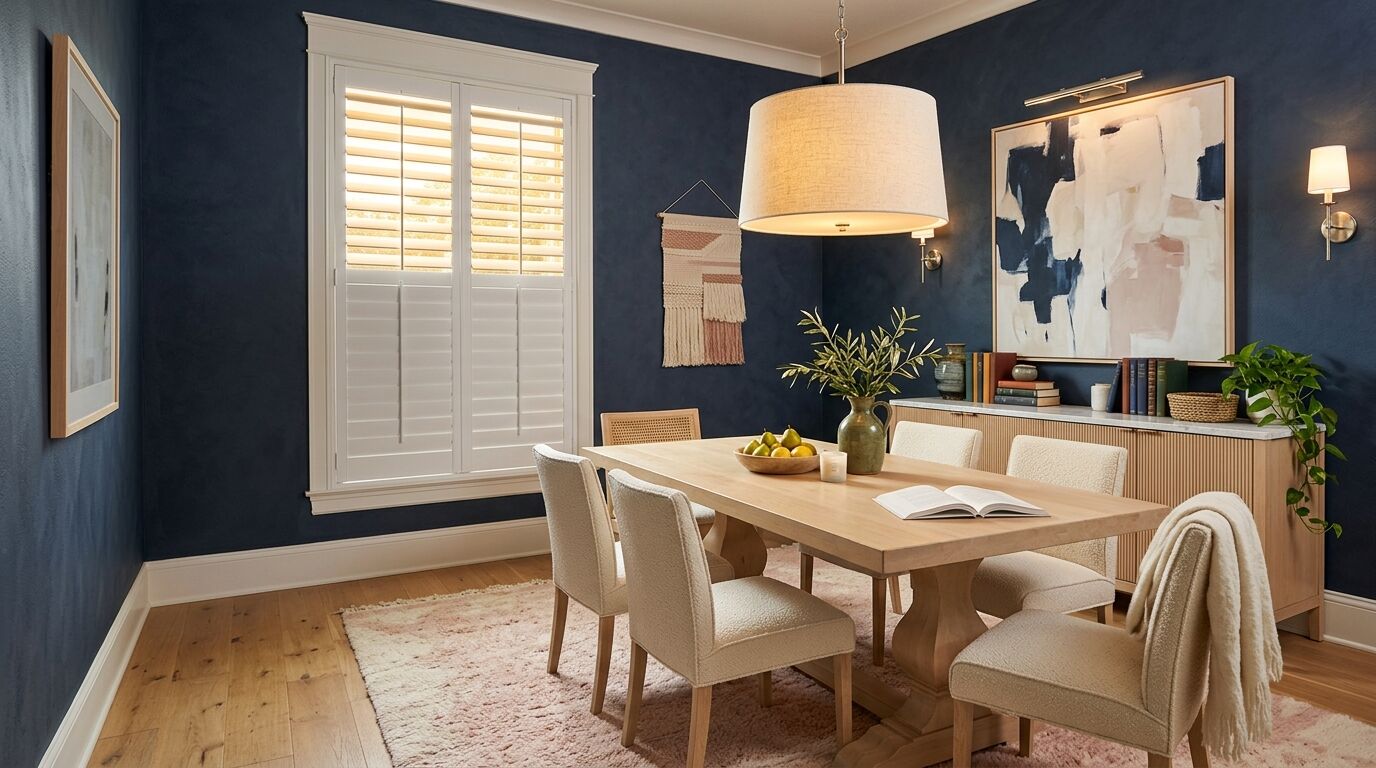
A shutter panel is joinery, and tall joinery wants to move. A divider rail is the fixed horizontal rail that runs across the panel to stop it. It comes with a second benefit that most people end up using every single day: two sets of louvers that tilt independently, so you can open the top for light and keep the bottom closed for privacy. On a tall window that is usually the feature that decides the order.
- A divider rail is a fixed horizontal rail across a shutter panel. It splits the louvers into two tiers, and each tier gets its own tilt rod.
- It does two jobs at once. It stiffens a long panel, and it lets you open the top while the bottom stays shut.
- Most shutter lines cap how tall a panel can be built without one. The figure varies by manufacturer and material and commonly lands somewhere near 65 inches.
- Some lines want a second rail once a panel runs past about eight feet.
- Dead centre is the factory default. It is not automatically the right place for your window.
- If the window already has a horizontal line in it, put the rail on that line.
- Across a room, set rail height from the floor so the rails agree with each other, rather than centring each panel on its own.
- Split tilt gives you the same independent control with no rail across the panel. It adds no strength, so it does not raise the height limit.
- The rail is built in at the factory. It cannot be added to shutters you already own.
What a Divider Rail Is
Every shutter panel is a frame. Two vertical stiles down the sides, a rail across the top, a rail across the bottom, and the louvers hung between them. A divider rail is a third rail, fixed horizontally somewhere in the middle, in the same material and the same paint as everything around it.
Adding it changes how the panel works. The louvers above the rail and the louvers below it become separate groups, and each group gets its own tilt rod. One panel now gives you two independent tiers instead of one long run.
The rail is built into the panel when the panel is made. Nobody cuts one into a finished shutter afterwards, which is why this has to be settled before the order goes in.
The Structural Job Nobody Mentions
The reason a rail is required rather than optional on a tall window has nothing to do with light. A panel is a frame hanging off two or three hinges along one edge. The taller it gets, the more weight sits on those hinges, and the more the stiles can bow away from each other in the middle.
Hardwood moves with humidity, and North Texas gives it plenty of reason to. Poly and composite panels do not move the same way, but they are heavier, so a long panel carries more load on the same hardware. Either way, a rail ties the two stiles together at the middle and keeps the panel square. A panel that stays square still closes flat against its frame in year ten.
Most shutter lines set a maximum panel height without a rail. The exact figure varies by manufacturer and by material, and it commonly lands somewhere near 65 inches. Some lines want a second rail once a panel runs past about eight feet. Ask what the line you are ordering requires rather than assuming it matches whatever a neighbour got.
The Part You Will Use Every Day
Two tiers means two tilt rods, and that is where the rail earns its keep. Close the lower tier flat and open the upper one, and the room keeps its daylight while anyone at street level sees a solid painted panel.
That setting solves a specific list of rooms. A formal dining room on the front of the house. A study where you take calls facing the sidewalk. A downstairs bedroom that looks onto a driveway.
It handles the other North Texas problem too, the one that shows up around four in the afternoon. On west-facing glass the low sun arrives above eye level first. With a divider rail you can shut the upper tier against the glare and leave the lower one open, which is the privacy setting in reverse and just as useful. Our post on tall window treatments in a two story great room covers the reach problem that tends to come with windows this size.
Where the Rail Should Sit
Most quotes default the rail to the middle of the panel. That is a manufacturing convention rather than a design decision, and on plenty of windows it is the wrong place.
Start with the window itself. If there is a horizontal line already in the opening, put the rail on it. The meeting rail on a double hung. The bar under a transom. The line where a mullion crosses a tall unit. Land the shutter rail on that line and the two read as one. Miss it by two inches and you have two horizontals arguing with each other across the glass, which is the sort of thing you cannot stop seeing once you have seen it.
If the window gives you nothing to align to, work from sightlines instead. Standing eye level for most adults sits a little over five feet, and that is roughly the line somebody on the sidewalk looks along. A rail near that height puts the closed lower tier exactly where it does the most good.
Then check the room as a whole. Windows of different heights, each with its rail centred in its own panel, produce a stepped and ragged line around the walls. Pick one height from the floor and hold it on every window you can take in from a single spot. That is the same logic behind choosing one louver size for a room, and it matters for the same reason.
Last, look at the furniture. A rail that lands dead level with a sofa back, a counter or a headboard reads as an accident. Move it three or four inches and the accident disappears.
One more note on dead centre. On a long panel a rail sitting slightly above the midpoint usually looks better than one sitting exactly on it, the same way a picture hung a touch high reads better than a picture hung low.
Divider Rail, Split Tilt or Tier on Tier
These three get confused with each other constantly, and they are doing different things.
A divider rail puts a solid horizontal rail across the panel and gives each tier its own tilt rod. It adds real stiffness. The trade is a few inches of glass sitting behind solid material.
Split tilt leaves the louvers running uninterrupted from top rail to bottom rail and splits the tilt rod instead, so the upper and lower louvers move separately. You get the same light and privacy control with a cleaner face and no solid band across the window. What you do not get is strength. Split tilt adds nothing structurally, so it cannot raise the height a panel is allowed to be built to.
Tier on tier stacks two separate panels, each hinged and each swinging open on its own. It is the most flexible of the three and it carries the most hardware. It suits very tall windows and looks awkward on short ones.
A hidden tilt rod changes how obvious any of this reads. With the rod gone from the face of the panel, a divider rail becomes the only horizontal interruption in the louvers, which some people like and some people do not.
What Gets Settled at the Window
Panel height decides whether you have a choice at all. Under the manufacturer limit, a rail is yours to take or leave. Over it, the rail is coming, and the only open question is where it goes.
Sheila measures the opening, reads what the window itself is doing, checks what the front of the house shows the street, and marks a rail height that holds across every window in the room. In a new build in Prosper that often means a dozen windows at once, several of them different heights, all of them needing to agree on one line.
On timing, custom plantation shutters typically run 6 to 8 weeks from order to installation, and some manufacturers stretch to 12 in a busy season. A divider rail does not change that. The exact timeline gets confirmed the day the order is placed.
See it in your own light.
Every room measures differently. Sheila comes to your home, looks at your actual windows and light, and helps you choose what fits. No showroom pressure, no obligation.
Book a free consultationProduct options, pricing and lead times vary by manufacturer and by window. Details here are general guidance — your in-home consultation is where we confirm what actually fits your home.