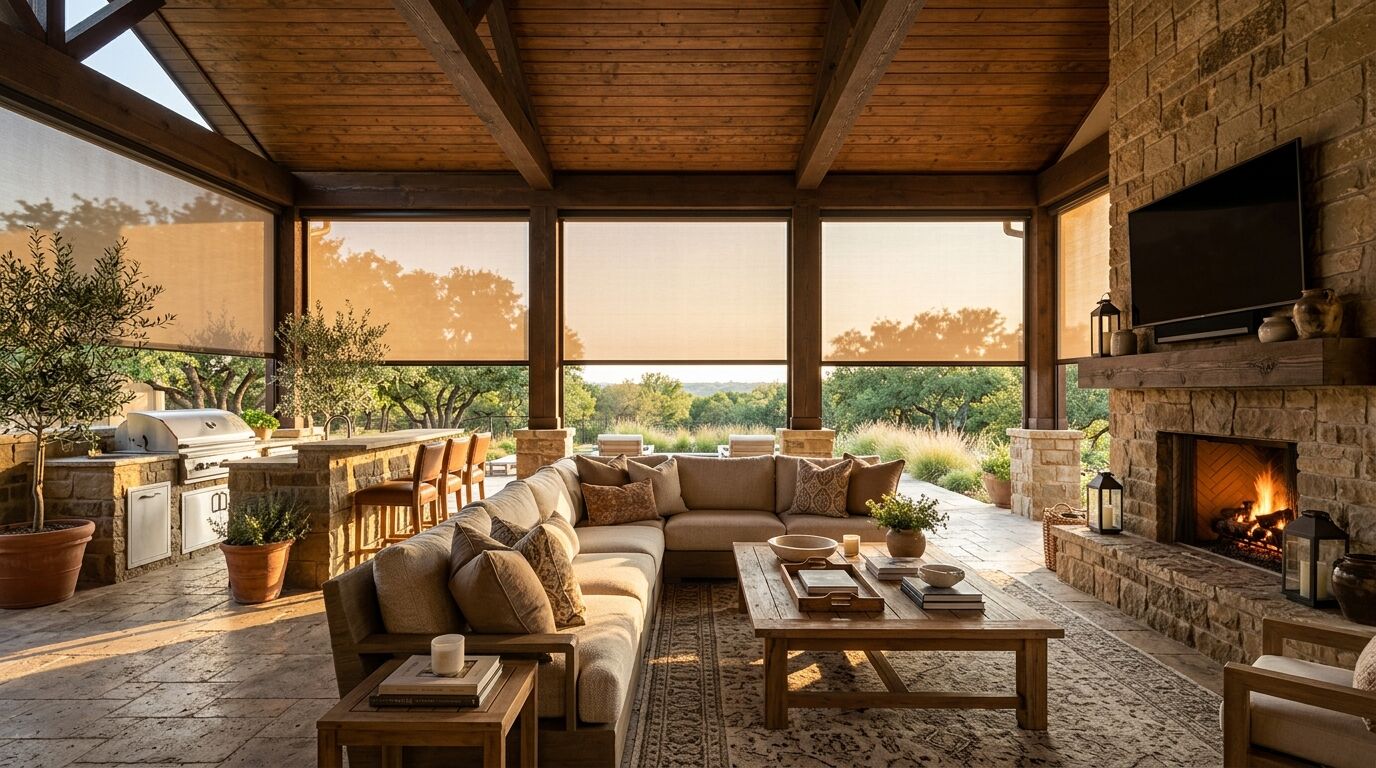
A covered patio in Prosper or Frisco is the best room in the house for about half the year. The other half it sits empty. The roof overhead handles the sun at noon and does nothing at five o'clock, when the light comes in sideways under the beams and the concrete is still holding the afternoon. Exterior screens are where most people land after the umbrella and the outdoor curtains both fail. Here is how they actually work, so you can ask better questions before you buy one.
- An outdoor screen is a roll of fabric in a housing at the top of the opening. It runs down a channel on each side to a weighted bottom bar.
- The side channel is the whole thing. It holds the fabric edge steady under wind and closes the gap insects use.
- Fabric openness decides how much sun you stop and how much of the yard you can still see.
- Open mesh keeps the view and the breeze. Solid vinyl blocks weather and seals the space off.
- A screen makes a hot patio usable. It does not make it air conditioned, and no fabric does.
What You Are Actually Buying
Strip away the marketing and an exterior screen is four parts. A roller tube with the fabric wound on it, a housing that hides the tube and keeps rain off it, a channel down each side of the opening, and a weighted bar sewn into the bottom edge.
Press a button and the tube unwinds. The bottom bar falls under its own weight and pulls the fabric tight. The side channels hold the two vertical edges so the middle cannot balloon out. Raise it and the whole thing disappears back into the housing, and your patio looks the way it did before.
That is the difference between a real outdoor roller shade and a length of shade cloth zip-tied to a post. The channels and the bottom bar are what turn fabric into a system that holds its shape.
The Sun: Openness Decides Everything
Solar screen mesh is rated by openness factor, which is the percentage of the weave that is holes. The range runs roughly from 1% to 14%.
A low number means a tight weave. More sun stopped, more glare knocked down, and a dimmer, softer view out. A high number means an open weave. You keep a clear view of the yard and the pool, and you accept that more sun comes through with it. There is no setting that gives you both, so the honest question is which one your patio needs at the hour you actually sit out there.
West and southwest exposures in North Texas usually want the tighter weave, because the problem there is low direct sun rather than general brightness. A patio that faces north and only needs the glare off a television can go much more open. This is the same physics we wrote about for west-facing windows in North Texas, one wall further out.
Which brings up a point people miss. If your patio screen hangs in front of the back windows of the house, it is shading those windows too, from the outside. The Department of Energy's Building America Solution Center guide on shading and solar control makes that point plainly: shading placed outside the glass is the most effective kind, because it stops the sun before the glass absorbs it and passes the heat inside. The screen you bought for the patio is doing a second job for the kitchen behind it.
The Wind: How the Fabric Edge Is Held
Wind is the reason the good systems cost what they cost, and it is worth understanding what you are paying for.
Every one of these screens lives or dies on how the vertical fabric edge is retained. There are a few real approaches:
Track-retained edges. A bead is welded or sewn into the fabric edge and locks into an aluminium channel, so the fabric is mechanically captured for the full height of the opening. A variation holds the channel closed with opposed magnets, which grip hard but let the edge flex out under a gust and then re-seat itself. Both keep the fabric in contact with the track while the wind is working on it. These are the systems engineered and rated specifically for high wind, and that engineering is the main reason a homeowner chooses one.
Cable-guided. A tensioned cable runs down each side and the fabric rides on it. Cheaper, common, and fine on a sheltered patio. Under load the fabric can bow away from the cable and open a gap along the edge.
Zipper systems. A sewn edge rides in a channel by friction. They work well when new. The friction fit is a wear point, and how long it stays tight varies a lot by how the system is built.
None of that is a knock on anyone selling the simpler versions. A screened breezeway on the east side of a house is a different job from a two-bay opening facing open field on the north edge of Celina. If a screen quotes you a wind speed, ask to see the manufacturer's published rating for that exact system, not a number from a brochure about a product family.
Mesh or Solid
Open mesh is the default and it is what most people want. Air moves through it, so the patio still feels like outside. You keep the view. Glare drops, direct sun drops, and the insects stop at the fabric.
Solid vinyl is a different tool. It blocks rain and blowing dust and cold, and it seals the space, which is the point in January. It also blocks the view completely unless it has a clear window panel set into it, and a sealed patio in August is a hot box. Plenty of homes here run mesh on the sides that get sun and one solid bay on the side the north wind comes from.
What a Screen Will Not Do
Two things worth being straight about.
A screen cuts the radiant load. The air on your patio is still outdoor air. On a 104 degree afternoon a shaded patio is meaningfully better than an unshaded one and it is still hot. Most people pair the screens with a fan and get their evenings back, which is usually the actual goal.
And solar mesh gives you no privacy at night. During the day it reads as a wall from outside, because the light is brighter out there than in. After dark, with your patio lights on, that reverses and the neighbours see in. If nighttime privacy is what you are after, that is a solid fabric conversation.
Motorized or Hand Crank
A hand crank is fine on a single narrow bay you raise twice a season. On a wide patio opening, or on three or four bays you want down at four o'clock and up after dinner, a crank stops getting used by about week three.
Motors here can run on battery, on low-voltage wiring, or on line power, and they take remote, wall switch or app control. Motorization on a big outdoor opening is about whether the screens get used at all, which is a different calculation from motorizing an interior shade.
What to Ask About Your Own Patio
Four things decide the answer, and none of them can be settled from a website. Which direction the opening faces and at what hour it hurts. How exposed the house is, since a patio backing to a greenbelt takes wind a patio between two houses never sees. Whether the columns and beams give a straight surface to mount channels to, because many covered porches do not. And whether you want to keep the view or close the space in.
Sheila comes out and looks at the actual patio, in the actual light, and measures the openings herself. Custom outdoor screens are built to those measurements and cannot be returned, which is exactly why nobody should be measuring their own. The free in-home consultation is where the fabric openness, the retention system and the timing get settled for your house.
See it in your own light.
Every room measures differently. Sheila comes to your home, looks at your actual windows and light, and helps you choose what fits. No showroom pressure, no obligation.
Book a free consultationProduct options, pricing and lead times vary by manufacturer and by window. Details here are general guidance — your in-home consultation is where we confirm what actually fits your home.