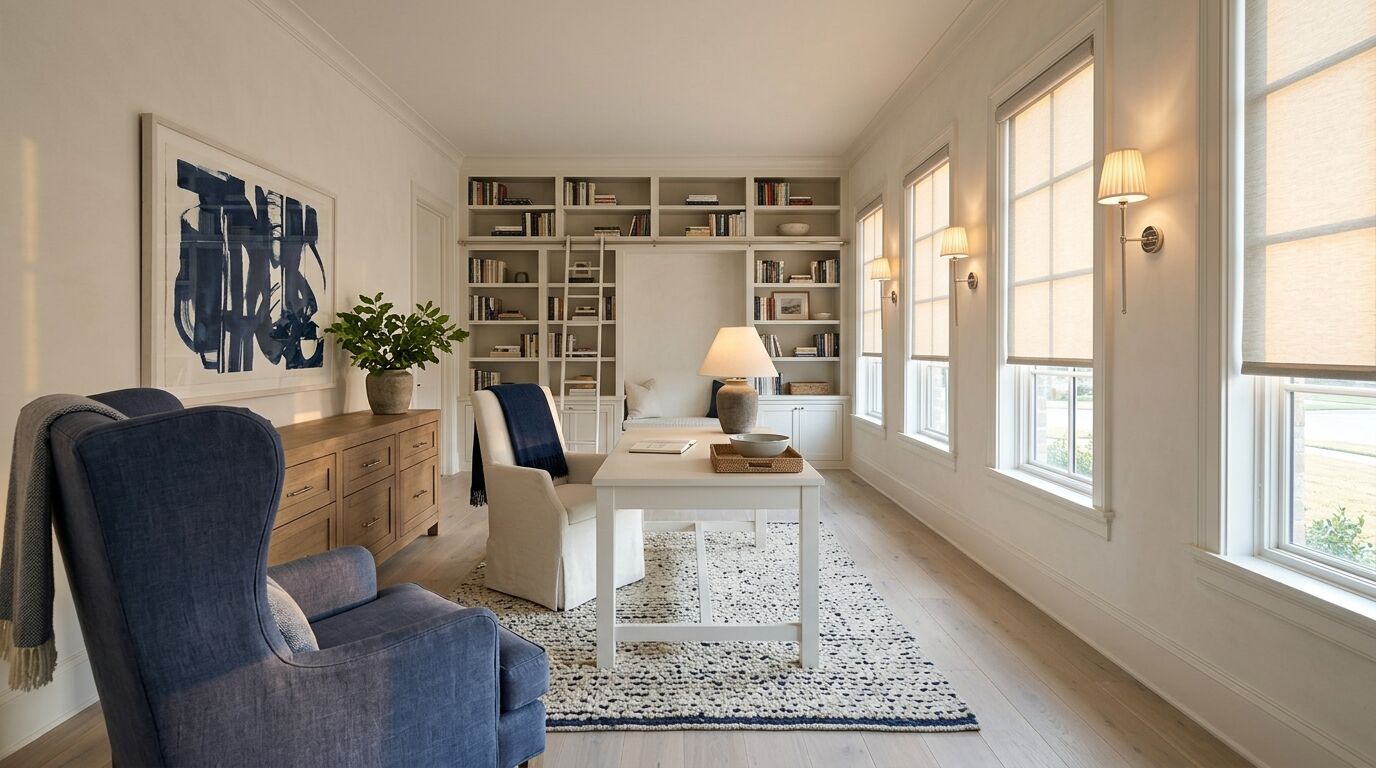
A great room with eight motorized windows does not need eight remotes. It needs a plan for which shades move together and which ones never do, and that plan is easiest to make before anything is ordered. Grouping is the word to know. A group is a set of shades that answers to one button, one app tile or one spoken phrase.
- Most motorized systems let you control shades one at a time, in groups, or all at once. The exact limits depend on the motor and the control system.
- Group by how the room is used and how the sun hits it, not by how the windows are numbered on the plans.
- West-facing glass usually earns its own group, because it needs shading hours before the north side does.
- Decide on groups while the windows are being measured. Regrouping later is possible, but it is easier to start with a plan.
- Sheila maps the groups with you at the consultation, window by window.
What Grouping Means for Motorized Shades
Every motorized shade has a motor, and every motor can be told what to do. Control systems differ in how many motors they can address and how they organize them. A simple handheld remote often has a set of channels, and each channel can hold one shade or several. A more capable system uses an app or a hub, and there you can build groups, name them and set them to move on a schedule.
The words matter because they get mixed up. A channel is a slot on a remote. A group is a set of shades you have chosen to move together. A scene is a saved arrangement, such as every shade on the sunny side down and the rest left open. Not every system offers all three, so it is worth asking which ones yours does.
How Many Shades Can Share One Remote
There is no single number that holds across the industry. Remotes vary in how many channels they carry, and systems vary in how many motors they will pair with one controller. Any figure we quoted here would be a guess about equipment you may not end up buying, so we leave it out.
What we can say is how to think about it. If you have a handful of windows in a room, one remote with a few channels is usually plenty. Once you are covering a whole floor, an app or hub becomes more useful than a drawer of remotes, because the groups live on your phone and you can change them without anyone visiting. Our post on smart home shades covers what that day-to-day control looks like.
Planning Motorized Shade Zones Around the Sun
In North Texas the sun is the real schedule. A west-facing wall of glass in a Frisco or Prosper great room can be hot and bright long before the east side needs anything. If all those shades share one button, you lower everything and lose the daylight you wanted.
Instead, think in zones that follow the light. One group takes the west or south glass that gets the afternoon sun. Another covers the street-facing windows, where privacy matters most. A third holds the rest, which you can leave open for daylight.
On a two-story wall, you may want the upper bank and the lower bank to move together so the fabric lines up. We wrote about that case in covering a two-story great room.
Individual Control Still Has a Place
Groups are for convenience. Nobody wants every shade in the house locked to the same behavior. A shade over a kitchen sink gets used differently from one behind a sofa. A bedroom shade you close every night does not belong in a group with a pantry window you never touch.
The best setups keep both. Each shade can be called up on its own when you need it, and the groups handle the routine moves. When you plan zones, leave a few shades out of every group on purpose.
Battery or Hardwired Changes the Planning
Power affects control too. Battery motors are common in retrofits, since most windows need no electrician, and they work well with remotes and apps. Hardwired motors suit new construction, where cable can be run before the walls are closed. We went through the trade-offs in battery or hardwired motorized shades.
Whichever you choose, ask how the motors talk to the controller and whether a hub is needed for app and voice control. Many systems work with Alexa and Google Home, but compatibility depends on the system, so confirm it for the one you are considering.
Questions to Settle Before You Order
A few decisions make grouping easy later. Walk through the room with a pencil and answer these:
- Which windows get direct sun, and at what time of day?
- Which windows need privacy at night?
- Which shades will you want to move one at a time?
- Will you control them by remote, app, voice or a mix?
Bring those answers to the consultation. Pricing depends on the shade, the motor, the size and the number of windows, so we do not quote figures here. If you are planning a room with many windows, book a free in-home consultation and Sheila will sketch the groups with you, standing at your actual windows. You can read more about our motorized shades before then.
See it in your own light.
Every room measures differently. Sheila comes to your home, looks at your actual windows and light, and helps you choose what fits. No showroom pressure, no obligation.
Book a free consultationProduct options, pricing and lead times vary by manufacturer and by window. Details here are general guidance — your in-home consultation is where we confirm what actually fits your home.