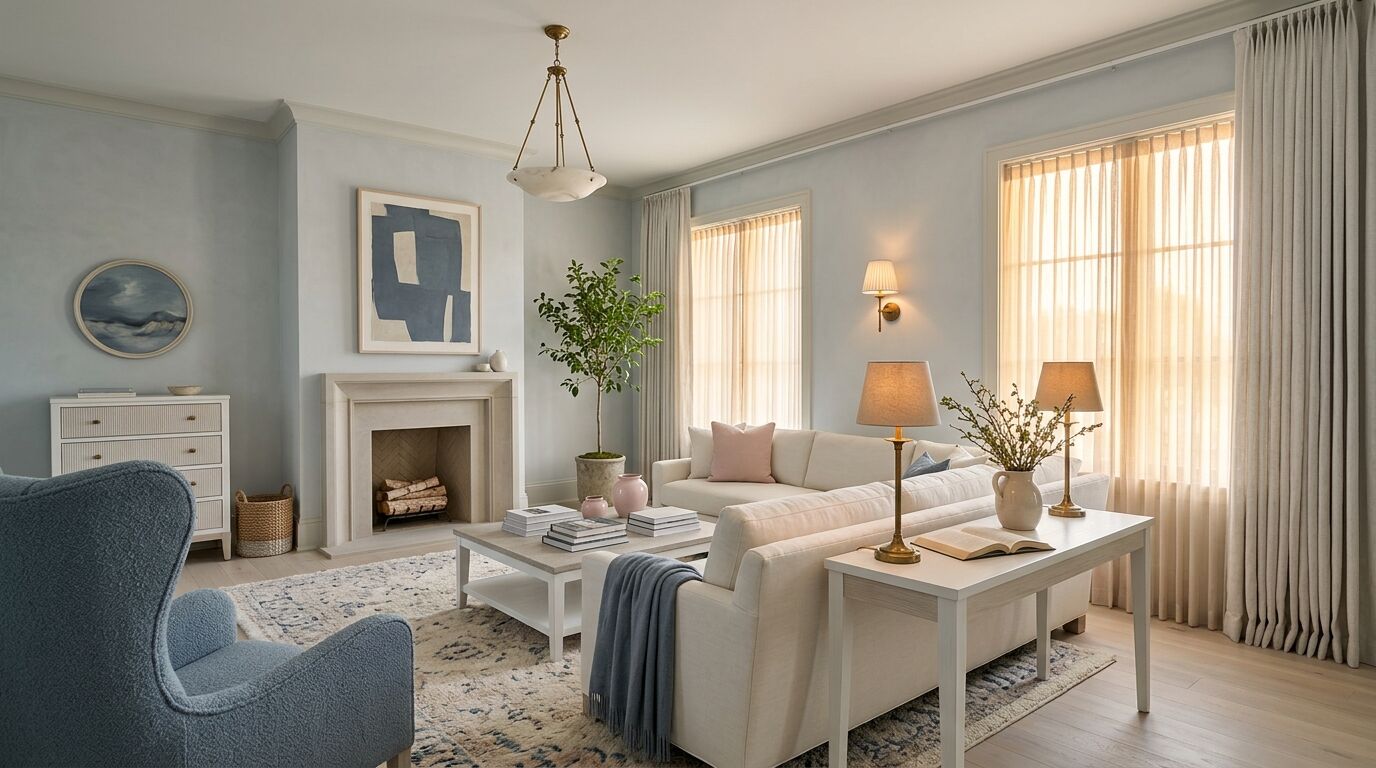
Drapery hardware gets picked last and noticed first. The rod or track decides how the panels hang, how far they stack back, and whether the window ends up looking tall or cut short.
- A rod suits a straight run on a standard window and shows off a decorative finial.
- A ceiling track hides the hardware, lifts the eye and glides more easily on a long wall of glass.
- The heading you choose narrows the options, so pick the heading and the hardware together.
- Heavy drapery over a wide span needs hardware that is supported along its length.
- Curved bays, uneven ceilings and motorization each point toward a particular system.
What a Rod Does Well
A rod is the familiar answer, and for good reason. It mounts on the wall above the window, it can be a feature in its own right, and a pinch pleat or grommet panel on a rod looks finished with very little else around it. On a single standard window, a rod is simple and easy to read.
The trade-off is the straight line and the visible hardware. Panels hang from rings or tabs that you slide by hand, and a long rod needs a support bracket in the middle so it doesn't sag under the fabric. That bracket is also a spot where rings catch when you pull the drapery.
What a Ceiling Track Does Well
A track mounts to the ceiling or sits recessed into it, and the panels hang from glides that run inside it. Nothing shows but the fabric. Because the drapery starts at the ceiling line, the window reads as taller than it is, which helps in a room with a lot of wall above the glass.
Tracks also move more smoothly across a wide opening. If you open and close the drapery every day over a slider or a long wall of windows, the glides do the work that rings drag against a rod. One design writer notes that a flexible ceiling track can be bent to a custom shape and lets you control how close the panels sit to the window, as Domino explains in its guide to hanging curtains from the ceiling.
The same piece points out the catch. The ceiling has to suit the design, and installation takes a ladder, drilling and a second pair of hands. Heavy drapery needs the weight spread over evenly spaced supports.
Let the Heading Pick the Hardware
Some headings only work on one or the other. A ripplefold panel is built for a track, because it uses evenly spaced carriers to form its regular, soft folds. A pinch pleat can hang from either, but it looks most traditional on a rod with rings. We went through how these two compare in our post on ripplefold and pinch pleat headings.
So the question is really what you want the panels to look like when they're closed, and when they're open.
Stack Back and Clearance
The place where drapery bunches when you open it is called the stack. A rod or track that stops right at the window frame leaves the stacked fabric sitting in front of the glass. Extending the hardware past the frame on each side lets the panels clear the window completely.
Fullness matters here too, since fuller drapery stacks wider. Our post on how much fabric drapery needs explains how to plan for it.
When the Window or Ceiling Gets Complicated
A rod restricts you to a straight line, which is one reason it struggles around a bay. A bent track or a curved rod made to your measurements follows the angles, and we touched on this in our post on bay and bow windows.
Ceilings matter as well. A track needs something solid to fasten to, and a ceiling with a lot of lines, steps or recessed fixtures takes planning. A rod only needs a good place on the wall. In a new build with a flat ceiling, a recessed track is easy to plan before the drywall is finished, which is worth knowing if you're still building.
Moving the Drapery by Hand or by Motor
If you want drapery that opens and closes with a remote or a schedule, tracks are the usual home for the motor, since the carriers already run in a channel. If you'd rather pull a panel by hand, a rod works well. Tell Sheila which you want before the hardware is chosen, because it's hard to add later.
How to Decide
Choose a rod if you like the look of the hardware, the window is a normal size and the run is straight. Choose a track if you want the hardware hidden, the wall of glass is wide, the heading is ripplefold or you may want a motor.
The easiest way to settle it is to hold fabric up in the room. During the free in-home consultation, Sheila measures the wall, checks the ceiling and shows you how each option hangs in your own light. Drapery timelines vary too much to state a range, so the exact timing is confirmed the day you order. Read more about custom drapery, or ask for a consultation.
See it in your own light.
Every room measures differently. Sheila comes to your home, looks at your actual windows and light, and helps you choose what fits. No showroom pressure, no obligation.
Book a free consultationProduct options, pricing and lead times vary by manufacturer and by window. Details here are general guidance — your in-home consultation is where we confirm what actually fits your home.