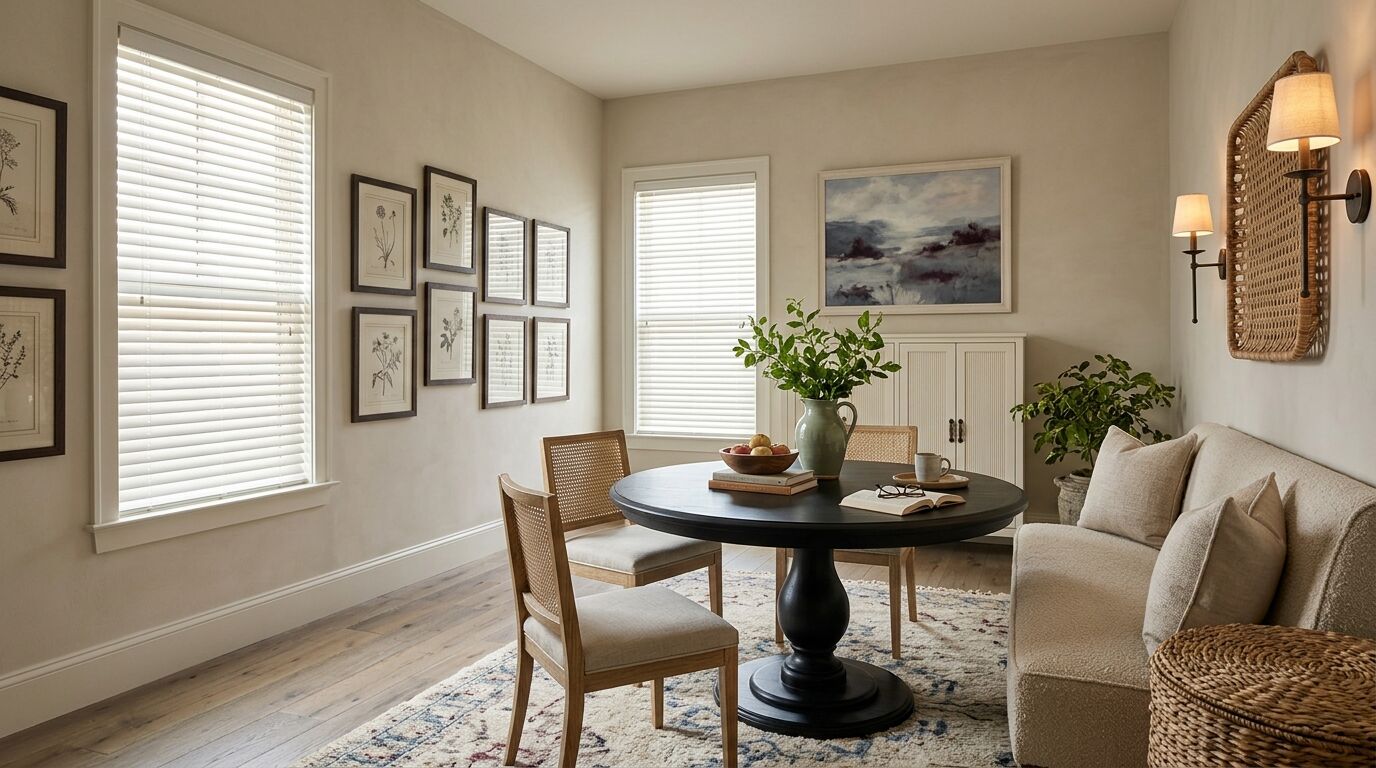
A stock blind is made in a standard size and trimmed down to fit. A custom blind is built to the measurements of your window. Everything else in this comparison follows from that one difference, and it is smaller on a good day and larger on a bad one than most people expect.
- Stock blinds come in set widths and drops. If your window matches one, the fit can be fine.
- When it doesn't match, a stock blind is cut down or left short, and the gap shows at the sides and the sill.
- Custom blinds are built to your measurements, so the headrail, the slats and the drop all land where the window does.
- Fabric, finish, slat width and lift options are wider in custom, including cordless and motorized.
- Stock is a reasonable call for a rental, a small utility window or a short-term fix.
- Custom orders can't be returned, which is why a careful measure matters more than the label on the box.
What "Stock" Actually Means
Stock blinds, sometimes sold as ready-made or off the shelf, are manufactured in a limited set of widths and drops and stocked in bulk. Some are trimmed to size at the store or at home. Others are simply sold as they are.
That works when your window happens to match. Plenty of windows do, especially in builder-grade houses where the same unit was used across a whole street. It stops working the moment a width falls between two stock sizes, which in newer construction happens more often than you'd think.
Where the Fit Goes Wrong
The usual problem is an inside mount in a window that is a quarter inch wider than the blind the box says it is. Blinds are built a little narrower than the opening so they can raise and lower without rubbing. When the blind is trimmed rather than built to the opening, that clearance can end up uneven, with a visible gap on one side and a snug fit on the other.
Light finds that gap at once. So does anyone looking in from outside at night. A custom blind is built to the exact opening with the clearance planned, so the edges sit evenly.
The drop has the same issue. A blind that stops short of the sill leaves a strip of bare glass. One that runs long puddles on the sill and bunches in the stack. If you want a closer look at how to take the numbers, our guide to measuring windows for blinds and shades walks through it.
What Custom Adds Beyond Fit
Fit is the headline, but the choices behind it matter just as much.
Custom blinds offer a wider run of slat widths, finishes and materials, so you can match trim colour more closely and decide between faux wood and real wood for each room. If slat width is the open question, we covered it in what changes between 1, 2 and 2.5 inch slats.
Lift and control options are wider too. Cordless lifts are common in custom, and motorized options exist across the range. Those are the choices that remove dangling cords, which matters if there are small children or pets in the house.
Odd windows are the other place custom pulls ahead. Oversized openings, sliding doors and anything out of square are awkward or impossible to cover well with a stock size.
When Stock Is the Right Call
It would be easy to say custom always wins. It doesn't.
If you rent, if the window is a small standard one in a utility space, or if you're covering something for a year or two before a remodel, a stock blind that fits reasonably well is a sensible choice. The same goes for a window that happens to match a stock size exactly. Spending more to fix a problem you don't have isn't a good trade.
Where stock tends to disappoint is the windows people see every day: the great room, the primary bedroom, the street-facing front of the house. Those are the ones where an uneven gap bothers you for years.
The Honest Trade-Off on Returns
Stock blinds can usually go back to the store if they don't fit. Custom blinds can't, because they're made to one specific window. That's the real cost of custom, and it's why the measure has to be right the first time.
It's also why we measure in person. Every opening gets checked at the top, middle and bottom, along with the frame depth and any obstruction that affects an inside mount. A small error multiplied across a whole house is what costs people money, and the in-home measure is there to prevent it.
How to Decide
Walk the house and sort the windows into two piles. The first pile is windows you see every day, windows with unusual size or shape, and windows where light control or safety matters. Those lean custom. The second pile is small, standard, out-of-the-way windows where an approximate fit is acceptable. Those can go either way.
Pricing depends on the product, the size, the material and how many windows are in the order, so we don't quote numbers in a blog post. What we can say is that the honest answer comes from seeing your windows. On timing, blinds and shades typically run 2 to 3 weeks from order to installation. That is a normal range rather than a promise, and the exact date is confirmed the day the order goes in.
Sheila brings samples to your home, measures each opening and tells you plainly which windows are worth building custom and which aren't. You can see the styles on our custom blinds page, and when you're ready to talk through your own windows, book a free in-home consultation.
See it in your own light.
Every room measures differently. Sheila comes to your home, looks at your actual windows and light, and helps you choose what fits. No showroom pressure, no obligation.
Book a free consultationProduct options, pricing and lead times vary by manufacturer and by window. Details here are general guidance — your in-home consultation is where we confirm what actually fits your home.