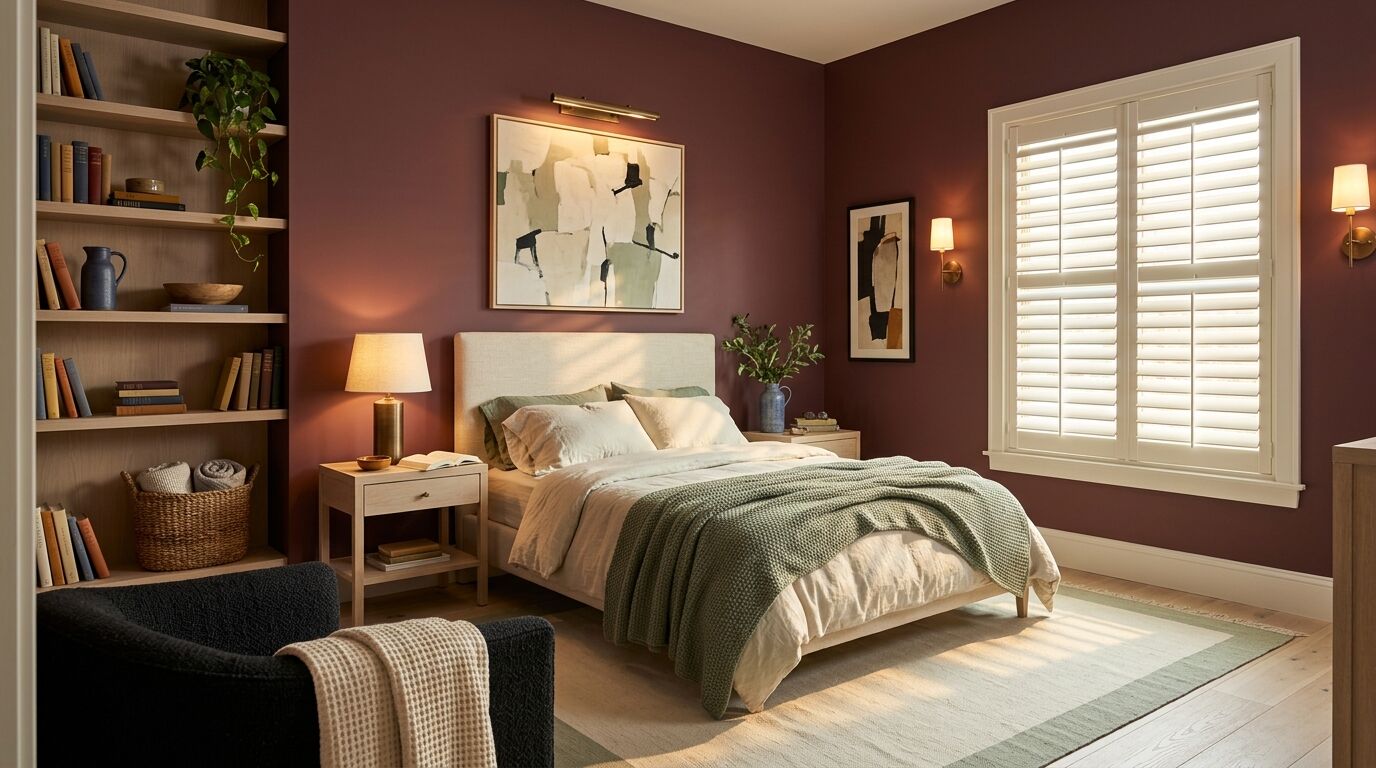
Most people pick a shutter white from a small chip held in their lap at the kitchen table. The panels arrive weeks later, go up in the opening, and something reads wrong against the casing they were meant to match. The panels are usually fine. The white got chosen in the wrong place, next to the wrong thing, in the wrong light.
- There is no neutral white. Every white leans warm, toward yellow or red, or cool, toward blue or grey. You only see the lean when a second white turns up beside it.
- Your builder trim already picked a side. Work out which one before you look at a single shutter sample.
- Shutter lines carry a short ladder of whites, running from a bright pure white through soft and off-white steps out to a warm cream.
- Poly and composite panels carry a factory finish, so the whites are a fixed set. Painted hardwood is where a custom match is generally possible.
- A shutter sits inside the opening with daylight behind it. The casing beside it is lit by the room. The same paint reads differently in those two positions.
- Sheen counts as much as color. Semi-gloss trim next to a lower-sheen panel looks like two whites even when it is one.
- The regret is almost always the near miss. Match closely, or differ on purpose.
- Test a real product sample, held up inside the window opening, in morning light and again at five in the afternoon.
Every White Leans Somewhere
Open any paint fan at the white page and you get forty rectangles that all look the same. They are not. Each one has a small amount of another color mixed into it, and that trace is what your eye latches onto the moment a second white shows up next to it.
Warm whites carry yellow, sometimes with a little red behind it. They read soft and creamy. Cool whites carry blue or grey and read crisp, cleaner, a bit sharper in bright light.
Alone on a wall you will never see the lean. Put two whites an inch apart at a joint and you will see nothing else.
Find Out What Your Trim Already Is
The quickest test costs nothing. Take a sheet of plain copier paper, which is about as close to a flat bright white as anything else in the house, and hold it against the window casing. A warm trim goes creamy or faintly yellow next to it. A cool trim goes slightly grey or blue. If the trim suddenly looks dingy, that is warmth, and it is a useful thing to know before you put a bright white panel in front of it.
Then find out what the paint actually was. A new build usually leaves a touch-up kit in the garage or the utility room, and the label on that can tells you exactly what went on the trim. Worth digging out anyway, since installation puts fasteners in the casing and you will want that paint eventually.
One more thing while you have the paper in your hand. Trim is often not a single white across a whole house. A room repainted after the punch list, a corner touched up with whatever was open, an upstairs run done on a different day: all of it drifts. Walk the rooms you plan to cover before you decide there is one answer.
The Whites A Shutter Comes In
Shutter lines do not offer one white. They offer a short ladder of them, usually running from a bright, slightly cool pure white at one end, through two or three soft and off-white steps, out to a warm cream at the other. The names differ by manufacturer and mean nothing. The position on that ladder is the part worth reading.
How much room you have to move depends on the material. On poly and composite panels the finish goes on at the factory and is part of the product, so you are choosing from a fixed set. Painted hardwood is where a custom match is generally possible, since the panel is being painted anyway and the finish can be mixed to a sample you supply. That is one more line in the poly versus wood decision, and it weighs more in a house with an unusual trim color than in one painted a common builder white.
A custom match is not free and it is not instant. Ask what it costs and what it does to the schedule before you commit, because shutters already run six to eight weeks from order in most seasons, and a special finish sits at the longer end of whatever range you are quoted.
The Shutter Will Never Look Exactly Like The Casing
This one catches people out, so it is worth saying before the samples come out. Even a perfect paint match will not read as identical on the window, for three plain reasons.
Position. The shutter sits inside the opening with daylight coming from behind it and across it. The casing around it is lit by the room. The same paint in those two places picks up different light, and the panel usually reads a touch cooler and a touch darker than the trim.
Sheen. Builder trim is generally painted in a semi-gloss, which bounces a lot of light straight back at you. Factory shutter finishes tend to sit lower than that. Two surfaces at the same color and a different sheen do not look like the same color from across a room.
Shape. A louver is a curved blade held at an angle. It carries a highlight along its top edge and a shadow underneath, all day, at every tilt. A flat casing has neither. The panel will always show more depth and variation than the trim beside it.
Laboratory identity is the wrong goal here. What you want is two whites that read as the same family, with nothing about the joint between them pulling your eye.
Match Closely Or Differ On Purpose
Almost every shutter color regret I hear about is the near miss. A soft white panel against a cool white casing, close enough to look like an attempt at a match and far enough that it failed. Your eye reads it as a mistake even when you cannot say what is wrong.
There are two ways out and both of them work.
Go close. Pick the step on the ladder nearest your trim and check it in the opening. Small differences vanish at the distance people actually stand, which is the doorway of the room and not eighteen inches from the casing.
Go clearly different. A warm cream panel inside a crisp white casing looks intentional, because nobody could mistake it for a failed match. The same goes for a stained hardwood panel, or a painted color pulled off the wall or the cabinetry. Shutters read as architecture, so a deliberate contrast at the window looks built in rather than bolted on. There are examples of both approaches in our gallery of finished projects.
Two Local Things Worth Weighing
West-facing glass. A bright pure white panel in a west window at five in the afternoon throws a lot of light back into the room. On the hottest, brightest openings in a North Texas house, a slightly softer white takes some of the hard edge off the glare without reading dark or dated. The wider the louver, the more surface there is doing that, which ties back to the louver size you choose.
The street view. Shutters are visible from outside, and plenty of neighborhoods here expect street-facing windows to read white or neutral from the curb. A cream interior white is normally still fine. A strong color or a dark stain on a front elevation window is worth checking against your HOA documents before anything gets ordered.
How To Test A Sample So The Answer Holds
A paint chip will not settle this. The material, the finish and the sheen all change what you see, so you need a sample of the actual panel.
- Hold it in the opening, not on the wall. Stand the sample against the casing where the shutter frame will land. That joint is the comparison that matters.
- Look twice, at least. Once in morning light and once late in the afternoon. A west room at five o'clock is a different room from a west room at nine.
- Back up. Walk to the doorway and look again. Half the differences that bother you at arm's length are gone from there.
- Check it against the whitest thing in the room. Crown molding, a painted built-in, the ceiling. Those whites are in the frame too.
- Carry it through every room on the order. One white for the whole house is the usual answer and the easiest to live with, but you want to have seen it in the dark north bedroom as well as the bright back den.
Sheila brings the full range of samples to the consultation and holds them in your actual openings, in your actual light, which is the only place this question gets settled honestly. She will also tell you when the trim you already have makes the decision easy, and it often does.
How I Would Decide
Start with the trim, because it is already on the walls and it is not changing. Work out whether it leans warm or cool with the paper test, then look only at the shutter whites on that side of the ladder. That single step removes most of the risk.
From there, pick the closest one and look at it in the window. If your trim is a common builder white you will almost certainly land on something you are happy with. If it is unusual, decide whether a custom match on painted hardwood is worth the cost and the extra time, or whether a clean, deliberate contrast gets you somewhere better for less.
Our custom plantation shutters come in the full range of whites alongside stains and custom colors, and the sample kit lives in the car. The exact timeline for a custom finish gets confirmed the day the order goes in.
See it in your own light.
Every room measures differently. Sheila comes to your home, looks at your actual windows and light, and helps you choose what fits. No showroom pressure, no obligation.
Book a free consultationProduct options, pricing and lead times vary by manufacturer and by window. Details here are general guidance — your in-home consultation is where we confirm what actually fits your home.